
PLANT FORUM: At The October 2025 Meeting
Updated: Nov 5, 2025
By Susi Torre-Bueno, for Let’s Talk Plants! November 2025.

For over two decades a meeting highlight was the Plant Forum, where a horticultural expert spoke about plants brought in by members. These descriptions were printed in the newsletter and were also compiled, and are available free on our website at https://sdhort.org/PlantForum. This is an alphabetical listing of over 7500 plants, including over 1600 detailed descriptions. Check it out when thinking about plants to add to your garden, and feel free to share this link with your friends.
After a few years on hiatus the Plant Forum returned with our May 2025 meeting, and we encourage all members to share some of your plants at the meetings you attend. I can guarantee that there will be many people who will have not grown, and might not have ever seen, the plants from your garden.
All you have to do is:
1) Bring a cutting or a potted plant to a meeting.
2) BEFORE you leave home, take a minute to fill out a slip of paper with the common and scientific name of the plant, where it is native to (if you know that), what city it is growing in, your name, and a couple of sentences about your experience with the plant.
Although I’m no expert I will do my best to talk about the plants I’m familiar with, and will get help from other attendees. At the end of the meeting, we will gather up the printed information and include it in the next newsletter. If you have any questions, contact Susi Torre-Bueno at storrebueno@cox.net.
I want to thank the members who bring in plants for the Plant Forum and then donate them for other members to take home.

Abutilon ‘Pink Supreme’ PINK SUPREME FLOWERING MAPLE
(Malvaceae) Horticultural Hybrid
From the SDHS Plant Forum Compilation (https://sdhort.org/PlantForum) - Description by Tom Piergrossi:
“150 species of shrubs and perennial herbs widely grown in conservatories worldwide and outside in mild climates. The flowers characteristically have five petals and are typically cupped and hanging. … Abutilon ×hybridum includes most cultivated varieties including many green and variegated varieties with flowers veined and not. Available from pure white to deep red, all shades of pink and into rosy lavenders, apricots, oranges and yellows. All are easy to grow, relatively fast and free blooming. Can be grown in full sun at the coast. They prefer a good loamy soil, with plenty of available moisture. Benefiting from occasional thinning to encourage air circulation, as whitefly can be a problem, as well as a large black scale. They are frequently planted in front of a window as they draw hummingbirds. Abutilons are not very long lived, but do produce easily from cuttings. They also will reseed in the garden sometimes producing new varieties.”
The pink-flowering specimen displayed was won at the April 2010 SDHS meeting as a 1-gal plant and has been in bloom most months for the last 15 years! It is being grown in the ground in mostly full sun with low to moderate watering. Over time it has become a rather open, rangy shrub to about 8’ tall by at least 9’ wide, weaving its branches through other plants, and the only maintenance it has gotten has been pruning to keep it within bounds. The light pink flowers are about 2-3” wide and drop off cleanly when spent. It flowers most freely in the fall and winter, providing much-appreciated color when pink flowers are rarely blooming in my garden.
(Susi Torre-Bueno, Vista, 10/25) – T.P. & S.T-B.
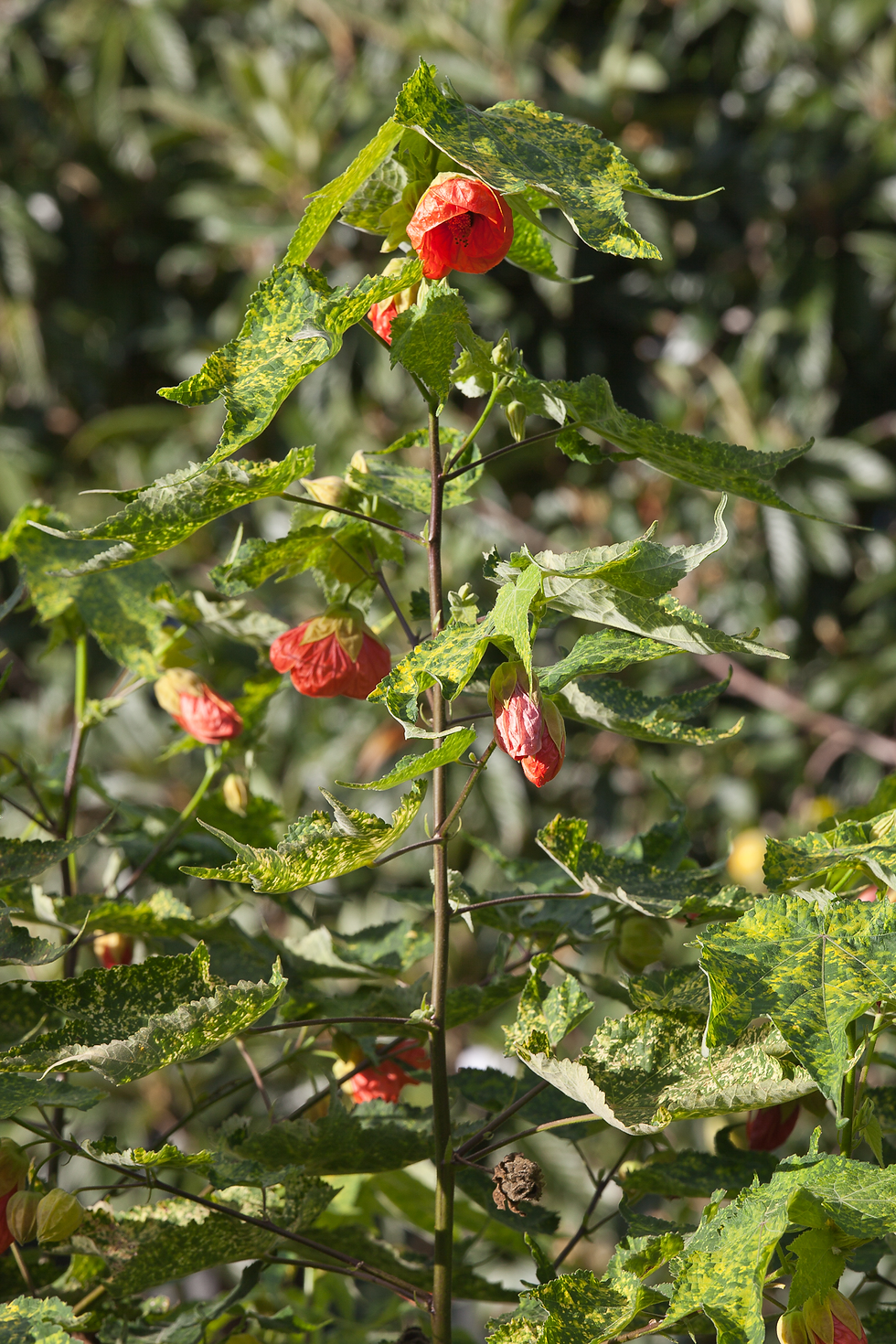
Abutilon pictum 'Thompsonii' VARIEGATED FLOWERING MAPLE
(Malvaceae) Horticultural Hybrid
From the San Marcos Growers website:
“A vigorous and upright evergreen and everblooming shrub grows 6 to 10 feet tall or more by nearly as wide but usually seen a bit smaller. Its dark green maple leaf shaped leaves are mottled with yellow, and it produces a profusion of pendant orange-flushed pink bell-shaped flowers spring through fall and even sometimes in winter in our mild Santa Barbara climate. It can tolerate full coastal sun but looks best with full morning, late afternoon sun or planted in bright shade. Give occasional to regular irrigation - not really drought tolerant but can get along with infrequent watering in cooler coastal gardens and tolerates temperatures down to around 20° F, so useful in USDA Zones 8 through 10. Give it some protection from wind as stems are brittle and tip prune to keep bushy and smaller. Abutilon pictum 'Thompsonii' has long been grown in gardens and is great for brightening up a space with foliage that really glows and flowers that attracts hummingbirds and butterflies. This plant originally grew in the São Paulo to Rio Grande do Sul area of Brazil and was first imported into England as a seedling in a shipment of Abutilon from the West Indies.”
In 2013 I planted a 1-gallon plant of this charming Abutilon with variegated foliage, and l was thrilled at how quickly it grew to about 15’ tall and wide, weaving through other plants and gracing the garden with charming leaves. The pale orange flowers, which in my garden appear mostly fall through spring, are a bonus, and this plant is worth growing for the foliage alone. It grows in mostly full sun to part shade (I’d recommend mostly shade in a warmer part of the county), with moderate to little water. If you want to keep your plant full, I recommend pinching the growing tips frequently, and as the plant flowers mostly on new growth this would also yield more blooms. Mine has never been bothered by any pests and looks good all year long. The species is native to southern Brazil, Argentina, Paraguay and Uruguay. Wikipedia claims that the flowers of this species are edible, but I haven’t tried eating them and would recommend doing your own research about this before adding them to a salad. Other sources also mention the edibility and that the flowers are sweet.
(Susi Torre-Bueno, Vista, 10/25) – S.T-B.

Agave lophantha ‘Quadricolor’ QUADRICOLOR CENTURY PLANT
(Agavaceae) Horticultural Hybrid
From the SDHS Plant Forum Compilation (https://sdhort.org/PlantForum)
Description by Joan Herskowitz:
“An attractive small agave (the species is from Mexico) that grows to a height of 1.5 feet and up to 2 feet wide, forming a rosette of 6-8-inch-long dark green leaves edged with yellow and a pale green mid-stripe. In addition, the leaf margins turn red when grown in bright light, giving the leaves four distinct colors. The plant provides a stunning display in a container or in the ground, and easily produces offsets that can be used for propagation. The plant does well in free-draining soil in full sun, and although it grows faster with regular water, it should be kept on the dry side in winter.”
In my garden I grow this plant with very little water in full sun to part shade. My original plant was a 1-gallon gift from Debra Lee Baldwin, who has written three outstanding books about using succulents in the garden. [Debra was the SDHS Horticulturist of the Year in 2017, and here’s a link to her 300th video about succulents: https://www.youtube.com/watch?v=sM2torUzFs4.]
From that original plant many pups have appeared over the years, so when you plant yours in the garden remember this tendency to multiply rapidly and locate it accordingly. The pups are easy to separate (wear heavy gloves as this succulent has very sharp spines!) and transplant elsewhere. The San Marcos Growers website states:
“There is a nice description about removing the excess pups this plant produces on Gerhard Bock's Succulents and More blog at Depupping Agave lophantha 'Quadricolor'.”
(Susi Torre-Bueno, Vista, 10/25) – J.H. & S.T-B.

Allium tuberosum GARLIC CHIVES
(Amaryllidaceae) China
From Wikipedia:
“Allium tuberosum is a rhizomatous, clump-forming perennial plant growing from a small, elongated bulb (about 10 mm; 13⁄32 inch, across) that is tough and fibrous. Unlike either onion or garlic, it has strap-shaped leaves with triangular bases, about 1.5 to 8 mm (1⁄16 to 5⁄16 in) wide. It produces many white flowers in a round cluster (umbel) on stalks 25 to 60 cm (10 to 24 in) tall. It grows in slowly expanding perennial clumps, but also readily sprouts from seed. In warmer areas (USDA zone 8 and warmer), garlic chives may remain green all year round. In cold areas (USDA zones 7 to 4b), leaves and stalks completely die back to the ground, and resprout from roots or rhizomes in the spring. The flavor is more like garlic than chives.”
Cathy Tylka brought in a potted specimen of this plant, which she grows in part shade. Because it can be an aggressive seeder, and also forms clumps from the base, it is recommended that you plant it where you can keep an eye on it; this makes it easier to remove the seed pods before the seeds develop so it doesn’t take over in your garden. You can cook with it similarly to how you use chives.
(Cathy Tylka, Escondido, 10/25) – S.T-B.

Aloe ‘Blizzard’
(Aloaceae) Horticultural Hybrid
From the Planet Desert website:
“Aloe ‘Blizzard’ is a striking hybrid succulent prized for its bold variegation and compact, frosty white streaked leaves. Indoors, it makes an excellent windowsill or tabletop plant, provided it receives bright light and well-drained soil. The most distinctive feature of Aloe ‘Blizzard’ is its green leaves marbled with bold white stripes, creating a frosted or snow-splashed effect. The leaves grow in rosettes, forming a compact clump that reaches about 12 inches tall and wide at maturity. Like many Aloes, the leaves have soft, serrated edges that add to their textural appeal. This plant’s small size and striking coloration make it particularly well-suited for containers and decorative displays. Aloe ‘Blizzard’ typically blooms in late spring through summer, sending up a tall flower stalk topped with clusters of tubular orange to coral-red flowers. These striking blooms stand above the rosette and create a vivid contrast against the plant’s frosted, variegated leaves. Beyond their ornamental appeal, the flowers serve an ecological role as well. Hummingbirds, bees, and other pollinators are naturally attracted to the nectar-rich blooms when the plant is grown outdoors, making Aloe ‘Blizzard’ both a showpiece and a pollinator-friendly choice.”
More information is available at https://planetdesert.com/products/aloe-blizzard
Aloe ‘Blizzard’ was developed by Altman Plants and is patented. Their website notes that it is a...
“...one-of-a-kind, perfect storm of variegation, attractive blooms, and compact size. Our breeding team wanted to create a white aloe that grew faster and more upright than one of its parents and with brighter color. Great for a windowsill, this dwarf aloe hybrid boasts bright white/deep green tones, tubular coral flowers, frequent flowering periods, and a pleasing penchant for multiplying.”
Member Lorie Johansen generously brought in several dozen of these charming small aloes to share.
(Lorie Johansen, Vista, 10/25) – S.T-B.

Calliandra californica BAJA FAIRY DUSTER
(Fabaceae) Mexico (Baja California)
From the SDHS Plant Forum Compilation (https://sdhort.org/PlantForum) -
Description by Susi Torre-Bueno:
“This slow-growing evergreen shrub from Baja has tiny, dark green, ferny leaves, and grows to about 3-5’ tall by 5-6’ wide. The red flowers, which are born nearly non-stop, look like powderpuffs and attract hummingbirds, bees and butterflies. Self-seeds gently in the garden. Tolerant of most soil types (including clay) and hardy to about 20ºF.”
The specimen displayed in October 2025 is from the same shrub that was displayed in 2014 and has rarely been out of bloom in the ensuing 11 years. The leaves and blooms are both a lot sparser this year, as our rainfall was half what it usually is and the plant gets very little supplemental water.
(Susi Torre-Bueno, Vista, 10/25) – S.T-B.

Calliandra haematocephala PINK POWDERPUFF
(Fabaceae) Bolivia, Brazil, Nicaragua to Ecuador
From the San Marcos Growers website:
“A fast-growing evergreen rambling shrub or small tree that can grow to 15 feet tall with an equal spread. The silky lime green pinnately compound leaves are a coppery color when first emerging and the newest terminal leaf is curved back like a lobster claw with leaves closing up in the evening. The 2- to 3-inch-wide pompon dark pink staminate flowers lacking petals open from tight interesting raspberry looking buds to bloom from October through March. Plant in a warm sunny location and give it plenty of water but also tolerates considerable shade. Hardy to about 25-30 degrees F. This plant forms a large spreading shrub but also espaliers very nicely and the flowers are attractive to butterflies and hummingbirds.Calliandra haematocephala was first discovered in Bolivia but is also distributed throughout southern Peru and planted extensively throughout South America and elsewhere, partly due to cultivation for ornament and for its bark which was marketed in the mid-1800s as a substitute for the unrelated Cinchona (Cinchona officinalis) from which the bark containing quinine was used to treat malaria.”
Also sometimes called Calliandra inaequalatera, in my garden this shrub thrives in light shade. It hasn’t been bothered by insects, nor gnawed at by bunnies, and the flower buds are adorable, looking a lot like raspberries. I’m not sure why the above source thinks it needs plenty of water, as the two that I have thrive on very minimal water and other sources note that it needs little water.
(Susi Torre-Bueno, Vista, 10/25) – S.T-B.

Calliandra surinamensis SURINAM POWDER PUFF, POWDER PUFF TREE
(Fabaceae) Brazil and Suriname
From the SDHS Plant Forum Compilation (https://sdhort.org/PlantForum) - Description by Tom Piergrossi:
“An evergreen large shrub or small tree, potentially to 20 feet or more. Can be more cold sensitive than Calliandra haematocephala, but in frost-free areas, it is an ideal specimen for year-round bloom. Easy to grow from cuttings and seeds, its grows at a fairly good rate if given plenty of water and fertilizer. The powder-puff like blooms are pink-tipped and white toward the center; many say it looks like a bottlebrush, but the foliage is more lush. The lacy leaves come in pinnate forked pairs and fold up at night. The branches arch out gracefully, covering themselves with flowers. Young plants in nursery pots don’t bloom much, and perhaps this plant is not often grown because it doesn’t look its best in the garden center. However, this is a must have tree—I wouldn’t plant a garden without one. It laces beautifully, and once established requires very little care. Full sun is best for good bloom.”
Tom Piergrossi’s description above is spot-on, and I couldn’t agree more that this plant is a must-have. My plant was purchased in 2007 from Tom’s old nursery in Vista, and has been in bloom nearly every single day since then! It is in full sun, gets very little water, and all I do to care for it is to prune it very occasionally when it encroaches on our parking area. It does set seed pods, but, unfortunately, I’ve never had luck germinating the seeds and have not been able to get cuttings to grow, so if you want this beauty you’ll have to find a local or mail order source for it. Despite its beauty it is surprisingly hard to find in nurseries. The photos of this tree in our book Ornamental Trees for Mediterranean Climates were taken at my old garden in Vista, where I had two plants in constant bloom for years.
(Susi Torre-Bueno, Vista, 10/25) — T.P. & S.T-B.

Callisia fragrans BASKET PLANT
(Commelinaceae) Central Mexico south to Colombia
From the San Marcos Growers website:
“A low growing perennial with 6- to 10-inch-long waxy green leaves arranged alternately with the bases overlapping so tightly that they appear to be in rosettes. The leaves have a slight purplish color underneath and on the upper margins when in bright light. Trailing stems grow out over the ground or upward with support. When in bloom in summer months the small, white fragrant flowers arranged in clusters of three in terminal panicles rise up on 2 foot tall spikes. Best planted in well-drained soil that is regularly irrigated in part sun to shade (purple color best with more light). Flourishes in warm subtropical climates but can tolerate a mild frost in the cooler winters of coastal California. Makes a good groundcover in mild climates and is good in a hanging basket. In bright light it lays flat and takes on the look of a cluster of bromeliads but when in deeper shade it grows upright and more closely resembles a small Dracaena. Callisia fragrans comes from central Mexico south to Columbia and it has naturalized in many subtropical areas where it is considered to be a garden weed and there often referred to as Inch Plant for the tendency to inch out on its stems, which root on contact with moist soil. This spreading nature has led some to also call it Octopus Plant.”
In my garden this plant does well in part sun with low watering about every 2 weeks, and I grow it for the foliage rather than for the flowers.
(Susi Torre-Bueno, Vista, 10/25) – S.T-B.

Cereus stenogonus NARROW-ANGLED CEREUS
(Cactaceae) Brazil, Bolivia, Paraguay, Argentina
What looked like an alien pod on the plant forum table was in fact a 2’ long section of Cereus stenogonus, which one lucky member was able to take home to plant in their own garden. Sherry Simmons said that in her garden the white flowers bloom for only a few hours at night, and this succulent grows quickly and can become so heavy that sections break off. Sherry says that hers is 8-12’ tall, and is growing at 2,000’ elevation in north central San Diego County 5 miles south of Temecula.
The World of Succulents website says,
“Cereus stenogonus is a branched columnar cactus with erect, cylindrical, bluish-green or yellowish-green columns with 4 or 5 ribs lined with felted areoles, each bearing a cluster of short spines. It can grow up to 26 feet (8 m) tall. The stems can reach up to 3.6 inches (9 cm) in diameter. The areoles bear 2 to 4 yellow spines with black tips. The spines can grow up to 0.3 inches (0.7 cm) long. The flowers are pink to rose, funnel-shaped, and can reach up to 9 inches (22.5 cm) in length. The fruits are red or orange, egg-shaped, and can grow up to 4 inches (10 cm) long.”
(Sherry Simmons, Temecula, 10/25) – S.T-B.

Crassula ovata JADE PLANT
(Crassulacea) So. Africa, Mozambique
The very popular jade plant is a garden staple here in coastal southern California, but in colder climates it is much appreciated as an undemanding long-lived potted plant. It takes pruning well and is often used for bonsai. The small pinkish flowers are a nice bonus and usually appear in winter, but this would be worth growing for the thick, shiny foliage alone. A great many cultivars are available with various leaf shapes and colors. Outdoor it can grow to 8’ tall, with a thick main stem (to 8” wide) that branches freely. Leaves that fall off often root directly beneath the mother plant, and it is also extremely easy to propagate by breaking off a small piece and planting it in the ground. You can grow this plant in full sun to part shade, in well-drained soil. Few pests seem to bother it. It doesn’t do well in cold climates, so if it gets below 32 degrees F in your area plan to take it inside for the winter. The plant at the meeting did not have a member’s name with it, but someone generously donated a potted specimen.
(?, 10/25) – S.T-B.

Dietes grandiflora FORTNIGHT LILY
(Iridaceae) So. Africa
From the San Marcos Growers website:
"This evergreen rhizomatous perennial produces clumps of long, upright narrow leaves that reach 4 feet tall. The flowers that rise above the foliage on erect slender stems have outer white petals with a golden area near the base and the inner petals are white flecked with brown at the base. The inner most petal-like structures, called style branches, are violet colored. This species flowers year-round in coastal southern California gardens with each individual flower lasting only a few days (up to 3) but quickly followed by new flowers. This plant is very drought tolerant in shade but can also be grown in full sun with regular to occasional irrigation but seems to look and bloom best with regular watering. Unfortunately, in areas that have such regular irrigation it also reseeds prolifically, and many consider it to be a thug in the garden, so really is best in drier situations where this is less of a problem. It is cold hardy to around 15 degrees F. It is a good container plant or can be used in mass plantings or as a solitary accent clump.”
The glistening white flowers with violet inner petals are seen in many gardens in our area, and the common name comes from the fact that they generally bloom about every two weeks, the British fortnight. Several attractive cultivars are available, including one with variegated foliage. The plant at the meeting did not have a member’s name with it, but someone generously donated a potted specimen.
(?, 10/25) – S.T-B.

Diospyros kaki 'Hachiya' HACHIYA PERSIMMON
(Ebenaceae) Horticultural cultivar
Karen England very generously brought in several cartons of beautifully ripe persimmons to share with members, along with a recipe for persimmon cookies. She writes:
“It is a cultivar of the Japanese persimmon species (Diospyros kaki). This fruit is known for its large, deep orange-red color and is popular for both fresh eating and baking once fully ripe and soft. Once you understand this delicious and nutritious fruit, you’ll be hooked! This acorn-shaped variety of persimmon, called Hachiya, must be ripened completely before enjoying [it is extremely tart before ripening]. Hachiya persimmons do not ripen like Fuyu persimmons, which are shaped more like a tomato and are eaten crisp, like an apple, when ripe. Hachiya persimmons must be completely soft first. Never fear – ripening is easy! Wash the fruit thoroughly, dry with a cloth, set the fruit out at room temperature until it is mushy, and once it is mushy from stem to stern, from top to bottom, it is ready to eat, to cook or bake with, and to enjoy! Tip: Once the Hachiya persimmon has ripened, put the mushy fruit, skin and all, into the freezer. Once frozen, eat it straight from the peel for an incredibly easy, delicious, and good-for-you sorbet-esque treat. Baking from frozen pulp is just as easy, too.”
Karen has written previously about her persimmon tree and shared recipes, including the cookie recipe, here:
The species is native to China, and cultivation of the deciduous D. kaki tree goes back 2000 years, according to Wikipedia. For information on growing this edible delight go to https://www.gardenia.net/plant/diospyros-kaki-hachiya-japanese-persimmon.
(Karen England, Vista, 10/25) – K.E. & S.T-B.

Grevillea 'Robyn Gordon' ROBYN GORDON GREVILLEA
(Proteacea) Garden Hybrid
From the SDHS Plant Forum Compilation (https://sdhort.org/PlantForum) - Description by Steve Brigham:
“This garden hybrid of G. banksii and G. bipinnatifida is the most popular grevillea in Australia. Slow spreading shrub with finely divided “ferny” foliage, it is drought-tolerant and blooms all year with 6-inch-long clusters of bright red flowers. Keys to success in growing it are a well-drained sandy or decomposed granite soil and no phosphorus in either soil or fertilizer. (Plants are severely chlorotic in clay soil because of phosphorous toxicity.) Slow to propagate, it is otherwise easy to grow, and moderately hardy, to 25°F.”
I planted a 1-gallon plant in March 2023 and it has now spread to about 8’ wide and 4-5’ tall. It is in full sun and gets moderate to low watering. Although the descriptions say the flowers are red, I find the central portion to be more of a peach, so it is possible I don’t have this specific cultivar.
(Susi Torre-Bueno, Vista, 10/25) – S.B. & S.T-B.
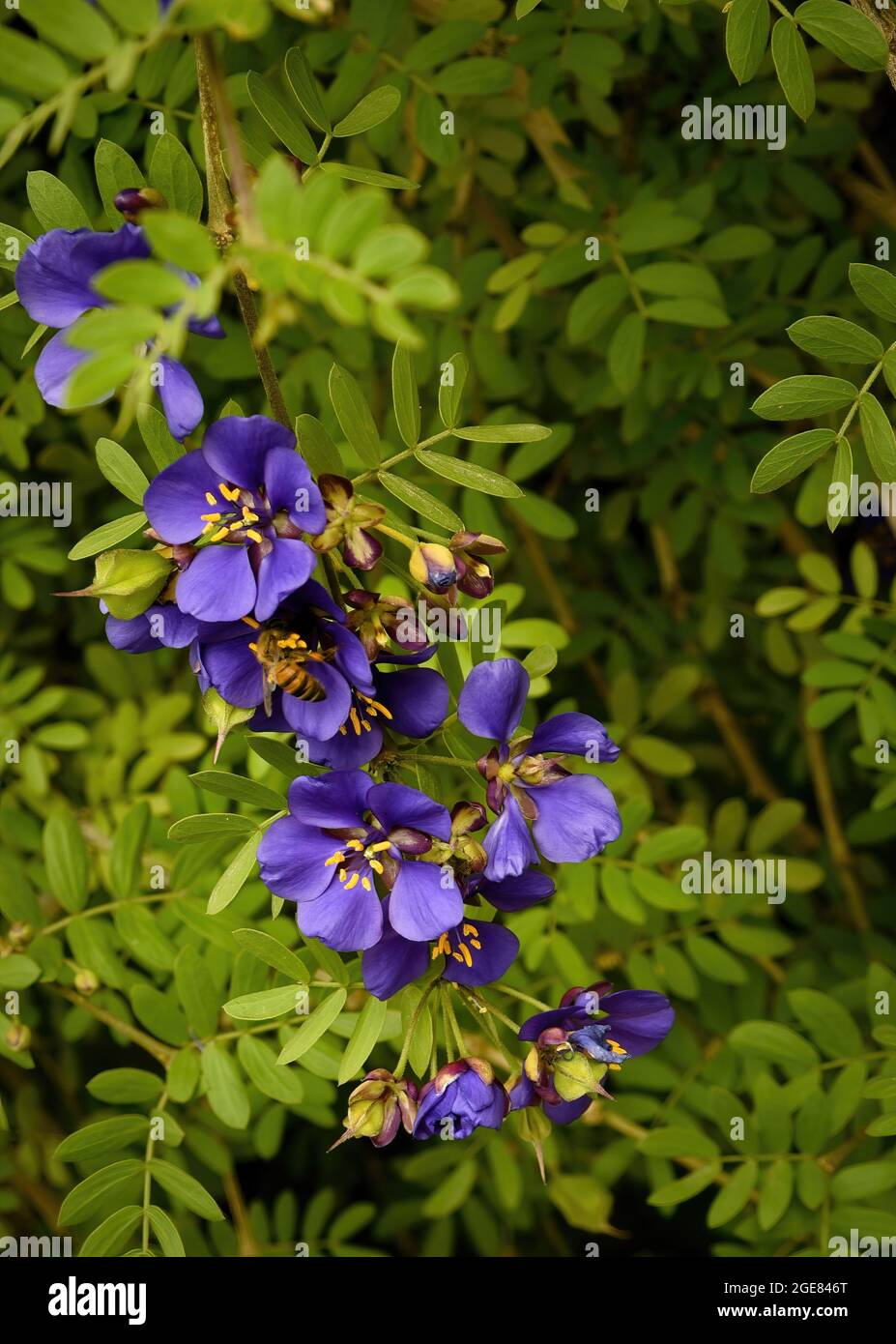
Guaicum coulteri GUAYACAN
(Zygophyllaceae) Mexico
From the SDHS Plant Forum Compilation (https://sdhort.org/PlantForum) - Description by Susi Torre-Bueno:
“This slow-growing, low-water plant is a large shrub or small tree, growing to about 10’ tall and wide (and perhaps up to 25’ over many years). According to the website for Mountain States Wholesale Nursery (where the plant displayed was purchased), it is native 'to the gravelly plains of western Mexico.' The 5-petaled blue flowers should appear spring through fall. It grows best in full sun with good drainage. (Photos and more details: www.mswn.com/media/info_sheets/guaiacum_coulteri.pdf.)”
I originally displayed a cutting of this plant in 2014, and 11 years later it still delights me. My plant is now about 4’ tall and 5’ wide and was purchased in 2012 as a 5-gallon plant. In my garden it has bloomed from June through October.
(Susi Torre-Bueno, Vista, 10/25) – S.T-B.

Narcissus tazetta ‘Ziva’ ZIVA PAPER WHITE NARCISSUS
(Amaryllidaceae) So. Europe
From the SDHS Plant Forum Compilation (https://sdhort.org/PlantForum) - Description by Susi Torre-Bueno:
“For centuries people have been forcing bulbs into bloom indoors by starting them indoors. (Learn more about this part of indoor gardening history at www.kennemerend.nl/history.html.) In Paper Whites this process takes about 3-6 weeks, and is very easily accomplished by putting the bulb in a container with water barely touching the bottom. (To learn more about forcing Paper Whites indoors go to http://gardening.about.com/od/forcingandprechilling/a/Paperwhites.htm.) Once the bulbs have bloomed, here in Southern California you can plant them in full sun to light shade in your garden, where they will bloom again in about 2 years. While the coronas of N. tazetta (also called Paper Whites) are cream, yellow, or orange in color, the specimen displayed has a completely white corona.”
The blooming cutting I displayed in October 2025 has a small bright white corona and a sweet scent, and is almost surely the cultivar ‘Ziva’. It was originally forced indoors in 2011 and planted in the ground in light shade in 2012, and has bloomed in late fall every year since, increasing to a sizeable clump from about 8-10 bulbs that were originally planted.
(Susi Torre-Bueno, Vista, 10/25) – S.T-B.

