
PLANT FORUM: At The November 2025 Meeting
Updated: Dec 2, 2025
By Susi Torre-Bueno, for Let’s Talk Plants! December 2025.

For over two decades a meeting highlight was the Plant Forum, where a horticultural expert spoke about plants brought in by members. These descriptions were printed in the newsletter and were also compiled, and are available free on our website at https://sdhort.org/PlantForum.
This is an alphabetical listing of over 7500 plants, including over 1600 detailed descriptions. Check it out when thinking about plants to add to your garden, and feel free to share this link with your friends.
After a few years on hiatus the Plant Forum is back, and we encourage all members to share some of your plants at the meetings you attend. I can guarantee that there will be many people who will have not grown, and might not have ever seen, the plants from your garden. All you have to do is:
1) Bring a cutting or a potted plant to a meeting.
2) BEFORE you leave home, take a minute to fill out a slip of paper with the common and scientific name of the plant, where it is native to (if you know that), what city it is growing in, your name, and a couple of sentences about your experience with the plant.
Although I’m no expert I will do my best to talk about the plants I’m familiar with, and will get help from other attendees. At the end of the meeting, we will gather up the printed information and include it in the next newsletter. If you have any questions, contact Susi Torre-Bueno at storrebueno@cox.net.
I want to thank the members who bring in plants for the Plant Forum and then donate them for other members to take home.

Agave lophantha ‘Quadricolor’ QUADRICOLOR CENTURY PLANT
(Agavaceae) Horticultural Hybrid
Described in the November 2025 newsletter and the SDHS Plant Forum Compilation (https://sdhort.org/PlantForum)
(Anne Murphy, Vista, 11/25) – S.T-B.

Aloe arborescens 'Lutea' GOLDEN TORCH ALOE
(Asphodeloideae) Horticultural Cultivar
From the San Marcos Growers website:
“This is the yellow form of Torch Aloe, named Aloe arborescens, a large densely growing species with red flowers that can grow to 9 feet tall by an equal spread but this cultivar 'Lutea' is generally a smaller plant to 4 to 5 feet tall and wide with yellow flowers that hang tightly on unbranched inflorescences that rise 2 feet above the foliage in late fall and early winter. The 18-inch-wide rosettes have leaves that are narrow and recurved with soft toothed margins. Leaf color varies with amount of sunlight but is typically a dull green or yellowish blue-green. Plant in full sun (coast) to light shade. This drought tolerant plant does great in coastal California without any supplementary irrigation. Hardy to about 22 degrees F. A nice cultivar that is a slower growing and smaller than the species. This species has an extensive natural distribution in southern Africa, from Mozambique, Zimbabwe and Malawi south through eastern South Africa, and then westward in a strip along the coast nearly to Cape Town. Much of its natural range receives summer or year-round rainfall but in our mediterranean climate this species has adapted well and thrives with our winter rainfall with very little to no summer irrigation.”
In 2018 I was given six robust cuttings from Patrick Anderson (whose garden in Fallbrook is a succulent-lover’s paradise). They are growing in mostly full sun with minimal water and produce pale yellow blooms for a couple of months, starting in November.
(Susi Torre-Bueno, Vista, 11/25) – S.T-B

Atriplex lentiformis ssp. breweri BREWER'S SALTBRUSH, QUAIL BRUSH, QUAILBUSH
(Chenopodiaceae) California, New Mexico, Mexico
I originally planted this silvery-leaved drought-tolerant evergreen shrub from a 1-gal plant purchased in 2009 at the U.C. Riverside fall plant sale. It has since taken over an area about 10’ x 15’, and is about 5’ tall. I absolutely love it for the bright foliage, and have since added five more, at least one of which is equally vigorous although not quite as tall. From https://calscape.org:
“Quailbush (Atriplex lentiformis ssp. breweri) is a shrub with beautiful gray leaves in the Chenopodiaceae or goosefoot family. It grows primarily along the coast in southern California, with scattered inland locations. Some authorities do not recognize this coastal subspecies as distinct from the parent species or ssp. lentiformis. The difference is in the larger leaves and fruits of ssp. breweri. Though not a showy plant, it is very tolerant of harsh conditions and great for quick cover, erosion control, and habitat gardens. It is an excellent wildlife plant, attracting numerous birds, small mammals, and insects.”
The Wild Bird Center says...
“...this shrub attracts more birds than any other plant in their garden.”
This source also notes the fragrance as “unpleasant,” although I don’t find the scent of the leaves is disagreeable, so perhaps they are talking about the flowers.
(Susi Torre-Bueno, Vista, 11/25) – S.T-B.

Crassula ovata JADE PLANT
(Crassulacea) So. Africa, Mozambique
Described in the November 2025 newsletter.
(Lauren Chin, Poway, 11/25)

Cyclamen hederifolium IVY LEAF CYCLAMEN
(Primulaceae) Eastern Europe, Mediterranean
Jason Chen brought in three species of cyclamen that he grew from seed. C. hederifolium forms a tuber that is dormant in the summer, sprouting leaves in the late summer and fall which is when it blooms. The shape and pattern of the leaves resemble ivy. The tubers grow just under the soil and with age can reach an impressive 10” across. The flower colors range from white to pink and purple, and after blooming can produce seeds which are easy to propagate. This hardy plant has naturalized in the Pacific Northwest. Grow it in part shade with moderate water; it does well in pots and is easy to grow. To learn more visit www.cyclamen.org.
(Jason Chen, Encinitas, 11/15) – S.T-B.

Cyclamen maritimum COAST CYCLAMEN
(Primulaceae) Aegean Islands, Greece, S. Turkey, NW Cyprus
Jason Chen brought in three species of cyclamen that he grew from seed. C. maritimum is another tuberous species from Mediterranean climates, but is not as hardy as C. hederifolium.
From www.cyclamen.org:
“Flowers appear in autumn, in the wild from September to November, sometimes later, dependent on the start of the autumn rains, in shades of pink, unscented or only faintly scented… Leaves appear late during flowering or after, dependent on the amount of rain, arising straight from the tuber, broadly oval, with a thickened slightly toothed (beaded) edge and shallowly scalloped (lobed), often with a satin sheen, extremely variably patterned in shades of green, grey or silver on a green, sometimes very dark, ground, underside purple, sometimes greenish, 5-15cm long, 3-13cm wide… Cyclamen maritimum is a tender plant... The thick roots appear adapted to seeking and storing water, so it is often grown in a deep ‘long tom’ pot and watered from the base.”
(Jason Chen, Encinitas, 11/15) – S.T-B.

Cyclamen mirabile MARVELOUS HARDY CYCLAMEN
(Primulaceae) Turkey
Jason Chen brought in three species of cyclamen that he grew from seed. C. mirabile is another tuberous species from Turkey growing to about 4” tall, with a summer dormant period. From Wikipedia:
“The tuber is round-flattened and roots irregularly from the lower surface. The leaves, appearing with the flowers or after they have emerged, are broad heart-shaped, and as wide or wider than long…Leaf color is dark green with a variable 'Christmas tree' pattern in lighter green or silver. The silver zone often starts out pink-tinged in young leaves. The flowers, appearing in autumn, are often fragrant with a coconut scent. Flower color is white to deep pink, often with a magenta blotch at the base of each petal…In cultivation this plant has proved reasonably hardy, tolerating temperatures as low as −10 °C (14 °F) when planted in a suitable setting. It grows best in well-drained soil that dries out in the dormant period (summer).”
According to Plant Delights Nursery in North Carolina:
“Cyclamen mirabile has been particularly reliable for us, thriving under our largest eucalyptus tree which provides dappled shade and dry soil during summer while the bulb is resting. The 1", bright pink, nodding flowers are typical of the species, although the individual petals are often twisted. New foliage emerges in autumn and is sometimes flushed pink, aptly living up to its epithet 'mirabile' which means marvelous!”
(Jason Chen, Encinitas, 11/15) – S.T-B.

Eremophila maculata ‘Aurea’ YELLOW EMU BUSH
(Myoporaceae) Cultivar
From the SDHS Plant Forum Compilation (https://sdhort.org/PlantForum) - Description by Steve Brigham:
“This beautiful drought-tolerant 3–4 foot shrub displays its 1½ inch tubular clear yellow flowers in winter and throughout the year. It also takes regular garden conditions better than other Emu Bushes, and takes to pruning well. Its yellow flowers look especially well with red grevilleas and blue ceanothus, and it makes a nice cut flower, too. Full sun, hardy to around 23°F.”
In my Vista garden the plant has bloomed nearly non-stop since 2016 with very little water in full sun.
(Susi Torre-Bueno, Vista, 11/25) —S.B. & S.T-B.

Euphorbia caput-medusae MEDUSA'S HEAD
(Euphorbiaceae) South Africa
From www.smgrowers.com:
“This unique South African native succulent has a central tap-rooted caudex to 8 inches wide from which emerge numerous snake-like gray-green bumpy-textured branches to 3+ feet long with a knobbed terminal end where small deciduous leaves are produced. White flowers bloom on short stalks rising from the ends of young branches in the spring and summer. It can reach about a foot high with a 3 foot spread. It prefers full coastal sun to light shade in a well-drained soil. Irrigate little to occasionally - it is drought tolerant. It is hardy to about 23 degrees F. Long trailing branches can get bleached out in summer in hot locations and the plant can be rejuvenated every few years by cutting back. Tolerates near-beach conditions and is great for a low groundcover on slopes in the succulent garden and also makes a very interesting container plant. This plant comes from Namaqualand and the southwestern Cape of South Africa, where it grows on sandy and stony slopes. It was first introduced into Europe at the Botanic Garden in Amsterdam around 1700. The name 'caput-medusae' meaning "head of Medusa" was fittingly coined by Carl Linnaeus in 1753 to in reference to the Greek mythological daughter of sea god Phorcys who had serpents for hair.”
(Anne Murphy, Vista, 11/25) – S.T-B.

Foeniculum vulgare FENNEL
(Apiaceae) [Umbelliferae] Mediterranean
Common fennel is a perennial herb in the carrot family with feathery leaves and small yellow flowers. It is widely cultivated for its anise-flavored foliage, bulb, and seeds, which are used in cooking and as a garnish. Native to the Mediterranean it now naturalized worldwide. Fennel is a food source for anise swallowtail and black swallowtail butterflies and their larvae, and birds eat the seeds. The mature flowers provide nectar for various beneficial insects, including butterflies and bees. Fennel was the International Herb Association’s inaugural Herb or the Year™ in 1995. Culinary uses: The leaf fronds can be used as a garnish or chopped in salads, sauces and marinades, which the bulb can be eaten raw or cooked. The aromatic seeds are used to flavor sausages, pickled, breads, and desserts. Florence fennel is (according to Wikipedia) ...
“a selection with a swollen bulb-like stem base (sometimes called bulb fennel) that is used as a vegetable.”
Karen mentioned at the meeting that the common species does not form the large bulb at the base of the plant, and that the plants she brought in have thin bases which are too tough and stringy to be used for cooking. This plant can be moderately invasive, so site it carefully and harvest the seeds before they can become a problem. According to the California Invasive Plant Council:
“…fennel… can drastically alter the composition and structure of many plant communities, including grasslands, coastal scrub, riparian, and wetland communities.”
Karen made some fabulous Fennel Fudge and has provided a recipe.

FENNEL FUDGE
From River Cottage Handbook: Herbs by Nikki Duffy, ©2012. Makes at least 25 pieces.
“This utterly moreish sweetmeat is delectably crumbly and melt-in-the-mouth. It can also be made with caraway seeds, although these are best given a good pounding with the mortar and pestle, or a whiz in a spice grinder to break them down a bit as they can be quite tough. Don't reduce them to a powder though - the fudge needs a bit of seedy texture.”
Ingredients:
A few drops of sunflower oil
300g (1¼ cups) granulated sugar
1 tablespoon maple syrup
100g (7 tablespoons) unsalted butter, cut into chunks
100ml (3.33 ounces) heavy cream
1 tablespoon fennel seeds
A large pinch of fine sea salt
Directions:
Use a few drops of sunflower oil to grease parchment paper lining an 8 x 8 inch square baking dish.
Put the sugar, maple syrup, butter and cream into a heavy based, deep saucepan, making sure the pan is no more than one-third full, as the fudge mixture will bubble up. Heat gently, stirring often, until the butter is melted and the sugar has fully dissolved.
Stop stirring, put a sugar (candy) thermometer into the pan and turn up the heat. Bring to a boil and boil until mixture gets to the soft-ball stage and registers 230˚F. on the thermometer. Take the pan off the heat and leave to stand for ten minutes.
Meanwhile, roughly crush the fennel seeds, using a mortar and pestle. Add the fennel seeds and salt to the fudge mixture and beat vigorously with a wooden spoon until it thickens, loses its gloss and becomes slightly grainy and starts to come away from the bottom of the pan. This should only take a minute or two of beating, but it can sometimes take longer.
Tip the hot fudge into the greased dish, smooth out and leave to set. Mark the fudge into squares with a small sharp knife as soon as it has set enough to hold the cut. Leave for 3-4 hours to set completely, then remove from the dish.
Store in an airtight container and use within a couple of weeks.
(Karen England, Vista, 11/25) – K.E.

Hakea laurina PINCUSHION HAKEA
(Proteaceae) S.W. Australia
From the SDHS Plant Forum Compilation (https://sdhort.org/PlantForum) - Description by Sheldon Lisker:
“This very drought-tolerant shrub or small tree grows to about 15ʹ′ tall, with narrow elliptical leaves to about 5ʺ wide. Globular flower heads burst into bloom in fall and winter, with pink flowers and long white stigmas that attract hummingbirds; makes a good cut flower. Hardy to low 20 degrees; grow it in full sun in well-drained soil.”
(Jim Bishop, San Diego, 11/15) – S.L.

Hesperaloe parviflora RED YUCCA
(Agavaceae [now Asparagaceae]) Southwest U.S., Mexico
From the website for San Marcos Growers:
“A stemless succulent with clumps of arching and spreading grass-like foliage to 3 to 4 feet tall and spreading wider than tall. The leathery long, narrow blue-green leaves have deep grooves and white fraying fibers along the margins and winter temperatures sometimes turn the foliage slightly purple. Clumps spread slowly to up to 6 feet wide. In late spring to mid-summer the clusters of rose-pink flowers are borne on tall red flower stalks to 5 feet long, that arch up and outward. These flowers, opening from the bottom up, are quite attractive to hummingbirds. Individual rosettes only flower once and are replace by younger ones with old plants appearing to be closely packed grass-like clumps but are actually clusters of separate but closely-spaced rosettes with the oldest flowering rosettes towards the center and younger vegetative rosettes towards the outside. Plant in full sun or light shade in a well-drained soil. It is drought tolerant and does best in a hot spot in the garden but appreciates occasional irrigation in summer to encourage flowering but do not over water. Hardy to well below 0° F some say as low as -20° F (USDA zone 5). It is a good clean plant for desert and succulent gardens, planted in masses or used in pots. Unarmed leaves make it useful along pathways but unfortunately it also makes it tempting as browse material for deer.”
Lorie adds a word of caution – this species is vulnerable to the agave snout-nose beetle.
(Lorie Johansen, Bonsall, 11/25) – S.T-B.

Heteromeles arbutifolia TOYON, CALIFORNIA HOLLY
(Rosaceae) California, N Baja California
From the SDHS Plant Forum Compilation (https://sdhort.org/PlantForum) - Description by Dayna Hydrick:
“This evergreen shrub or small tree grows to 25 feet tall and about as wide; can be pruned to shape. The glossy leathery leaves (2–4 inches long) are a nice background for the small white summertime flowers. The red berries which follow in winter are a favorite of our local birds. Although drought tolerant, it looks better if given some water. Grow in full sun to part shade.”
(Jim Bishop, San Diego, 11/15) – D.H.
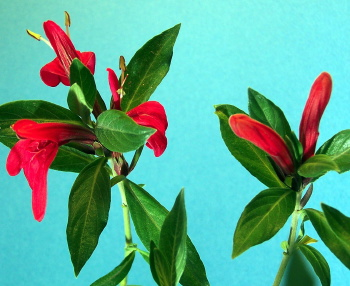
Justicia sericea ‘Inca Queen’
(Acanthaceae) Peru
From the SDHS Plant Forum Compilation (https://sdhort.org/PlantForum) - Description by Susi Torre-Bueno:
“This evergreen Peruvian shrub attracts hummers with its 2” long tubular dark red flowers, which appear from spring to fall (or longer). The dark green elliptical leaves are borne on stems covered with silky hairs. It thrives in full sun to light shade with well-drained soil, and is drought-tolerant once established. Grows to about 3’ tall x 3’ wide.”
The 1-gal plant I purchased and planted in 2009 has grown into a 5’ tall x 6’ wide shrub which has been in bloom virtually every month. Pests have completely ignored it.
(Susi Torre-Bueno, Vista, 11/25) – S.T-B.

Leucophyllum zygophyllum TEXAS RANGER, BLUE RAIN SAGE
(Scrophulariaceae) S.W. U.S., N. Mexico (Chihuahuan Desert and elsewhere)
From the SDHS Plant Forum Compilation (https://sdhort.org/PlantForum) - Description by Susi Torre-Bueno:
“The drought-tolerant evergreen shrubs commonly known as Texas Ranger are wonderful choices for the garden. The species displayed is supposed to be the shortest in this genus and has dense silvery foliage visible a long way. It grows to about 3ʹ′ tall and wide (one source says 4-6’ tall and wide) in full sun with good drainage and does fine with very little water. From spring to fall, this heat-loving plant puts on a very striking display of violet flowers that contrast well with the foliage. Attracts butterflies, hummingbirds, and other beneficial insects."
Mary Irish’s excellent book, Trees and Shrubs for the Southwest: Woody Plants for Arid Gardens, notes that...
“It is almost round, and the branches are so closely packed that it looks like a silver ball. This effect is enhanced by the young stems, which are tightly clustered, upright, and covered with fine, silvery hairs.”
A specimen of this plant was first displayed in 2012, and it gets better every year.
(Susi Torre-Bueno, Vista, 11/25) – S.T-B.

Lobelia laxiflora
(Campanulaceae [Lobeliaceae]) Arizona to Mexico and Colombia
From the SDHS Plant Forum Compilation (https://sdhort.org/PlantForum) - Description by Steve Brigham:
“This shrubby perennial grows to 3 feet and is striking in bloom with its spikes of red-orange and yellow tubular flowers. Most common in local cultivation is a relatively compact, glossy-leaved form—but the species is variable and other forms are grown with larger flowers and fuzzier leaves. Somewhat drought tolerant, this handsome plant likes full sun and good drainage. Attracts hummingbirds.”
Susi Torre-Bueno noted, and several members in attendance agreed, that this plant can spread aggressively in the garden if given more than minimal water.
(Anne Murphy, Vista, 11/25) —S.B.

Megaskepasma erythrochlamys BRAZILIAN RED CLOAK
(Acanthaceace) Venezuela
From the SDHS Plant Forum Compilation (https://sdhort.org/PlantForum) - Description by Tom Piergrossi:
“A fast growing member of the Justicia family. A large shrub to six feet or more with large leaves and spectacular flowers borne terminally. The inflorescence is a panicle of red bracts, the actual flowers are small and white. Popular in the more tropical areas in the U.S. such as Florida and Hawaii, probably preferring the heat and high humidity. It can be grown here in Southern California in a micro-climate somewhat duplicating those conditions. Easily grown from cuttings and should be tried more extensively here.”
(Donna Mallen, Chula Vista, 11/25) —T.P.

Narcissus tazetta ssp. papyraceus PAPER WHITE NARCISSUS
(Amaryllidaceae) So. Europe
From the SDHS Plant Forum Compilation (https://sdhort.org/PlantForum) - Description by Susi Torre-Bueno:
“For centuries people have been forcing bulbs into bloom indoors by starting them indoors. (Learn more about this part of indoor gardening history at www.kennemerend.nl/history.html.) In Paper Whites this process takes about 3-6 weeks, and is very easily accomplished by putting the bulb in a container with water barely touching the bottom. (To learn more about forcing Paper Whites indoors go to https://www.thespruce.com/how-to-force-paperwhite-narcissus-indoors-1402282.) Once the bulbs have bloomed, here in Southern California you can plant them in full sun to light shade in your garden, where they will bloom again in about 2 years. While the coronas of N. tazetta (also called Paper Whites) are cream, yellow, or orange in color, the specimen displayed (N. t. ssp. papyraceus) has a completely white corona.”
Note from the 2025 editor: What is correct? Paperwhite or paper-white or Paper White narcissus? All are in use but "paperwhite", one word, is the most common.
(Anne Murphy, Vista, 11/25) – S.T-B.

Plectranthus tomentosa (= Plectranthus hadiensis) VICKS PLANT
(Lamiaceae) So. Africa, eastern tropical Africa, Somalia and the southern Arabian Peninsula.
“[This is a] member of the mint family and has somewhat thin (but still succulent!) leaves. It's known for the minty, camphor fragrance of its leaves. 'Tomentose' refers to the fuzzy, velvety coating that covers the whole plant. The undersides of the leaves are lined with raised veins, and the edges are scalloped. It also produces large quantities of showy, lavender blooms. Vicks Plant is a soft succulent and needs protection from frost and heavy rains. Make sure it has well-draining pots and soil, lots of bright sun, and deep water (when the soil is dry). It re-roots readily from stem cuttings (more info).”
(Anne Murphy, Vista, 11/25) – S.T-B.

Pyrus communis BARTLETT PEAR
(Rosaceae) Cultivar
The rose family brings us many edible fruits in addition to lovely flowers: apples, pears, quinces, apricots, plums, cherries, peaches, raspberries, blackberries, loquats, strawberries, rose hips, hawthorns, and almonds. From Wikipedia:
“The Williams' bon Chrétien pear, commonly called the Williams pear, or the Bartlett pear in the United States and Canada, is a cultivar (cultivated variety) of the species Pyrus communis, commonly known as the European pear. The fruit has a bell shape, considered the traditional pear shape in the west, and its green skin turns yellow upon later ripening, although red-skinned derivative varieties exist. It is considered a summer pear, not as tolerant of cold as some varieties. It is often eaten raw, but holds its shape well when baked, and is a common choice for canned or other processed pear uses.”
Cathy brought in several large pears from her tree, which is grown in full sun; she slices, peels and freezes the fruit for winter pies. Note that this cultivar needs significant winter chill to produce good fruit, so it might not be suitable for many parts of San Diego County. For an interesting article about low-chill pears for Southern California go to https://blog.anawaltlumber.com/growing-pear-trees/.
(Cathy Tylka, Escondido, 11/25) – S.T-B.

Rhododendron radians (section Vireya)
(Ericaceae) Indonesia (Sulawesi)
Tropical Rhododendrons are known as Vireyas, and are a section under the Rhododendron genus. The flowering specimen displayed was greenhouse grown in a pot and had white scented flowers. From https://www.orchidbotanics.co.uk:
“Rhododendron radians is a captivating species native to the mountainous regions of Sulawesi. It thrives in cool, temperate forests and alpine meadows at elevations ranging from 2,500 to 3,500 meters. In its natural habitat, this rhododendron grows as a terrestrial shrub or occasionally as an epiphyte, where it benefits from high humidity, filtered light, and well-draining soils enriched with organic matter. Rhododendron radians is a small to medium sized shrub; mature plants typically reach 50-100 cm in height This species is celebrated for its compact, rounded growth habit and its stunning floral display. The plant produces elliptical, glossy green leaves that are often tinged with a bronze or reddish hue when young. Its standout feature is its trumpet-shaped flowers, which bloom in clusters and range in color from the palest pink to white. The flowers emit a subtle fragrance and attract pollinators, adding vitality to its surroundings. This rhododendron’s manageable size and breathtaking blooms make it a favorite among gardeners and collectors, particularly those with an interest in cool-climate or alpine species.”
(Jason Chen, Encinitas, 11/25) – S.T-B.

Salvia ‘Indigo Spires’ INDIGO SPIRES SALVIA
(Lamiaceae) Horticultural Selection
(Anne Murphy, Vista, 11/25) —J.W.

Senecio anteuphorbium (= Kleinia antheuphorbium, K. anteuphorbiumand) SWIZZLE STICKS
(Asteraceae) Morocco
From the website for San Marcos Growers:
“A summer dormant deciduous shrub that has a generally upright growth habit to 3 to 5 feet tall with long arching pale gray-green segmented round stems striated with darker longitudinal lines and small gray-green lanceolate leaves that lie appressed along the stems near the branch tips. In fall appear the fragrant rayless flowers that have white disk flowers with yellow stigmas and anthers. Although not particularly showy in bloom the flowers lightly sweet fragrance is a pleasant surprise given the usually fetid smelling flowers of other succulent Senecio species. Plant in full sun to light shade and give little to no irrigation, but with occasional summer irrigation will hold the leaves on the stems which otherwise fall off. Though often listed for frost free gardens this plant has proven stem hardy to 25° F. during our January 2007 freeze. Makes an interesting and wild plant in the garden or in a large pot. Trim out low horizontal stems as needed to show off the more upright ones. This plant comes from North and Northeast Africa from Morocco to the Arabian Peninsula. In the 1928 Standard Cyclopedia of American Horticulture by L.H Bailey this plant is described as being one of the earliest of the ‘Cape plants’ to be cultivated in Europe, with plantings dated around 1570, and that the name ‘anteuphorbium’, or Ante-euphorbium as it was commonly called, was in reference to its being ‘a reputed antidote against the acrid poison of the Cape Euphorbia [E. officinarum]’. Gordon Rowley in Succulent Compositae notes that he could ‘find no scientific evidence to support its supposed beneficial properties. Although this plant did not come from the Cape region, its early cultivation and derivation of the name is interesting. This plant is often listed under the name Kleinia antheuphorbium and The Global Compositae Checklist lists Kleinia anteuphorbium and as its correct current name.’”
(Anne Murphy, Vista, 11/25) – S.T-B.

Senecio kleiniiformis SPEAR HEAD
(Asteraceae) South Africa
According to Wikipedia,
“Senecio is one of the largest genera of flowering plants,”...
...and members of this genus are found all over the world in Mediterranean climates. About 24 species of Senecios have been brought in to SDHS meetings over the years, but with nearly 1500 species to choose from it isn’t surprising that S. kleiniiformis hasn’t shown up at one of our Plant Forum displays.
Here’s a description from PlanetDesert.com:
“The Senecio kleiniiformis, known as spear head plant, is a visually striking succulent known for its distinctive foliage and hardy nature. Its triangular, spear-shaped leaves give it a modern, sculptural appearance that complements minimalist and contemporary design themes. This … plant has a sprawling or trailing growth habit, making it suitable for ground cover, hanging baskets, or as an accent in mixed arrangements… The Spear Head Plant is aptly named for the sharp, geometric shape of its leaves, which resemble spearheads. This common name reflects its bold and angular aesthetic, a feature that makes it stand out in arrangements and xeriscapes… [It] features fleshy, triangular leaves that are gray-green with a powdery coating, giving them a soft, matte finish. The leaves are arranged in a rosette or a slightly sprawling growth pattern. Mature plants typically grow up to 18 inches tall and spread about 12 inches wide, making it a compact yet striking addition to gardens or indoor collections. The flowers of Senecio kleiniiformis bloom in late summer to early fall with small, yellow, daisy-like flowers that appear on tall stalks.”
The sample displayed was a cutting from a potted plant purchased as a 2” plant in December 2021. It has been repotted into a 6” pot and is about 1’ tall, growing in full sun.
(Susi Torre-Bueno, Vista, 11/25) – S.T-B.

Senna bicapsularis ‘Butter Creme’, syn. Cassia bicapsularis ‘Butter Creme’ SENNA BUTTER CREME
(Fabaceae) Horticultural Selection
From the SDHS Plant Forum Compilation (https://sdhort.org/PlantForum) - Description by Steve Brigham:
“It looks like we gardeners will soon have to get used to this and a number of other cassias as sennas, since a redesignation to the genus Senna seems to be ‘sticking’ in the botanical sense. This creamy- yellow form of the species was selected and named by Patrick Worley around 12 years ago [at the time of original writing], and it is superb for its delicate color. (I wanted to name it ‘Lemon Creme’—Patrick always uses that spelling of ‘crème’ in his names—but Patrick won out.) It is possible to get this color variant by seed, but it only turns up in 10-20% of the seedlings at best, and this cutting-grown selection is as good as any. In contrast to the bright golden-yellow of ‘California Gold’ and typical seedlings, C. ‘Butter Creme’ is very combinable with a host of more delicate colors. Like the species, it is a big shrub to 8–10 feet that blooms heavily and reliably in October and November—easily the showiest shrubby Cassia (Senna) that we grow. Full sun, regular watering, hardy to around 24°F.”
(Jim Bishop, San Diego, 11/25) —S.B.

Tagetes lemmonii 'Compacta' COPPER CANYON DAISY
(Asteraceae) AZ, Mexico
The specimen displayed was grown as a cutting from the parent plant, purchased in 2018 at the U.C. Riverside fall plant sale. This compact form gets to about 2-3’ tall and wide, half the size of the species. Related to the common garden Marigold, this species is a shrubby perennial or shrub with highly aromatic, dark green, finely divided foliage. It blooms from late fall until late spring, and the bright golden-yellow flowers are very eye-catching. Grow it in full sun to light shade with moderate to very little water. Prune as needed to maintain the desired size and to encourage fullness.
(Susi Torre-Bueno, Vista, 11/25) – S.T-B.

Tulbaghia simmleri (= T. fragrans) SWEET GARLIC
Alliaceae (~Amaryllidaceae) South Africa
It you love the look of society garlic (Tulbaghia fragrans), but hate that strong garlic scent emanating from the leaves, the specimen displayed deserves a spot in your garden as it is garlic-aroma-free and has sweetly-scented flowers to boot! From the website for San Marcos Growers:
“An evergreen perennial with a bulblike rootstock that forms 1-2 foot tall and wide clumps of grey-green flat agapanthus like foliage and fragrant lavender-pink tubular flowers composed of 6 tepals with a crown in the center that are held in umbels on top of 1-2 foot tall erect stems in late winter and early spring as foliage is re-emerging and often lasting into summer with some rebloom in the fall and early winter. Plant in full coastal sun in a well-drained soil and best if watered regularly late spring and summer. Dislikes wet winter conditions and struggles a bit with dry summers but can survive with minimal summer irrigation. The deciduous crown is hardy to frosts and short duration temperatures down to around 20° F, but even a light frost will knock down the flowering stems. Unlike other commonly grown Tulbaghia this one has pleasant fragrant [flowers] that are long lasting so great for the vase with flowers that can perfume a whole house - some feel this a bit overpowering so best for an outdoor arrangement. Since it is deciduous, it is best interplanted with evergreen perennials, grasses or sedges.”
In my experience, the plant can be easily dug and divided for increasing the clumps in your garden.
(Susi Torre-Bueno, Vista, 11/25) – S.T-B.

Vitis 'Roger's Red' Roger's California Grape
(Vitaceae) Horticultural Selection
From the website for San Marcos Growers:
“A fast growing deciduous grape vine that has as one parent the grape native to central California. It can grow 25-40 feet tall and wide with support with dull grayish-green that are transformed into great draperies of rich, scarlet red leaves in the fall. It has small fairly insignificant flowers followed by edible grapes that are small and dark purple – the juice is very tasty but it has a large seed and a bitter skin so most don't enjoy eating much of it, but birds certainly find it tasty. Plant in full sun to part shade - sun grown plants develop the best fall color. It is frost hardy and has low water needs. An attractive large plant that is great when trained across an arbor or other support. Vitis 'Roger's Red' was a selection made by Roger Raiche, who came across this unusual red specimen while driving in Sonoma County in 1983. This plant has been quite popular because it is visually attractive, its fruit attractive to wildlife and because it was thought to be a native California plant; however recent DNA studies on this plant indicate that it is not a pure Vitis californica selection, as originally thought, but is a hybrid between our native grape and Vitis vinifera, the grape of commerce. In 2006 we were contacted by Dr. Les Goertzen in the Biological Sciences at Auburn University about supplying pieces of Vitis 'Roger's Red' and subsequent DNA sequences suggested that it is a hybrid. In the process they recovered a pure V. californica allele and a mixed cal/vinifera allele, apparently resulting from recombination. This combination suggested to Dr. Goertzen that it was a backcross of some advanced generation, rather than a simple V. californica and V. vinifera F1 hybrid. This was explained in the October/November 2011 issue of Pacific Horticulture in an article by Roger Raiche titled Vitis 'Roger's Red'.”
(Jim Bishop, San Diego, 11/25) – S.T-B.
![Westringia Blue Gem ['WES03'] PP25,674 at San Marcos Growers.](https://static.wixstatic.com/media/fdb24f_1f111ef25e0b467a9b5078e991e47f3e~mv2.png/v1/fill/w_300,h_300,al_c,q_85,enc_avif,quality_auto/fdb24f_1f111ef25e0b467a9b5078e991e47f3e~mv2.png)
Westringia 'Blue Gem' BLUE GEM COAST ROSEMARY
(Lamiaceae (Labiatae)) Horticultural Hybrid
Looking for a long-blooming, low water, full sun, shrub with lavender-blue flowers for sun or shade? This plant should be on your buy-it-now list. From the website for San Marcos Growers:
“A beautiful hybrid of the Australian Coast Rosemary shrub that has a compact upright form to 4 to 6 feet tall (stretching a bit taller in shade) by 3 to 4 feet wide with foliage composed of narrow 3/4 inch long olive-green leaves on dark maroon-brown stems. The vibrant bluish-purple flowers erupt in profusion in spring but are also present scattered on the plant throughout much of the rest of the year. Plant in full sun to light shade and irrigate infrequently to occasionally. Like other Westringia cultivars this plant is tolerant of most soils so long as they drain and situations include coastal exposure, drought, inland heat, and humidity. Hardy to at least to 25° F and likely a bit lower - possibly to as low as 18° F for short durations. Prune to shape once or twice a year to keep it dense. It can be kept as a smaller shrub and with more regular trimming and makes an excellent compact low hedge to around 3 feet tall - tolerates this pruning treatment far better than the similar and larger cultivar 'Wynyabbie Gem'. With its long blooming period this plant also will make a great landscape specimen in the garden.”
From a 1-gallon plant purchased in 2022 the specimen is about 3’ tall and nearly as wide, growing in full sun, and has never been bothered by any pests.
(Susi Torre-Bueno, Vista, 11/25) – S.T-B.

Whitfeldia elongata WHITE CANDLES
(Acanthaceae) Tropical Africa: Nigeria to Sudan, south to Angola and Tanzania
From the Chicago Botanic Garden website:
“Whitfieldia elongata is commonly called white candles for its never-ending display of 2- to 3-inch pure white flowers surrounded by a petaloid calyx. Glossy leaves with prominent drip tips are all indicative of its origins in tropical rainforests. In cultivation it requires relatively warm temperatures and high humidity, and grows equally well in a large container or planted in the soil of a conservatory. Bright light is preferable. This genus was named in honor of T. Whitfield, a nineteenth-century collector of African plants. The species was discovered by the intrepid explorer Vogel in a region known as Fernando Po in equatorial Guinea. Its range extends across much of equatorial West Africa.”
(Donna Mallen, Chula Vista, 11/25) – S.T-B.

