
PLANT FORUM: At The February 2026 Meeting
By Susi Torre-Bueno, for Let’s Talk Plants! March 2026.

For over two decades a meeting highlight was the Plant Forum, where a horticultural expert spoke about plants brought in by members. These descriptions were printed in the newsletter and were also compiled, and are available free on our website at https://sdhort.org/PlantForum. This is an alphabetical listing of over 7500 plants, including over 1600 detailed descriptions. Check it out when thinking about plants to add to your garden, and feel free to share this link with your friends.
After a few years on hiatus the Plant Forum is back, and we encourage all members to share some of your plants at the meetings you attend. I can guarantee that there will be many people who will have not grown, and might not have ever seen, the plants from your garden.
All you have to do is:
1) Bring a cutting or a potted plant to a meeting.
2) BEFORE you leave home, take a minute to fill out a slip of paper with the common and scientific name of the plant, where it is native to (if you know that), what city it is growing in, your name, and a couple of sentences about your experience with the plant.
Although I’m no expert I will do my best to talk about the plants I’m familiar with, and will get help from other attendees. At the end of the meeting, we will gather up the printed information and include it in the next newsletter. If you have any questions, contact Susi Torre-Bueno at storrebueno@cox.net.
I want to thank the members who bring in plants for the Plant Forum and then donate them for other members to take home.
Usually, I list the plants in strictly alphabetical order, but at the February meeting president Karen England brought in a group of plants that are closely related and which have some interesting properties, so I’m going to put that group first. [For more information about these plants see the SDHS Plant Forum Compilation (https://sdhort.org/PlantForum)]
Here’s what Karen wrote about the plants:
From Leptospermum and Relatives - Australian Native Plants Society (Australia) (anpsa.org.au): “The ‘Leptospermum Alliance’ is a group of plants in the myrtle family (Myrtaceae). It includes many well-known and widely cultivated plants including Leptospermum itself (tea trees), Callistemon (bottlebrushes), and Melaleuca (paperbarks).”
The Leptospermum Alliance, from left to right, Leptospermum (tea trees), Callistemon (bottlebrushes), and Melaleuca (paperbarks). Photos credit: anpsa.org.au.

Leptospermum is an herb that I have grown for over twenty-five years and yet I have never used it herbally until 2024. I always intended to make tea from the “Tea Trees” that I grow but until recently had not done so. I served the very first tea tree tea I ever made from my plants to my business partner while we were working in the office in late March 2024 and we both agreed that this herb tea is delightful.

I found a YouTube video of how to make it, Manuka Tea Tree - Making Herbal Tea at Home - Brett Elliott, but the example plant was not blooming like mine. Still, I proceeded as instructed using blossoms and leaves both and, wow! Really delicious. I regret not trying this sooner. According to New Zealand herbalist Brett Elliot, “Tea Tree is the common name given to the native Manuka tree of New Zealand and Australia. It was named by Captain Cook because he used it as an herbal tea.
Be careful when selecting the tree and make sure you’re getting the right thing. Look for the pointy leaves and flaky bark. Simply pick a couple of smaller branches and remember to thank the tree. It can be used at any time of year, but I prefer to use it when it’s dry and not flowering. Wash thoroughly or soak out any bugs. Strip the leaves off and add to a teapot with boiling water. After 10 minutes you should have a beautiful herbal tea. Sweeten it with a little honey or stevia. This tea is great for general health and vitality but is particularly good at supporting the immune system, as it has natural antiseptic, antibacterial and antiviral properties.”
How to Grow Leptospermum - Tea Tree (harvesttotable.com) Steven Albert of Harvest to Table recommends these varieties to grow and I believe I am growing several on his list.
Leptospermum laevigatum AUSTRALIAN TEA TREE. Grows multi-trunked to 30 feet tall and wide with a rounded but irregular shape and drooping branchlets; shaggy-barked; gray green to matte green, 1-inch leaves; single white flowers in spring.
Leptospermum scoparium NEW ZEALAND TEA TREE. Dense, erect shrub grows 6 to 12 feet tall and wide, with tiny needlelike green leaves; profuse white (rarely pink or red) ½-inch flowers in spring or summer. True species is rarely seen, but there are several cultivars single or double pink, red, or white blossoms that are showy. Popular cultivars include: ‘Helene Strybing’ has deep pink spring flowers; somewhat silver leaves with a graceful, more open habit; ‘Nanum Tui’ 2-foot dwarf with a cushion shape and pale pink single flowers, darker in the middle; ‘Pink Pearl’ grows 6 to 10 feet tall with pink buds that open to double white or pink flowers; ‘Red Damask’ has large, double cherry red flowers from midwinter to spring with leaves tinged reddish purple; ‘Ruby Glow’ grows 6 to 8 feet tall with profuse double red flowers in winter and spring; ‘Snow White’ grows 2 to 4 feet tall and spreading with double white, dark-green-centered flowers winter to spring.”
And with this last bit of information, I will get off my herbal soap box . . .

Myrtus communis MYRTLE. The herb called common Myrtle, (Myrtaceae) is not listed by the Australian Native Plant Society as being in the Leptospermum Alliance, because myrtle is native to Northern Africa, southwestern Asia, southern Europe. (I am currently growing not only myrtle but also the full Leptospermum Alliance of tea trees, bottlebrushes, and paperbarks.)
Aechmea blanchetina ‘Orange’ or ‘Orangeade’
(Bromeliaceae) Brazil

Full description in the August 2025 newsletter. Adrienne brought in a generous number of large pups of this bromeliad to share. She grows hers in full sun, primarily in pots.
(Adrienne Prezzano, Mission Hills, 2/26)
Aeonium canariense CANARY AEONIUM
(Crassulaceae) Canary Islands

This large Aeonium can be confused with A. tabuliforme, the Dinner Plate Aeonium, which is similar but is flatter and also native to the Canary Islands. A. canariense grows well with minimal watering in full sun to part shade near the coast, although it probably does better with more shade inland. It thrives on neglect, and a small cutting will grow to occupy a space 2’-4’ wide in a couple of years, achieving a height of about 18” to 2’ and looking like a small shrub. The plant forms large rosettes of light green leaves which can easily reach 12-18” wide, an impressive sight. After a few years the plant will form yellow flower clusters and then die, but not before it has produced numerous offsets which can be cut off the main stalk and planted separately. Does well in pots. For an excellent article with many photos about the varieties of Aeonium that grow well here go to https://debraleebaldwin.com/aeonium-photos-labeled-feel-free-to-use/
(Anne Murphy, Vista, 2/26) – S.T-B.
Agave lophantha ‘Quadricolor’ QUADRICOLOR CENTURY PLANT
(Agavaceae) Horticultural Hybrid

A full description is in the November 2025 newsletter. PLANT FORUM: At The November 2025 Meeting
(Anne Murphy, Vista, 2/26)
Asparagus asparagoides BRIDAL CREEPER, BRIDAL-VEIL CREEPER, SMILAX OR SMILAX ASPARAGUS
(Asparagaceae) Eastern and Southern Africa

Although native to Eastern and Southern Africa, this vining relative of edible asparagus is often a pest in our Southern California gardens, where the thin vines of bright green leaves can quickly climb up any plant or garden fence. From Wikipedia: “Asparagus asparagoides grows as an herbaceous vine with a scrambling or climbing habit which can reach 3 m (10 ft) in length. It has shiny green leaf-like structures (phylloclades) which are flattened stems rather than true leaves. They measure up to 4 cm long by 2 cm wide. The pendent white flowers appear over winter and spring, from July to September. It is rhizomatous, and bears tubers which reach 6 cm (2.4 in) by 2 cm (1.8 in) in size. It has become naturalized in parts of Southern California and Australia, where it is considered an invasive plant. … A. asparagoides, often under the name smilax, is commonly used in floral arrangements or home decorating. [It] is a major weed species in southern Australia and New Zealand.” When removing this plant from your garden it is important to dig up the entire underground mat of white tubers and not just cut off the leafy parts of the plant.
(Sheila Grasso, Vista, 2/26) – S.T-B.
Crassula ovata 'Gollum' GOLLUM JADE
(Crassulaceae) South Africa

An excellent plant for sharing with friends, this succulent roots like gangbusters. The tubular leaves are very distinctive. From the San Marcos Growers website: “A small shrubby succulent to 2 to 3 feet tall by 1 to 2 feet wide with interesting tubular leaves that have a reddish tint. As with Jade plant this cultivar has pinkish white star-like flowers, that often appear in late fall and early winter. Plant in full sun to bright shade in a well-drained soil. Cold hardy to 20-25° F and useful as an outdoor ornamental in USDA Zones 9-10 and a great house plant or winter protected specimen potted plant elsewhere. This is a similar cultivar to the earlier Jade cultivar 'Hobbit' that has leaves that are curled back around while the cultivar 'Gollum' has leaves that are nearly tubular and appear to be tipped with a suction cup reminiscent of the J.R.R. Tolkein character by the same name. Both 'Gollum' and 'Hobbit', which are sometimes referred to collectively as the "Tolkien Group", are interesting plants with trunks that become thick with age and develop interesting stem patterns. Great for container culture and Bonsai cultivation.”
(Anne Murphy, Vista, 2/26) – S.T-B.
Epidendrum ibaguense hybrid (syn. E. radicans hybrid) Reed-Stem Orchid
(Orchidaceae) Trinidad & So. America

A full description is in the July 2025 newsletter. PLANT FORUM: June 2025 Monthly Meeting Edition
(Anne Murphy, Vista, 2/26)
Eranthemum pulchellum BLUE SAGE
(Acanthaceae) India

From the SDHS Plant Forum Compilation (https://sdhort.org/PlantForum)], description by Steve Brigham: “One of our finest blue-flowered shrubs is also a winter bloomer here. Erroneously called “Blue Sage”, this 3-foot shrub likes part shade and regular feeding and watering. It does not like strong frost. Flowers are in terminal spikes, and the foliage is lush and tropical-looking.”
(Donna Mallen, Chula Vista, 2/26) —S.B.
Freesia cultivar
(Iridaceae)

From the SDHS Plant Forum Compilation (https://sdhort.org/PlantForum), description by Tom Piergrossi: “Freesias are corms and are some of the very best bulbous plants for our San Diego climate. There are about 11 species, but over 500 cultivars. They bloom in the spring with fragrant white, yellow, pink, salmon, red or lavender trumpet-like flowers above strap-like foliage; double flowered cultivars are also available. Growing to 12 inches tall, they like sun and good drainage; while they are not picky about soil or water larger plants and flowers are produced in better soil with ample fertilizer and water. After blooming, plants go dormant until the following winter. The are an ideal filler around perennials and grasses which are dormant when the freesias bloom. They also complement deciduous shrubs and roses. Propagation can be by seed or division of corms. They can be grown in pots and brought indoors when in bloom to fill a room with fragrance. Corms are available from nurseries in the fall.
(Anne Murphy, Vista, 2/26) —T.P
Kalanchoe sp. or cv.
(Crassulaceae)

There are a number of Kalanchoe species and cultivars which grow really well here, and many of them can be quite vigorous (or even invasive) in the garden, especially if given too much water. I believe the plant displayed was K. fedtschenkoi, from Madagascar, which has attractive tubular orange flowers this time of year and scalloped leaves. Very easy to grow in full sun or light shade, and easily roots from cuttings.
(Anne Murphy, Vista, 2/26) – S.T-B.
Leucojum aestivum WINTER SNOWFLAKE, SUMMER SNOWFLAKE
(Amaryllidaceae [Liliaceae s.l.]) Great Britain to Iran

From the SDHS Plant Forum Compilation (https://sdhort.org/PlantForum), description by Tom Piergrossi: The most common snowflake grown here is Leucojum aestivum. These bulbs have strap-like foliage to about 18 inches long. Nodding white bell-like flowers are tipped with green and bloom in our winter.
They are exceedingly easy to grow in sun or part shade; under a deciduous tree is ideal. Not commonly found in nurseries, they are more commonly divided and distributed among gardening friends (at any time of year). Plant bulbs 4 inches deep in amended soil. Regular water produces larger plants.
(Anne Murphy, Vista, 2/26) – T.P.
Oscularia caulescens (or Lampranthus caulescens) DASSIEVYGIE, CANDY BUSH
(Aizoaceae) S. Africa

From the website for San Marcos Growers, with permission: “A succulent groundcover subshrub with blue gray foliage that reaches to almost to 1 foot high and spreads to 2 to 3 feet wide. It has wiry dark pink stems and blue-green 3-angled fleshy leaves. In spring into mid-summer appear the 1-1/4 inch wide bright pink pinwheel-shaped flowers that open fully as afternoon approaches. They are pleasantly scented with the stamens white at the base and pink near the tips, arranged upright in a cone-like formation in the flower center. Plant in full sun to light shade in a fairly well-drained soil and irrigate little to regularly; plants well-watered in full sun are more plump and make a denser planting while those less watered can take on reddish hues in the summer and in too much shade are a bit sparse and bloom less. Not sure on the hardiness of this species but it has grown well at the Ruth Bancroft Garden in Walnut Creek which experiences pretty hard frost and hopefully it is as hardy as Oscularia deltoides which can go down to around 18°F and maybe a bit less for short durations. This plant displays a stunning show when in full bloom and is attractive year-round. Ideal for slopes, borders or containers. Cut the plant back hard in mid-spring if necessary to control size. Oscularia caulescens is native to the winter rainfall west cape area of South Africa where it reportedly grows exclusively on sandstone rocks, ranging along the mountains from Jonkershoek to Rooiels. The name Oscularia is Latin from the word 'osculum' meaning "little mouth" with 'oscularia' meaning "a collection of little mouths" in reference to the way the leaves appear as open mouths, particularly on Oscularia deltoides. The specific epithet comes from the Latin words 'caulos' meaning "stem" and the adjective suffix 'escent' meaning "like" in reference to this plant having a well-developed above ground stem. The common name comes from the word Vygie, which is any member of the Aizoaceae or Mesembryanthemaceae (Mesemb for short!) and Dassie, which is a large South African rodent. However, we really prefer the name "Candy Bush" that Annie Hayes of Annie's Annuals coined for this plant. According to the Plant List the correct name for this plant is now considered to be Lampranthus deltoides but we continue to list it as Oscularia until such time that this name gains broader acceptance or the name gets changed back. It was listed as Oscularia caulescens in Heidrun Hartmann's treatment of the genus in Handbook of Succulent Plants: Aizoaceae written in 2001, who noted it differed from Oscularia deltoides in having solitary flowers and lacking teeth on the leaf keel.”
In 2015 I purchased a 1-gallon plant from the UC Riverside plant sale, and since then I have given away thousands of cuttings - it roots very easily from cuttings and spreads rapidly with moderate to very low water. It is good in full sun to light shade – I grow it in full sun. Terrific growing on a slope.
(Susi Torre-Bueno, Vista, 8/25) – S.T-B.
Plectranthus amboinicus ‘Aureo-Variegata’ VARIEGATED CUBAN OREGANO
(Lamiaceae) Africa
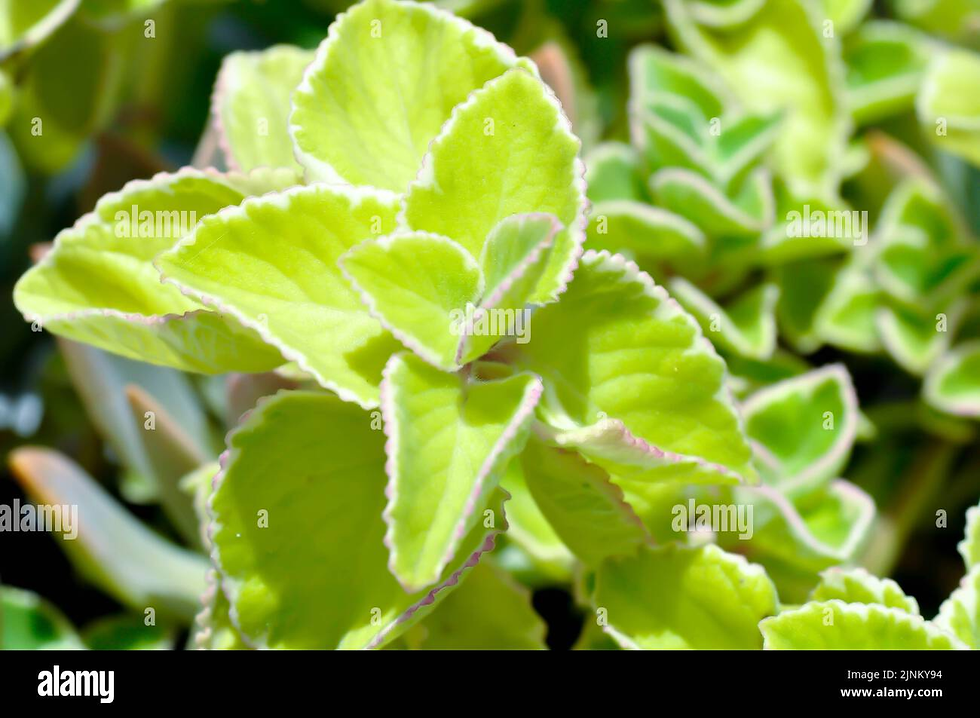
From the SDHS Plant Forum Compilation (https://sdhort.org/PlantForum) - Description by Steve Brigham: “This trailing, semi-succulent coleus relative has trailing stems to 1' tall and 3' wide, and grows best in partial shade with protection from heavy frost. It is grown primarily for its colorful 3" leaves, which are used in Cuban cooking and have a fragrance somewhat like oregano and thyme but a bit sweeter. There are a number of variegated varieties of this species, sometimes grown under different names, but all with a distinctive leaf flavor.”
(Sue Mansour, Rancho Bernardo, 2/26) – S.B.
Rhus integrifólia LEMONADE BERRY
(Anacardiaceae) So. California, Arizona, Baja California

From the SDHS Plant Forum Compilation (https://sdhort.org/PlantForum) - Description by Susi Torre-Bueno: “This versatile evergreen plant ranges in size from about 4-20ʹ′ tall and wide, performing well with very little water (can be quite drought-tolerant) and providing habitat for native wildlife. It asks little besides sun to part shade and good drainage, and the common name comes from the refreshing drink made by soaking the reddish fruits in water (many animals eat them, too). Long-lived (a formally-pruned hedge plants in the 1940s continues to thrive at Santa Barbara Botanic Garden) and good along coastal bluffs (where it stays low), this shrub can be pruned into a small tree. The thick leathery leaves provide a dark green background for the white to pink flowers that appear in late winter to spring. Use lemonade berry as an informal screen or hedge, or lace it out for a more open look.
(Susi Torre-Bueno, Vista, 2/26) – S.T-B.
Editor's note: during the meeting Karen England was asked if she made lemonade from lemonade berries and she had once, using a recipe found in a newsletter article written by Pat Pawlowski. FROM THE ARCHIVES: A Glass Of Lemonade-berry-ade
"Here’s the recipe courtesy of A Taste of Nature by Kahanah Farnsworth:
Almost Lemonade
(Makes 2 quarts)
1/2 cup lemonade berries, cleaned
About 1 cup sugar
2 quarts water
Soak the berries in water for 1/2 hour. Remove them and sweeten the remaining liquid to taste. Don’t let the clear color fool you – this drink definitely has a lemon-like flavor. Cheers!
The recipe doesn’t mention the fact that the berries contain Vitamin C, so it is really a healthful drink if you cut down on the sugar. Native Americans knew this. If you are out on a hike, in fact, you can throw some berries into your water bottle to jazz it up a little. And the shrub itself will jazz up your entire garden."
Rhus ovata SUGARBUSH
(Anacardiaceae) Southern California, Baja California, Arizona

From the SDHS Plant Forum Compilation (https://sdhort.org/PlantForum) - Description by the late Chuck Kline (our first Horticulturist of the Year): “Compact, well-rounded evergreen shrub with glossy leathery leaves. Does best in full sun with good drainage. Will grow in a variety of soils; won’t tolerate much summer watering and will not take direct exposure to salt spray. Flowers are borne in dense terminal cone-shaped clusters, creamy with tinges of red. Fruit is small, rounded and flattened, covered with a sugary or waxy secretion, and turns red when mature. Sugarbush is found from coastal Santa Barbara County south to San Diego County and east into the desert; also on Santa Catalina and Santa Cruz Islands. It is considered one of the most desirable of all native shrubs.”
(Susi Torre-Bueno, Vista, 2/26) – C.K.
Salvia clevelandii CLEVELAND SAGE
(Lamiaceae) S. Calif., Baja California

From the SDHS Plant Forum Compilation (https://sdhort.org/PlantForum) - Description by Tom Piergrossi: “One of our native sages, very popular and with good reason. It’s drought tolerant, needs little care, blooms heavily in spring and summer with light blue flowers, and has very aromatic foliage in the most subtle gray-green. It grows to about 4 feet tall and wide, requires full sun and good drainage and while it will look great even with no summer water it also tolerates being grown in a mixed garden. I prune mine back about a third in the summer to keep it neat. Eventually the plant can get old and woody and needs to be replaced, but young replacements grow quickly and can be grown from cuttings. Many named varieties exist as do hybrids. ‘Winifred Gilman’ is one of my favorites, blooming a little later with violet blue flowers and with a little greener foliage.”
(Cathy Tylka, Escondido, 2/26) —T.P.
Salvia leucophylla 'Amethyst Bluff' LARGE PURPLE SAGE
Lamiaceae (Labiatae) California

From the website for San Marcos Growers, with permission: “'Amethyst Bluff' is a large native California salvia with aromatic silvery foliage and 12 inch long, vivid purple-pink flower spikes. Starts out as a low-mounding shrub and eventually can reach up to 10 feet in height and continues to spread out laterally, up to 15 feet wide. This highly versatile shrub is ideally suited for full sun and tolerates fairly heavy soils and occasional summer irrigation and is cold hardy to 20-25° F (Sunset zones 18-24). This a great large selection of the species that attracts hummingbirds, bees and butterflies. It works well in floral arrangements and is a perfect choice for sunny slopes and banks where it can sprawl freely and provide some erosion control. Salvia leucophylla grows naturally within the coastal sage plant community along the lower elevations of the coastal ranges of California south into Baja California. The type specimen for the species was collected near Santa Barbara, California by Scottish botanist David Douglas (who Douglas Fir was named for) who collected plants along the Pacific coast on three separate expeditions from 1823 until 1834. It was officially described by American botanist Edward Lee Greene in 1892. This larger selection of purple sage with darker flowers was made by horticulturist Carol Bornstein from the coastal Bluffs of Point Sal in northern Santa Barbara County.”
In 2015 I planted a 1-gallon plant and it is now about 20’x15’ and looks good all year with very little water.
(Susi Torre-Bueno, Vista, 2/26) – S.T-B.
Salvia madrensis YELLOW SAGE, FORSYTHIA SAGE
(Lamiaceae) Mexico

From the SDHS Plant Forum Compilation (https://sdhort.org/PlantForum) - Description by Steve Brigham: “One of the few salvias with yellow flowers, this large (to 5 feet) subtropical shrub bears terminal panicles of bright yellow flowers in the fall and winter here. The species name refers to its native home in Mexico’s Sierra Madre mountains. It is grown in South Texas and so tolerates a fair amount of cold. Full sun to part shade; regular water. “
In my garden this plant gets very little water and spreads readily in part shade. The thick stems are square and very distinctive. I started with a 1-gallon plant in 2015 and had to move it from its original location because it is so vigorous.
(Susi Torre-Bueno, Vista, 2/26) —S.B. & S.T-B.
Sambucus mexicana MEXICAN ELDERBERRY
(Adoxaceae) Mexico, Oregon south to Baja and east to West Texas

From the SDHS Plant Forum Compilation (https://sdhort.org/PlantForum) - Description by Pat Pawlowski and Susi Torre-Bueno: “This briefly-deciduous shrub or small tree (with pruning) is a great plant for attracting wildlife. It is fairly drought tolerant and grows 10-25’ tall in full sun to part shade. Drought-tolerant once well established. Bright green leaves are a good foil for the small creamy white flowers that appear in spring and are prized by pollinators. The edible blue-black berries (which are toxic to people until ripe) are loved by both birds and people (think elderberry wine).”
(Susi Torre-Bueno, Vista, 2/26) – P.P. & S. T-B.
Senecio anteuphorbium (= Kleinia antheuphorbium, K. anteuphorbiumand) SWIZZLE STICKS
(Asteraceae) Morocco

Full description in the December 2025 newsletter. PLANT FORUM: At The November 2025 Meeting
(Anne Murphy, Vista, 2/26)
Verbena lilacina 'De La Mina' BAJA BUTTERFLY FLOWER, CEDROS ISLAND VERBENA, BAJA
VERBENA (Verbenaceae) Horticultural Selection

From the SDHS Plant Forum Compilation (https://sdhort.org/PlantForum) - Description by Steve Brigham & Pat Pawlowski: “When considering the concept of "native" plants for San Diego gardens, we should always remember that we here have much more in common climate-wise with Baja California than we do with Northern California. In that sense, the showy and drought-tolerant Baja Butterfly Flower may be considered a "native", and in fact it is perfectly suited to our climate. This is an evergreen shrub that grows to around 18" tall and 3' wide, with lacy foliage of olive-green divided leaves. From spring through fall, it bears many clusters of small lavender flowers (they have a slight spicy fragrance) that attract butterflies. Hardy to at least 15°F, it grows quickly in full sun to part shade with average to very little watering. Rabbit resistant.
The San Marcos Growers website (www.smgrowers.com) notes that, “This plant was collected by Carol Bornstein, then Director of Horticulture at the Santa Barbara Botanic Garden, in the Canyon de la Mina on Cedros Island, an island off the west coast of Baja California. Although not native to California proper, the northern Pacific Ocean islands off Baja California have a mediterranean climate and are considered to be part of the California floristic province and so plants of this area are often treated as ‘California Natives’. This selection differs from previous introductions of the species by having much deeper colored flowers.”
I purchased three 4” pots in 2009 and have taken many cuttings since then, spreading this beauty around the garden. I prune it heavily in late fall.
(Susi Torre-Bueno, Vista, 2/26) – S.B. & P.P.

Susi Torre-Bueno is a SDHS past president, newsletter editor and was the Horticulturist of the Year in 2012. In her busy retirement these days she has started a business http://www.asusioriginal.com/
and has rejoined the San Diego Horticultural Society board of directors.
She can be reached at Susi@sdhort.org

