
TREES, PLEASE! Don’t Park Your Baby Buggy Under City Of Encinitas 6281ETREE
By Tim Clancy, for Let’s Talk Plants! March 2026.

Don’t Park Your Baby Buggy Under City of Encinitas 6281ETREE
Like many human relationships, with trees the relationship between a tree’s above ground parts (A) and below ground parts (B) is complicated. In the case of trees, the A and B parts must collaborate to ensure a tree’s survival. If one part of the equation suffers then the other part responds to the best of its ability. They are not necessarily in balance, yet they are constantly in a state of flux, trying to create enough of A to maintain B or vice-versa.
It is widely understood that pruning, whether canopy or roots, elicits a response by the tree. The size of the response is directly relevant to the amount of foliage or roots removed. Take just a little bit and the tree responds by putting a little bit back. Here’s where it gets interesting. If you prune canopy from part A, the tree will respond by promptly slowing root growth in part B to almost a standstill, until it can regrow the same amount of foliage that was removed. Conversely, if you prune part B, then part A slows to a crawl in the growth department until the root volume removed can be replaced.

In Encinitas, at the corner of the 101 and Marcheta Street, resides City of Encinitas tree number “6281ETREE”. It is commonly known as a Sugar Gum. The botanical name is “Eucalyptus cladocalyx”. The tree was part of an inventory around 2018. At that time, it was reported to have a diameter (measured 54” above grade) of 25-30” and a height of 35 to 40’. Presumably, it was in good condition at the time as it still stands (perhaps precariously) today.
You can see from the pre-construction photo (see cover/first photo of this article) that the tree was in a typical municipal planter approximately 8’ wide and “open” on the length side. We can also see that the tree has been subjected to capital improvements with a sidewalk and bus bench among other things. I am guessing here, but I think the tree was in its location for somewhere around 50 years. So, looking at the pre-construction photo, we can see a thriving canopy that has overcome the previous round of “improvements”.
Many species of dicot trees can withstand this treatment multiple times over the service life of the tree. This typically involves removing foliage from the canopy and allowing the tree to regrow the volume lost to pruning because it has a good high vitality root system. Root pruning occurs much less frequently.

Sometimes though things don’t work out. In the case of our tree 6281ETREE, I fear the end is near. You see, when a tree can no longer grow enough canopy (part A) to maintain the roots (part B) it results in some of its root system dying. The city has for a long time been fussing over the 101 Highway through Leucadia. As such there have been many improvements. Our tree was in the middle of the construction zone around 2022, specifically a new sidewalk was installed as part of the improvements. In performing that work many roots were cut to facilitate the installation of a new walkway. In the photo “New Walkway for Baby Buggies” you can see that the tree has been impacted on all sides due to the construction.
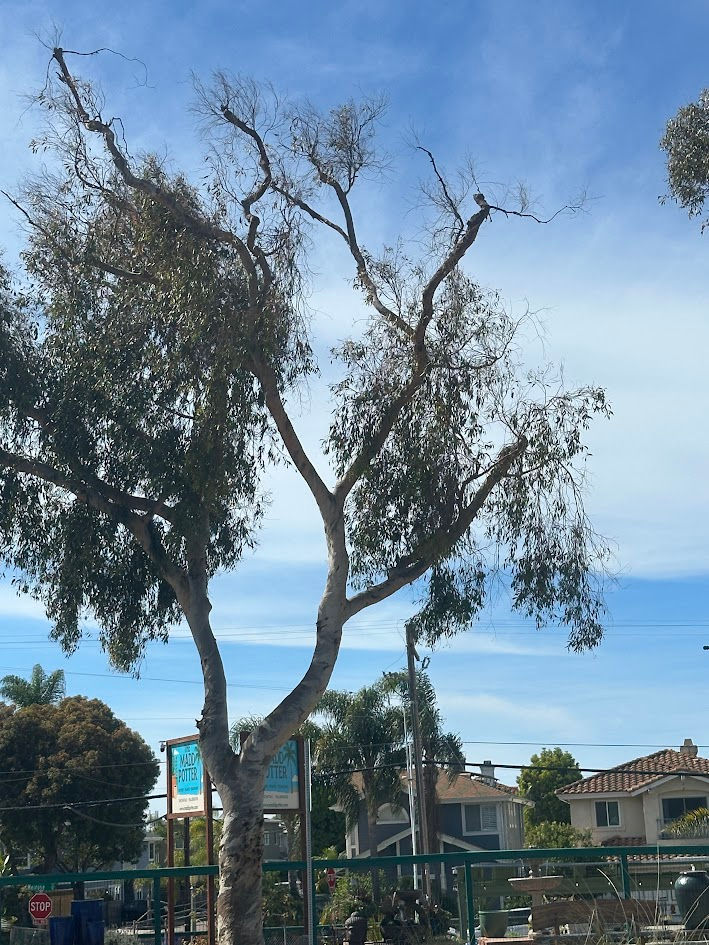
It appears our tree is unable to respond to the construction activity with high vitality. As is seen in our full tree photo, the canopy is thinning and has dieback. Almost 50% of the canopy is missing; this of course complicates things. Because the tree can grow new foliage it is not technically “dead”. Relative to the size of the tree this is a problem. Over time the roots (which, at one time, were large enough to maintain our tree) start to senesce. Eventually the roots that have been holding up our 40’ tall 30” diameter tree are no longer sufficient, and the tree “fails” (falls down).
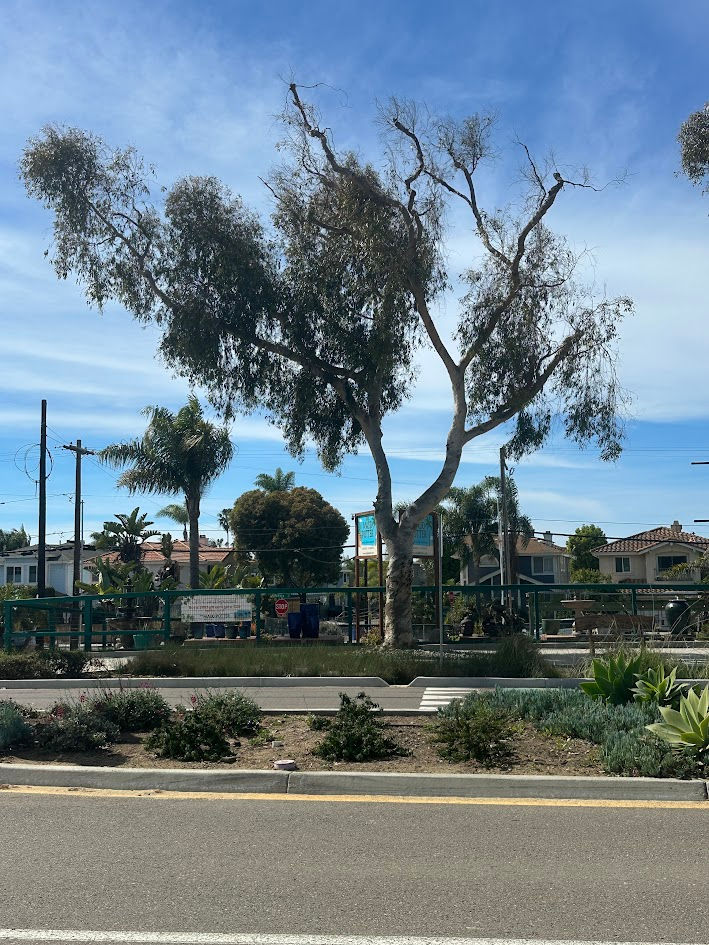
In the case of our tree not only has it been subjected to root pruning as part of the 2022 improvements, but over the years it has also been pruned regularly and, for this author, far too regularly with far too much canopy removed each cycle. This of course contributes to our scenario.
As of this writing, the tree is standing at its assigned location as literally thousands of cars drive by within striking distance if it were to fall. It is only a matter of time.


Tim Clancy & Associates LLC
Cardiff-by-the-Sea, CA 92007
International Society of Arboriculture Certified Arborist No. WE-0806A
International Society of Arboriculture - Tree Risk Assessment Qualified


