
TREES, PLEASE! Bananas – Are they Going, Going - Gone?
Updated: Aug 2
By Robin Y Rivet, for Let’s Talk Plants! August 2026.

Are bananas as we know them doomed? Probably yes. Considering it’s the most popular and widely distributed fruit in the world, that ought to be a scary thought.

What’s up? Bananas used to have hard seeds. Lots of them. Wild bananas could reproduce naturally and retain genetic diversity. Life forms that may adapt to environmental stressors without modifying their genetic makeup is a concept called “phenotypic plasticity”. But modern bananas have been domesticated and hybridized for 1000’s of years and eventually seedless bananas became the norm. Today almost all commercial bananas are cloned hybrids. Continuously cloned plants often end up with replicative failure and poor immunity to diseases.

You have to be about 70 in age to recall the history of ‘Gros Michel’, but when I was a child, we affectionately called it ‘Big Mike’. Up until the 1950s, ‘Gros Michel’ were the dominant exported variety of bananas. By the mid 1960’s it had succumbed to the dreaded Panama Disease caused by Fusarium oxysporum f.sp. cubense, a wilt that killed off entire banana plantations in most of Central America. Back then it was feared the export banana trade was finished. In fact, the song, “Yes, We Have No Bananas” was adopted to bemoan the potential loss of the beloved banana worldwide.

Hastily, farmers and breeders thought they had solved the problem by introducing the ‘Cavendish’ banana (which was also a Musa acuminata variety), since it seemed to grow for a while in the tainted soils that had previously devastated the ‘Gros Michel.’ Unfortunately, by around 2008 it was clear that most ‘Cavendish’ cultivars would perish too. They are now on the brink of extinction. Not only has fusarium disease hurt banana crops, but a new fungus called Black Sigatoka threatens to finish off any surviving Cavendish orchards.

So, are your trees doomed? Not necessarily, but that’s because banana “trees” don’t exist. Most banana species are botanically considered giant “herbs”, although the fruit we consume are technically labeled “berries”. Unlike trees, bananas don’t develop a woody trunk, but instead produce a “pseudo-stem” made of tightly packed overlapping leaves. Each banana plant will produce about 38-40 leaves before it is mature enough to create a male flower. (That number may vary from 35-45 depending on climate and cultivar), but for backyard growers in San Diego, the production of about 39 leaves is a pretty good predictor that a male flower will come next.) Once the enormous inflorescence emerges, the female flowers begin to grow upwards and get pollinated; then soon mature into tasty bananas.
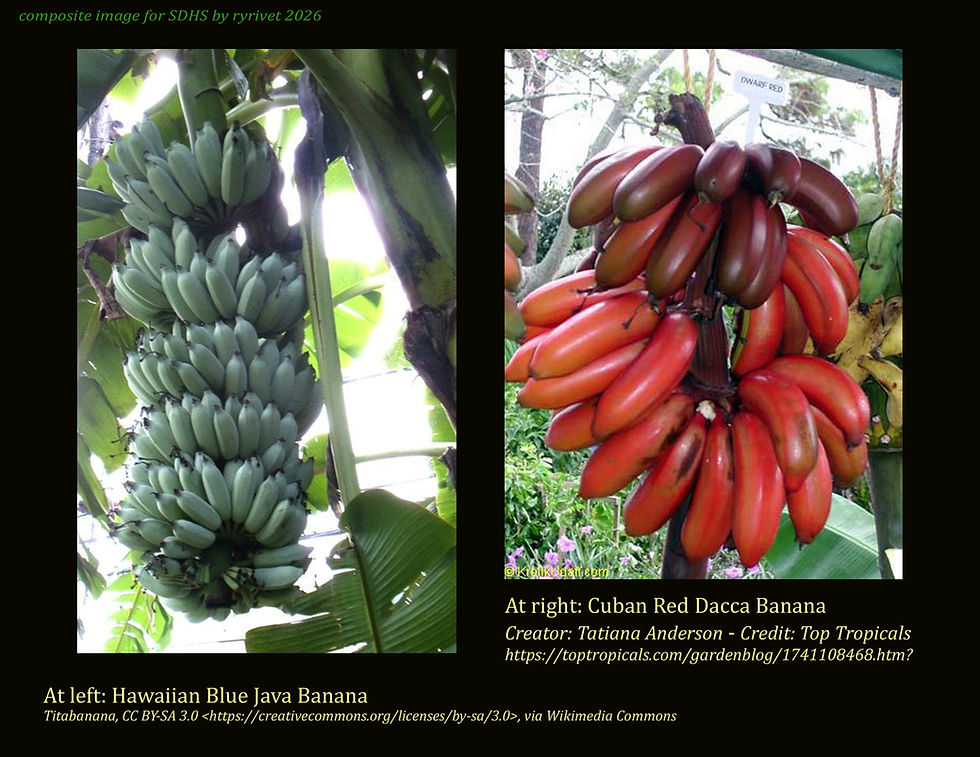
There is some hope for San Diegan gardeners. If you are growing a backyard banana it might not be a ‘Cavendish.’ ‘Blue Java’ (ice-cream banana) is very popular, and so are red bananas, plantains and others. More importantly, how are you managing your garden soil? It is far easier to prevent or exclude Fusarium wilt, than to eradicate it later. Did you know that even if you don’t like bananas, that they can be used for making paper?

