
SHARING SECRETS: Your Favorite Agave!
Edited by Cathy Tylka, for Let’s Talk Plants! September 2025.

The question for Sharing Secrets this month -
What is your favorite AGAVE? Is it in your garden? Is it from South Africa or Mexico? Why is it your favorite and what color is the flower?
Debra Lee Baldwin of 92026 proclaims…
... I like everything about Agave parryi var. truncata: Its size (2 to 3 feet in diameter and about 2 feet tall); its silvery-gray color; its ease of care; and most of all, its perfectly symmetrical artichoke shape. It looks good wherever you put it, doesn’t get unmanageably large, offsets (but not invasively, just enough to provide free plants), and it doesn’t bloom at an early age (at least 10 years).

Gerald D. Stewart of 92085, replied…

... My all-time favorite Agave is Agave attenuata 'Variegata', commonly known as Variegated Foxtail Agave. It is stunningly variegated. I first had it in the 1990s, purchased from Tropic World, north of Escondido, owned by Paul Hutchinson, a globally known cactus and succulent specialist. As an aside, he and my mother were co-valedictorians when they graduated from high school in 1942. I had his clone for a lot of years. It was purchased in a 2-1/4" rose pot, and cost $10, an expensive price back then. In the early 2000s Dan Heims and Ken Brown, owners of Terra Nova Nurseries in Oregon, were visiting, saw the plant, and wanted it so they could micro-propagate it. I wanted to keep the plant but gave them a cutting of the growing tip (the plant was in an 8-1/2" pot, not very big). They weren't able to propagate it, and my plant died. In 2016, Anderson La Costa Nursery special-ordered one for me from San Marcos Growers in Santa Barbara. The price had gone up to about $175. I was thrilled to be able to buy it and have it once again. It slowly deteriorated to death. In 2019, a fellow plant maniac, Koby Hall, gifted me one. I had the same experience as with the one in 2016. Clearly, I have grown it wrong. It is my favorite Agave, but too darned expensive to try again. I've lived a life of successfully growing plants, but I can't keep my favorite Agave alive. C'est la vie doesn't cover the situation. C'est la guerre does...!
I have 'Raea's Gold', 'Ray of Light', and 'Kara's Stripes'. I'd say 'Ray of Light' is the sturdiest of the colorfully-foliaged Foxtail Agaves.
Amy Feinberg, of 92677, proclaims…
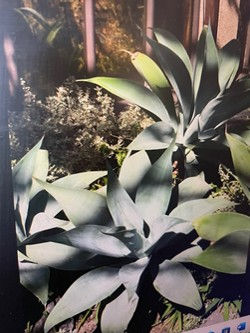
... My favorite agave was Agave attenuata 'Nova', blue foxtail agave, ...
... but now my favorite agave, which isn't currently in my garden, is Sharkskin Agave, native to Mexico. It's a hybrid of two other Mexican native species, Agave victoriae-reginae ...

... and Agave scabra, from Wikipedia (picture.)

Jim Bishop of 91345 comments on his choice…
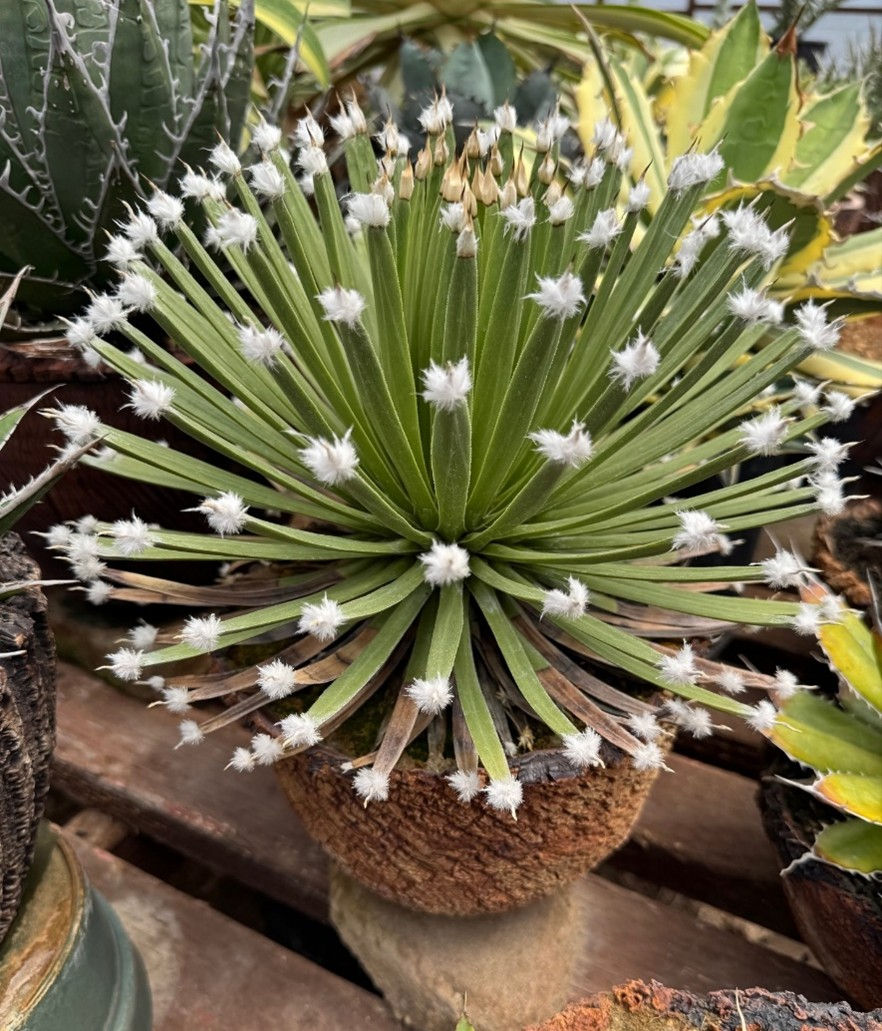
... Agave albopilosa. Seen here at Jeremy Spath’s nursery, Hidden Agave in Escondido back in June.
It was formally described in 2007. It is native to Sierra Madre Oriental in the mountains of Nuevo Leon, southwest of Monterrey, Mexico at altitudes between 3,300 to 4,900 feet.
Linda O’Brien of 92062 shared…

... Shaw's Agave.
Here's a snippet from the Nature Collective:
Shaw’s agave, Agave shawii, is a statuesque plant, from the large, sharp spines on the rosette leaves, to the spectacular display of yellow blooms massed on tall spires. The species is indigenous to a small region of coastal Baja California with the northern boundary extending into San Diego County. The California population has been seriously reduced by urban development and the last remaining population north of the border was destroyed in 2008 by the construction of the border fence. A single native plant was left.
Helen Purcell Montag proclaims…

...My favorite agave is Shaw's agave, Agave shawii, which is native to the coastal regions of San Diego County and northern Baja California, Mexico. I don’t have it in my own garden, but I know its flowers are a striking yellow with touches of red. While guiding visitors through the San Diego Botanic Garden in Encinitas, I’ve often pointed out many beautiful specimens of Shaw’s agave.
This agave was named after Henry Shaw, the founder of the Missouri Botanical Garden. It holds special significance in San Diego, where the Kumeyaay people traditionally used it for food, tools, and clothing.
To help preserve this rare species, Shaw's agaves have been planted in protected areas such as Torrey Pines State Natural Reserve and Cabrillo National Monument.
Al Vield, also, relates…

... Shaw’s agave, native to San Diego and Baja.
See it at Point Loma Native Plant Garden, Cabrillo National Monument and San Diego Botanic Garden.
Julie Erickson shares…
... 17 years ago, we were recovering from a fire and had to rebuild. It was clear we needed something to stabilize some very sloped areas on our property.
I just happened to run into some people who were having a lot of agaves dug up from their property and throwing them away! We rescued all of them and stuck them in the ground on our sloped areas. It worked! They have been growing and expanding there ever since! And the big bonus: they present us with tall orange flowers every spring that last well into summer! I don’t know their name, but they are definitely my favorite for holding our hillsides right where we want them! The abundant flowers are a nice bonus!
Cathy Tylka of 92026 comments on her fav…

...The Agave americana which is an octopus and is also variegated!
A. americana is cultivated as an ornamental plant, particularly valued for its large, dramatic mature form. It is often found in modernist, xeriscapes (drought-tolerant), and desert-style cactus gardens. It is popularly used in hot climates and areas prone to drought. The plant's presence can evoke the ambiance of 18th- to 19th-century Spanish colonial and Mexican provincial areas in the Southwestern United States, California, and xeric regions of Mexico. In dry beach gardens in Florida and coastal areas of the Southeastern United States, it is a favored choice for landscaping.
I just learned the Aztecs used the pulped leaves of A. americana to create paper. The fragments known as the Humboldt fragments were made using this technique. The info is from Wikipedia, but it is my picture.
Karen England of 92084 is ashamed to admit ...
... that she was not a fan of most agaves until recently. (If it hadn’t been for tequila she wouldn’t have liked any agaves up until now. Shocking I know! How on earth did this person become president of this society?)

But redemption awaits.
Karen learned at a recent SD Hort meeting all about Agave Restoration and Corridor Conservation for Bats and People presented by Kristen Lear, Ph.D. of BATCON.ORG.
Link to the presentation on our YouTube channel:
Karen has always loved bats, and it took these amazing creatures to get her to finally love agaves. Her favorite now? It is still Agave tequilana F.A.C.Weber, from Mexico.
Question for next month…
Did you ever think a plant was named one thing and then find out you were wrong? Did you do something you thought would work and it failed? Did the failure turn into a win-win? Tell me about your errors in gardening!

