
SHARING SECRETS: What’s In Bloom?
Edited by Cathy Tylka, for Let’s Talk Plants! February 2026.

What’s In Bloom?
This month’s question…
What is blooming in your garden or in the gardens of those around you that make you happy it’s in season? And take and send a photo, if you can too!

Kay McGrath tells us …
... It is the season for aloes to bloom! This year they are fantastic.

Christel Chase of 92103 relates…
... So great that you propelled me outside, AWAY from my computer! I found so much more than toyon. Let my joy from berry yielding toyon native at yard's edge fulfill me during winter. The African Daisy, scientifically known an Osteospermum, is a vibrant flowering plant native to South Africa, known for its colorful blooms and resilience in various growing conditions.


Jim Booman responded…
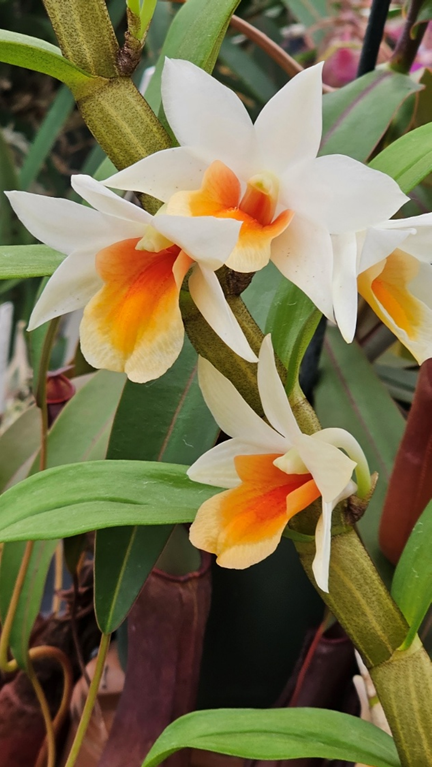
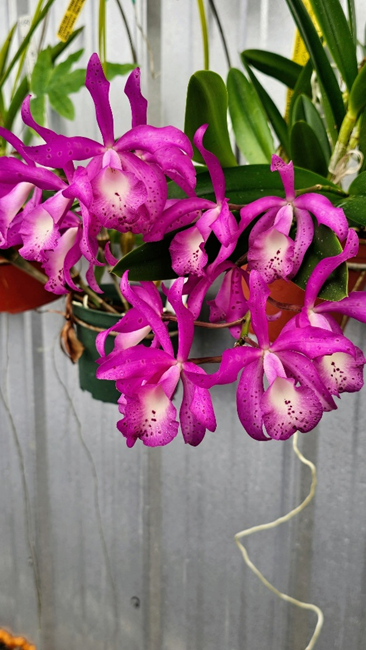
... I love this time of year in San Diego because neighborhood gardens still have Hibiscus in bloom, my Hoya plants show great leaf color, and my orchids come into bloom.


Greg Rubin shared…
... Winter is the time for glorious Manzanita blossoms, as well as Ribes, or the currants & gooseberries. One of the showiest currants is Ribes sanguineus glutenoum, or the pink flowering currant, with pendulous clusters of white to pink flowers. Another is the golden currant, or R. aureum, which is also showy and has the best eating native currants (some say the best period!). Finally, Manzanita blossoms are highly fragrant and make wonderful tea.

Barbara Dunn, who lives in San Marcos, proclaims…
... Protea neriifolin. (Pink Ice). Proteas need full sun with good drainage. I planted mine in the Fall after I built a mound of dirt to allow drainage. Their native habitats are South Africa and Australia, usually growing on hillsides.
And remember, no fertilizer. Only water when newly planted. Leave it alone and it will thrive.

Ida Rigby of 92064 considers…
... Today, January 6, I continued to be alarmed that too much is blooming and concerned that there will be no spring.
Fortunately, when I returned to my computer, I found Dan Hinkley's January 6 Post from Windcliff: "The Unimaginable Zero Winter"; so, I am not alone. Hinkley writes…
"…a rather large collection of Begonia species at Windcliff are, on January 3rd, 2026, providing an unexpected, never-before-experienced season of backlit foliage. . . The flower buds of too many shrubs and trees are being seduced and juiced into growth two months too early. . . "
Hinkley’s observations may bring some solace to those of you who, like me, are worried that our December/January “springtime" will leave us with no April/May springtime.
What's blooming? Roses are blooming: Old Blush; Parade; Dublin Bay; Happenstance; Pinky Climbing.

Some bulbs including N. ‘Grande Soleil d'Or’ and heirloom N. ‘Geranium’ are blooming, and Tulip bakeri 'Lilac Wonder' is in full leaf.

Blue Daisy (Felicia amelloides ‘San Gabriel' from South Africa), a spiky species grevillea and Spider Net grevillea (Grevillea thelemanniana, which always blooms from December through April) are in full bloom along with Turks Cap, (native to southern Mexico into South America). Its virtue is that it thrives in dry shade.


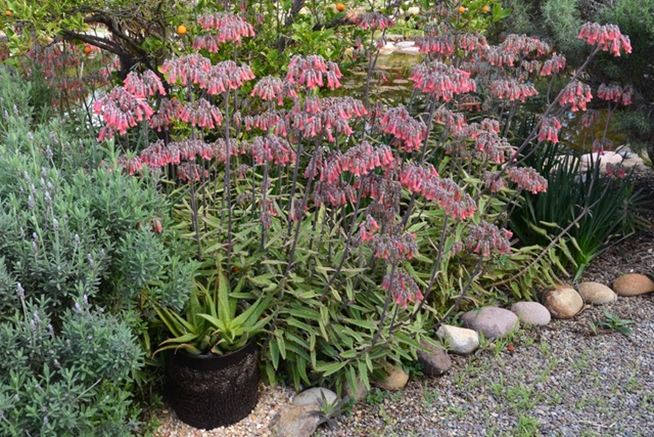
In most years Mother of Thousands (Kalanchoe daigremontianin from Madagascar) needs a floating row cloth from early December to guard against the flower stalks collapsing in a frost, not this year.
A tropical water lily, Doris Hart, a luscious raspberry/cranberry color is still blooming, months beyond its usual season. Two hardy lilies, Moon Dance and Prakisad, are producing buds, but not opening.

Perhaps the plants think it's September since our extraordinarily hot Poway summer extended well into November. We do get a rose bloom like this in September, but combined with winter/spring bulbs? It reminds me of the surreal combination of arctic, alpine and tropical plants/flowers I experienced on a birding expedition above Quito, Ecuador where a confluence of altitude and latitude created a curious arctic/tropics zone with tiny tropical ferns and orchids and minuscule arctic and alpine flowers. What will "Spring” bring this year?

Linda O’Brien provides this answer…
... Hookers Primrose and Coastal Goldenrod both CA natives.


They both bloom when most other flowers don't, so they're good for pollinators like sphinx moths and bees in the morning. They are California drought-tolerant, mostly in Zone 9. They can be showy, drought-tolerant California natives. Hooker's is tall and known for its large yellow flowers that open in the evening, attract sphinx moths, and help stabilize disturbed sites. The golden bush attracts numerous insects, including butterflies and moths. They are tough plants that like full sun and prefer well-draining sandy or rocky soil. I live in Ramona, CA, and these plants thrive in coastal sage scrub on my three-acre property.
Lorie Johansen of 92084 answers…
... It’s all about aloes!

When asked about care, she replied…
“It’s really lack thereof…. both enjoy full sun, minimal water, no maintenance…not affected by aloe mite – yet…. Aloe vanbalenii is the yellow bloomer, the other may be Aloe ‘David Verity’.


Cathy Tylka of 92026 has trouble deciding…
... One of my favorite plants is the Jade plant. When it flowers, as it’s doing now, it is more fantastic.

Crassula ovata, commonly known as, or money tree, is a succulent with small pink or white flowers from South Africa. It is also known as lucky plant and money plant.

‘Safari Sunset’ Leucadendron has been growing for quite a few years, but now, it’s really living up to its name. I have seen this plant made into a wreath and it is phenomenal.

Mine is just growing natural, without babying, watering, fertilizing and mostly leaving it alone.

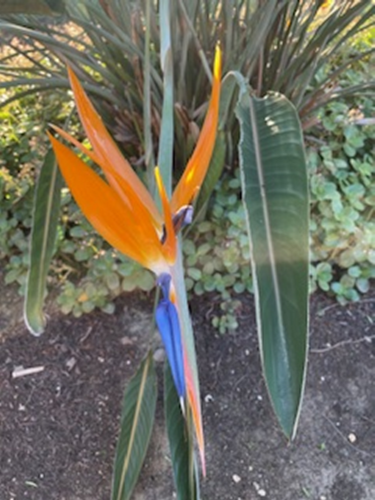
I never get tired of the Bird of Paradise. It survives in spite of me, with benign neglect, but it’s an incredible looking plant and the flower is a gift. The most common species of bird of paradise,(Strelitzia reginae), produces an orange and blue flower; the less-common white bird of paradise, (S.nicolai), has white flowers highlighted with dark blue. Strelitzia reginae, commonly known as the crane flower, bird of paradise, orisiguden Nguni, is a species of flowering plant native in South Africa.
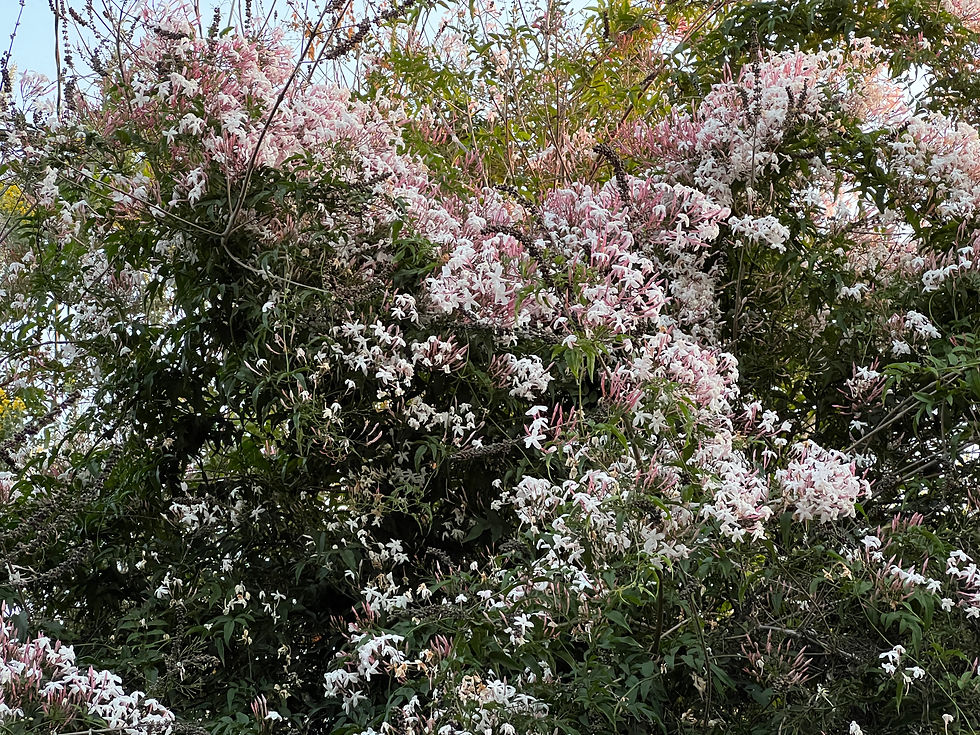
Karen England of 92084 loves the fragrance…
… wafting in the bedroom window from the pink jasmine vine in full bloom, Jasminum polyanthum, growing in her garden nearby. There is nothing like it!
Question for next month:
With all the rain and then sunshine following, blooms are out early. Do you have anything blooming that has not done so in the past? This includes all, as in bulbs, trees, shrubs, flowers, or anything else in your garden or somewhere else.

Why are you seeing this? Because you might not remember that we have it.
The funds garnered from this enterprise support our scholarships.


