
SHARING SECRETS: What is growing in your garden, or what do you plant in your garden, to attract natural bees?
Edited by Cathy Tylka, for Let's Talk Plants! July 2026.

Question of the month –
What is growing in your garden, or what do you plant in your garden, to attract natural bees?
We learned much from the May Speaker, Dr. Molly Rightmeyer, about the need for natural habitat. Let’s see if we can use this important information.

Russel Ray of 92021 replied…
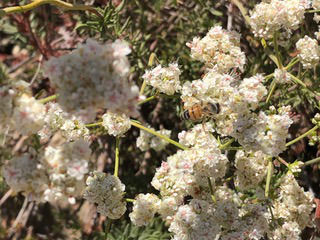
When I moved to Winter Gardens in July 2017, there was a huge bee nest between the front door and the garage. I contacted a bee removal service which sent a guy out to look at my situation. He determined that the bees were thirsty and had found natural spring water. He showed me how to move the bees by building a pond in the back yard and then encouraging them to move that way using watermelon, strawberries, and other fruits. It worked. Now I have a pond in the back yard full of thirsty bees, and if I let the pond go dry, the bees get a little upset. As far as plants go, the bees love my many Crowns of Thorns and my huge mimosa tree. The Crowns of Thorns bloom year-round.

Denise Stockman of 92083 shares…
To attract bees to my garden I have the usual: Yarrow, Mint, Lavender, Zinnias, Sages and Salvias but my FAVORITE is African Blue Basil.
There are so many bees that visit that I sometimes wonder if the plant will lift off like a helicopter.
Linda Chisarnos of 92014 relates…
Borage, Sage, three different Lavenders, Zinnia, Calendula, Sunflowers, Bachelor Buttons, Lobelia…. all planted in my vegetable garden. The bees arrived in early March this year as did the tomatoes, thanks to the pollinating efforts of the bees!


Karen England of 92084, surprises us with…
I have several varieties of lavender growing, Lavandula heterophylla, Lavandula x intermedia 'Provence', Lavandula x intermedia 'Grosso' and Lavandula dentata, that, when in bloom, "are all to the bees what chocolate is to people!" (That is a direct quote from my old boss and the original owner of The Lavender Fields of Valley Center where I worked for 10 years.) Bees are everywhere on my lavenders and on lots of other blooming herbs in my garden.

Make your own Lavender Sea Salt by Karen England
This seasoning makes a great seasoning for all kinds of meats and fish, and is wonderful with eggs and veggies. Rim you Margarita Glass with it and set on the tables to invite your guests to try instead of plain old salt. Makes a great gift!
Mix 1 tablespoon of dried lavender florets
With ½ c of coarse sea salt
Pound the mixture with a mortar and pestle or (mix in a coffee grinder used only for spices), until medium grind and mix with salt.
Store in airtight container and Enjoy!
Oreet Herbst & John Knott, of 92029 pursue it with gusto…
Our native bee attraction and support plan: habitat —> food + water + shelter
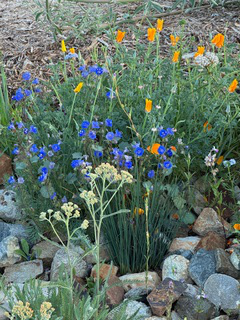
The perimeter of our property is planted entirely with native trees, shrubs, and perennials to create a native habitat zone: mallow, yarrow, manzanita, ceanothus, dudleya, buckwheat, yucca, toyon, penstemon, oaks, lemonade berry, salvias, sumac, etc.

2. A few years ago, we seeded native annual wildflowers which now self-propagate: California poppy, lupine, clarkia, gilia, baby blue eyes, owls’ clover, phacelia, etc.
3. We halve low-pressure bubbling / puddling fountain in the front yard and plan to add two additional fountains in the back as water sources for pollinators and birds.
4. When we cleared the property for landscaping, we kept six of the old avocado stumps - we placed them around the yard in the native habitat zone to provide punky wood nesting sites for solitary native bees. We also have several areas of bare soil for ground dwelling native bees.

Pat Pawlowski of 92084 states…
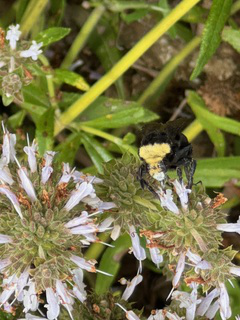
Recently, a gorgeous bumblebee (unfortunately, I don't know which species) was busy gathering pollen from my Cleveland sage.
At the time, I happened to be inches away from the bee, immersing myself in that wonderful sage aroma.
Can you get high sniffing salvia? Maybe.
Anyway, at that moment, the bee and I were enjoying life together, amid a beautiful cloud of striking violet-blue flowers.
Tynan Wyatt supports…
My best bee attractors in my garden are:


Planning on building a bee-hive with my kiddos one day. We'll see!

Cathy Tylka of 92026 relates…
My Coleus Neochilus, better known to me as Italian Oregano, always welcomes the black tailed bumble bee.

The Cactus Chimney Bees love the Opuntia Robusta, aka, Prickly Pear Cactus.
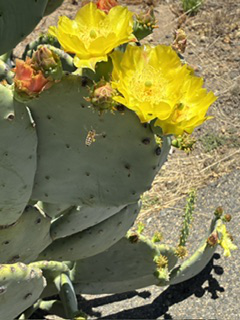

The Cleveland Sage and Barley bushes love living intertwined.

And, what would the arena be like if there wasn’t a little downed timber for the independently living bees. This happens to be some pepper tree discards.

Tony Gurnoe summarizes...
Having only a small garden of my own, most of what I grow is to eat. Among those edible plants, the local pollinators have definitely been enjoying cilantro and dill going to flower, squash blossoms (a favorite of native bees), and tomato flowers.
Dill in flower.

Question for next month:
We learned much about planting the right tree this past month from Tony Gurnoe. Do you have a tree in your garden that you think you have for the right reason? Or, do you have some you wish you hadn’t planted or just have. And, can you tell us why you think either way on either subject?

Cathy Tylka, RN, retired Emergency Nurse, found her love of plants and the SDHS merge many years ago. Cathy acted as Treasurer for the organization and volunteers for many activities. Now, she is more than happy to assist in gathering questions to ask you in the Sharing Secrets area of the Newsletter.

The funds garnered from this enterprise support our scholarships.
