
SHARING SECRETS: What are you doing to conserve plants?
- 19 hours ago
- 7 min read
Edited by Cathy Tylka, for Let's Talk Plants! September 2026.

Question of the month –
What are you doing to conserve plants?
In July, we heard from the most knowledgeable Kevin Alison, who serves as the Native Plant Manager for the Catalina Island Conservancy, where he leverages his expertise in conservation, restoration, and horticulture to prevent extinction.
I was wondering if you have done or are doing or plan to do similar activities with any plants in your garden? It does not have to be to prevent extinction, but to restore of keep a plant that is failing on you!
Even if your method is unconventional or just happened, it’s interesting to hear about this.

Pat Pawlowski of 92084 reports…
All along, I thought that I was growing Bahiopsis laciniata (San Diego Sunflower) only because I liked the look of it, and that it was easy to maintain. It had been growing, naturally, at my old homestead in East County. I knew it was a tough little evergreen shrub with small yellow daisy-like flowers, and that it was very (and I mean very) drought tolerant. I thought that it was ubiquitous.
Little did I know that San Diego Sunflower, like myself, is uncommon and threatened by development. I learned this through a wonderful book called Wildflowers of Orange County and the Santa Barbara Mountains by Robert L. Allen and Fred M. Roberts Jr. Also, I found out that San Diego Sunflower is a fabulous plant for wildlife like native bees, birds, butterflies, and other pollinators. It is about 3' x 3' and laughs (laughs!) at excessive heat and sunshine. So, get a San Diego Sunflower this fall and get that book, too.
Helianthus californicus is a species of Sunflower know by the common name California Sunflower. It is native to California and Baja California, and grows in many habitats. This wild flower is an erect perennial growing from a network of tough woody roots and small rhizomes.
Gerald D. Stewart of 92084 shares…
I made a decision some time ago to plant rare and unusual plants, that I have typically kept as potted collections, into the ground as part of the landscape. Over the last year I had a long period of a-symptomatic a-fib, and at 78 years-old, can no longer function well in temperatures over 80°F. As a consequence, I lost a collection of 6 different Brugmansia cultivars with variegated foliage when I couldn't go out and water during heatwaves.
I lost about a dozen Hibiscus cultivars with variegated foliage. I lost scores of colorfully-foliaged rare plants, including one that, literally, cost $700. I have been able to re-acquire five of the six Brugmansias, and they are now part of the Front Yard landscape.

Variegated Hibiscus replacements are beginning to arrive, and they will become a collection planted in the entryway shrub bed. Finding replacements of rare colorfully-foliaged plants is a difficult challenge. Fortunately, the acre I live on has a lot of areas where I can plant into the ground, and install drip irrigation controlled by time clocks.
The goal is to eliminate hand watering hundreds of plants now that I have survived long enough that I can't assume I will always be able to take care of the collections manually, like I have for decades. Until this question was posed, I hadn't considered that what I was doing was eliminating extinction. I thought I was eliminating the need to find sources for replacement. Somehow eliminating extinction seems far more-grand. So, that's what I am now doing.

Julie Erickson retorts…
Good question! I’m looking forward to reading responses!
I’m a tea drinker. I save all my tea bags by setting them out to dry on the plants by my sink. Once I have a good pile of dry ones, I cut them open and brew a tea for plants and am sure to include tea leaves in with the “watering” tea. I honestly don’t know if it’s made a huge difference in the lives of the plants. But I hope they know that they are loved.

Karen England of 92084 cajoles…
The closest thing I can think of as a herb plant that I want to (and work to) save from extinction is the pale, yellow California poppy that came with my property.
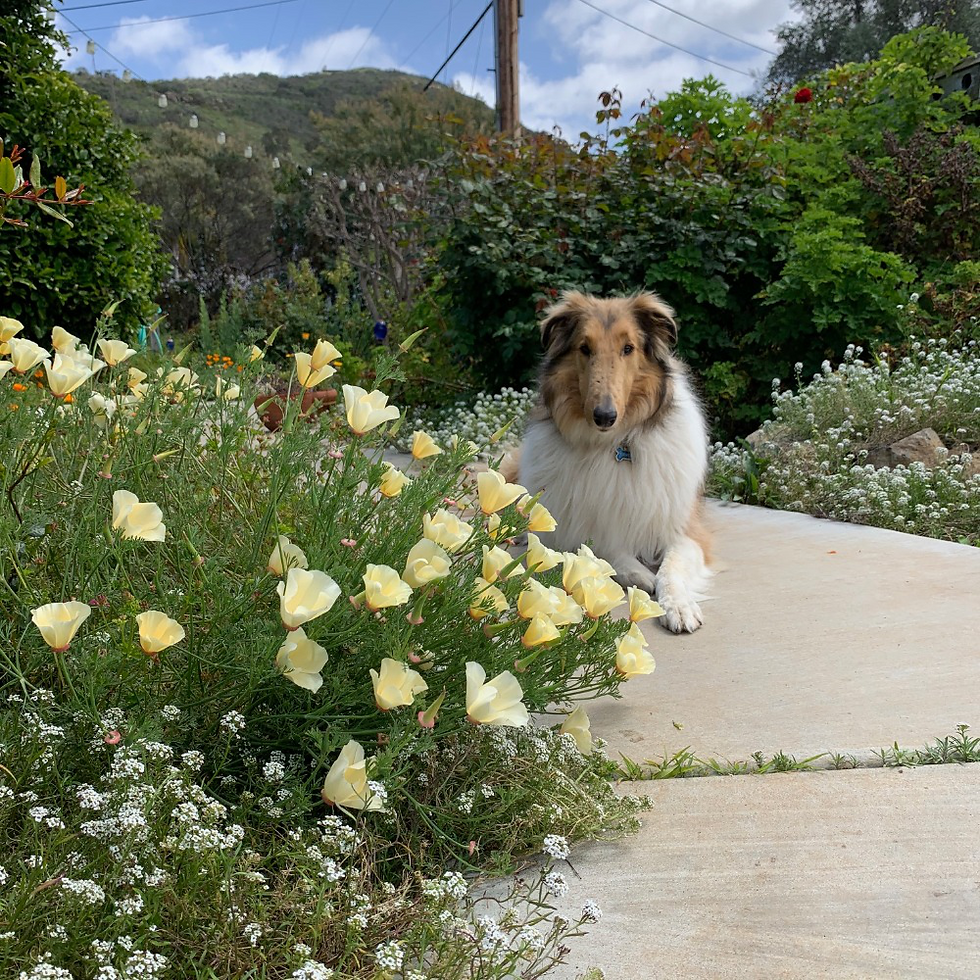
Many of you aren’t surprised that I call the Eschscholzia californica plant an herb because you know me well enough to expect from me herbal answers to every plant question, but you might still be surprised that the California poppy is an important herb.
I never planted this native herb, as it was already growing at my property when I acquired the place in 2000. Most of the California poppies growing here are the classic orange color but a small percentage every year are the prettiest pale yellow. Of course, I wish to preserve all native poppies, but especially the pale yellow Eschscholzia californica plants.
It should be noted that “…pale yellow California poppies share the exact same herbal uses and medicinal properties as the standard bright orange and golden varieties.” (California Poppy Benefits + Recipe – Herbal Academy)
What are the herbal characteristics of the California poppy? According to PubMed Central ( California poppy (Eschscholzia californica), the Papaveraceae golden girl model organism for evodevo and specialized metabolism - PMC ) California poppy is “traditionally used in herbal medicine to treat anxiety, insomnia, muscle spasms, and mild pain. Unlike its relative the opium poppy, it contains no narcotics or opiates, though it does contain isoquinoline alkaloids that offer mild sedative and calming effects.”
(You can purchase organic dried California poppy for making your own medicinal tea from Mountain Rose Herbs if you don’t want to harvest your own. California Poppy)
Besides the plant’s medicinal qualities, the flower and root have long been used to make a plant dye used in crafts and the California poppy can be found growing in historic Dye Gardens. I have never dyed anything with California poppy but it’s on my list of things to try!
Cathy Tylka from 92026 ponders…
I love the wild buckwheat in my garden and the lovely Cleveland sage. I have started to recognize it, when it grows in other areas, and have been able to use it in my garden, when it started in the cracks of my walkway. I hope to continue to incorporate it and other natives, like our ceanothus.

Tony Gurnoe from 92007 concludes...
I've been privileged to work alongside some of the world's most talented conservation botanists, including Kevin Alison, to try to preserve many of the rarest species suitable to grow in our area.
My own garden is quite minimal but still equipped with good stories to share. In fact, one of my plants is actually considered not just threatened or endangered but extinct in the wild! That plant is Brighamia insignis, historically native to the cliffs of Kauai's rugged Na Pali coast. B. insignis is a curious plant because counterintuitively they're succulent despite being native to one of the wettest parts of our planet. This seeming contradiction relates to the almost entire lack of topsoil along those cliffs and the extreme drainage qualities of porous volcanic rock. In the wild, at least in the past, these plants exist in a delicate balance of frequent rain, low water retention, entire absence of frost, and with a unique ecological context because of evolving on a remote island.

So what happened? Well, I already told this story once on TV: https://www.pbssocal.org/shows/growing-passion/episodes/botanic-garden-your-backyard-yfbws7 but I'll briefly reiterate. Feral goats ravaged what plants they could reach. Wildfires, which Hawaii is not well adapted to, further devastated the Brighamia population. To compound all of that, hurricane Iniki scoured most of the remaining plants off of the faces of their cliffside homes. Altogether, this dramatic reduction in the plant population led to the extinction of the only insect in their home range that could effectively pollinate these plants. You might wonder, then, how do I have one growing in Cardiff by the Sea?

The fact that this unique species still exists at all is predominantly to the credit of one person - Steve Perlman, who was a botanist with the National Tropical Botanic Garden and who set the stage for people like myself and Kevin to learn how to continue such important work. in 1976 & 1977 Steve bravely rappelled down the cliffs where these plants once grew in an effort to source seeds. Fortunately for this species, he shared some of those seeds and ultimately gardeners are who prevented this species from disappearing completely. But I mentioned that their obligate pollinator actually went all the way extinct, so how do these plants reproduce at all anymore? It might sound silly in its simplicity, but the answer is a paint brush and again, gardeners.

I'll admit that it's an odd dynamic in which the plants produced by gardeners are all that there will ever be of this species. In one sense it's a remarkable success story on behalf of horticulture but it's also a level of responsibility that tends to distort the notions of moral responsibility in our gardening. I better not get complacent and kill what is one of the only remaining individuals of its entire species, right?! Fortunately it is possible for us to grow more of these plants.

However, we also don't want to just inbreed my plant into oblivion because that's bad for the ultimate resilience of future plants. This is where botany looked to zoology and adopted some of the same techniques used to maintain genetic diversity in the rarest remaining animals such as Siberian tigers and California condors. Just as in the conservation strategies for those animals, every single group of B. insignis have been genetically analyzed and we essentially know how closely related any plant is to any other plant. Part of the fun of this story is that my plant from my little patio garden was included in that study, which was led by the Chicago Botanic Garden! Here's some additional information - just know that where it references samples from the San Diego Zoo, those were actually samples that I collected. Chicago BG reached out to the zoo because they're obviously more well known than I am but ultimately I gathered the leaves which went into that broad genetic analysis: https://www.chicagobotanic.org/downloads/conservation/brighamia.pdf

Question for next month: What is growing that is good to eat in your yard. Is this the first year, or is this something you have had for a long time.
Do you have a favorite recipe for this horticulture goodie?

Cathy Tylka, RN, retired Emergency Nurse, found her love of plants and the SDHS merge many years ago. Cathy acted as Treasurer for the organization and volunteers for many activities. Now, she is more than happy to assist in gathering questions to ask you in the Sharing Secrets area of the Newsletter.

The funds garnered from this enterprise support our scholarships.
