
SHARING SECRETS: Do you have a tree in your garden that you think you have for the right reason?
- 7 days ago
- 7 min read
Edited by Cathy Tylka, for Let's Talk Plants! August 2026.

Question of the month –
Do you have a tree in your garden that you think you have for the right reason? Or, do you have some you wish you hadn’t planted or just have?
We learned much about planting the right tree this past month from Tony Gurnoe.
Barbara Bolton shares….
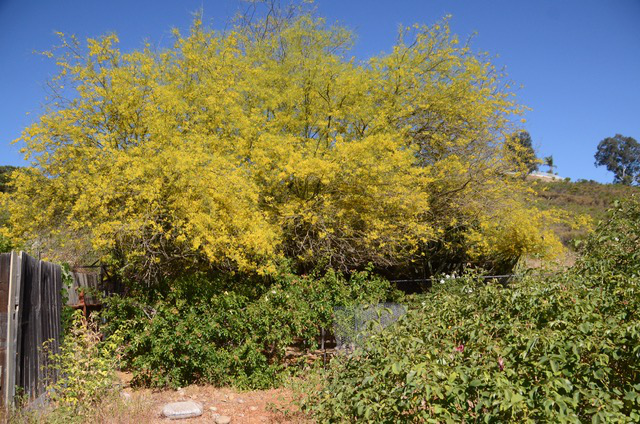
When we redesigned our landscape, I wanted to feed the birds, bees, butterflies and me. We have a variety of fruit trees including Rangpur lime, Ana and Golden Dorset apples, naval orange, Mexican lime . pink grapefruit, Feijoa, Fuyu persimmons, kumquat, mandarin orange, bananas, and passionfruit. We have a large variety of flowering plants including Grevillea, plumerias, and lots of tube-shaped flowers that delight hummingbirds. I like every tree, bush, and plant. We had an Orchid tree that got too large for our yard and removed it, we just had to take out a 50' cedar tree as it's roots were compromised, plus a few other bushes that were poorly placed by the crew performing our remodel. I like the variety of birds, bees, and butterflies that visit. It is delightful.

Karen England of 92084, reports…
When my late husband and I bought our two-acre property in the fall of 2000 it had many dead trees all over it, mostly old fruit trees; citrus and stone fruits mainly, but there were four very mature trees scattered around the two acres we purchased that were flourishing - a now famous prolific Hachiya persimmon, a massive "California" pepper, an olive and a eucalyptus. We decided to keep all four trees although I had to barter and beg to save the pepper tree. The four living trees that we inherited, I am happy to say after 26 years, are all still thriving. In addition, over the years we (and now I have) planted many other trees, a variety of acacias, pines, oaks, mulberry, apples, avocados, citrus, pomegranate, fig, and more. Even some shrubs that we've planted have turned into trees such as leptospermums, vitex and bay laurel.
The question I am asked often is why did I want to save the pepper tree? I know the bad rep that pepper trees have, but this magnificent tree was growing without any care for decades before we arrived, and why would I demean that? My tree is huge and glorious and deserving of respect in my opinion for surviving when so many other trees had died. I have a male tree, so there are no pink peppercorns on my tree. (I harvest pink peppercorns from my cousin's female tree in Bonsall for use in cooking. According tocanopy.org... Canopy”. Controversy arose in 1982 when research suggested that fruits from the California pepper tree could cause irritating effects similar to that of poison ivy, a cousin of the tree. What followed was a crazed frenzy — the FDA banned pink peppercorns from importation, shops stopped selling them, and they became untrendy in the culinary world.
Yet despite this blow to the fruit’s reputation, it eventually found its way back into our stores and food. The French later submitted research to the FDA showing that pink peppercorns were non-toxic, resulting in a lift to their import ban. Other sources found that the majority of allergic reactions to the peppercorns were due to tree nut allergies, not necessarily due to the peppercorns themselves...")
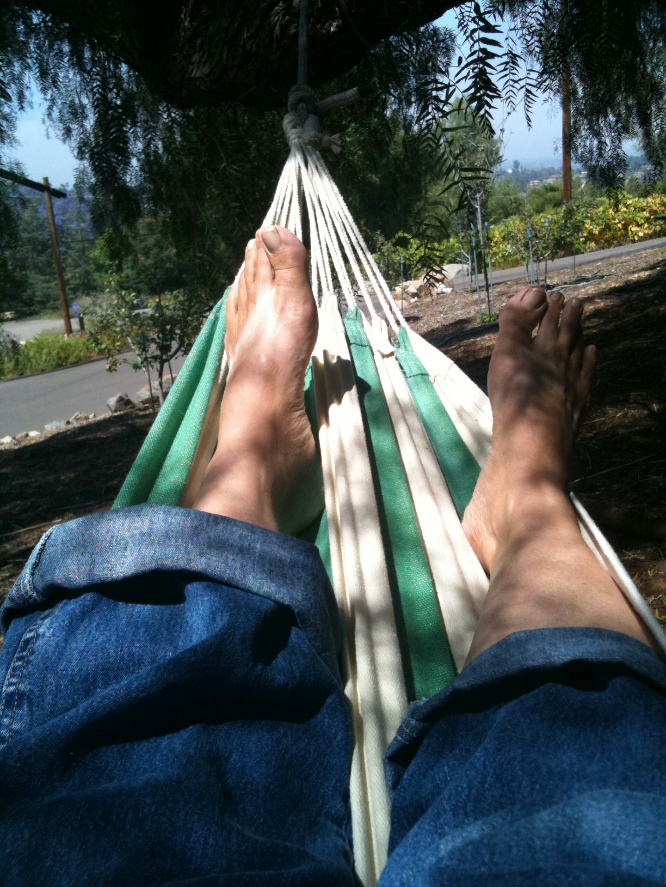
In my garden, this pepper tree is still the right tree for me in 2026, or maybe I am the right person for this tree, but I am still glad I saved it. I do nothing for it and yet it gives shade to the chicken run, is a perfect tree for a hammock, is a host to birds and beneficials and is green year-round. A small patch of Mexican elderberry shrubs has sprung up underneath my pepper tree, proving it is not true that "nothing" else can grow under a pepper, although not much else can. Too learn more about the allelopathy of pepper trees read this thesis Allelopathic Impacts of Schinus Molle (Peruvian pepper tree) on Invasive and Native Plant Communities of Southern California
Gerald Stewart of 92083 recalls…
I have three trees on the property that need to be eliminated. A Ficus carica seedling that was ignored and is now huge. A Golden Council Tree Ficus altissima and an Abidjan Ficus decora. They are beautiful, but way too huge in scale for even the acre that I live on. The roots of the Council Tree grew so big they destroyed an above ground pond that I have for colorfully-foliaged bog plants.
I have a Ficus decora that is variegated that I've never seen mention of anywhere, a cutting of it was given to me by Barbara Jolly of the San Diego Geranium Society back in the 1980s. It is in the front yard, and has a very respectable growth habit.
That is one that I very much enjoy.
I will be planting several colorfully-foliaged Brugmansia (Angel's Trumpet) in the front yard. I expect them to get 6'-8' tall. That may be more considered a shrub, but I will prune them into standards as "shade trees" to protect the shade-loving colorfully-foliaged plants that are creating a Bodacious Border along the west fence.
At a cost of close to $2000 a 30'+ elm was removed from the front yard last year. This year I hope to totally remove the Golden Council Tree. I inherited the family home 11 years ago. A 60-year-old Silver Maple in the front yard and a 60-year-old Modesto Ash in the backyard were so huge they completely covered the lot the house is on, plus provided a lot of shade for two neighbors. The roots of the Ash were beginning to crack the concrete in the garage. Both had to be removed. When I studied Ornamental Horticulture at Cal Poly around 1970 both of those trees were considered suitable for subdivision house landscaping. Now we know better.

Ida Rigby of 92064 speaks up and reports…
Some of our trees that should fit Tony Gurnoe’s criteria for appropriate trees to our Poway canyon are now over 30 years old. The two Engelmann oaks in the front garden cams from Tree of Life as 9” tiny tress in 1994. The toyon, also in front (background center behind the Mexican redbud) also came with the truckload of natives from Tree of Life.

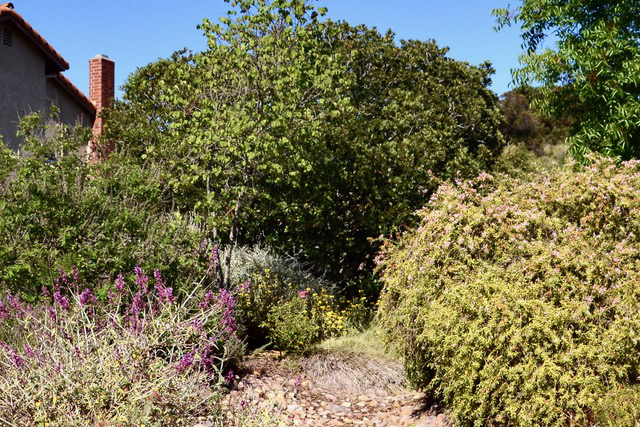
In the back garden, from left, the loquat (seedling from an older tree, species Palo Verde from Ganter Nursery (1995).


And Chitalpa from the California Botanic Garden (then the Santa Ana Botanic Garden) planted in l999 are thriving. A caveat about the Chitalpa tashkentensis ‘Morning Cloud’: Chitalpas carry Xylella fastidiosa, a bacterial infection that causes left scorch and dieback. Our three Chitalpas all show those symptoms. The dead branches are wonderful perches for hummingbirds and the black phoebes that gnat catch over the pond every day, but the leaf scorch, unsightly by the end of the summer.

Our four pomegranates ‘Wonderful’ produce sweet, juicy pomegranates.
James L. Booman of 92103, appreciates the question…
Best decision 30+ years ago was to plant Chorisia speciosa (now Ceiba). The silk floss tree's huge pink flowers on green trunks are
But here is a photo of a tree I am growing more and more of now: Brachychiton rupestris. Australian origin, and well adapted to Coastal San Diego.
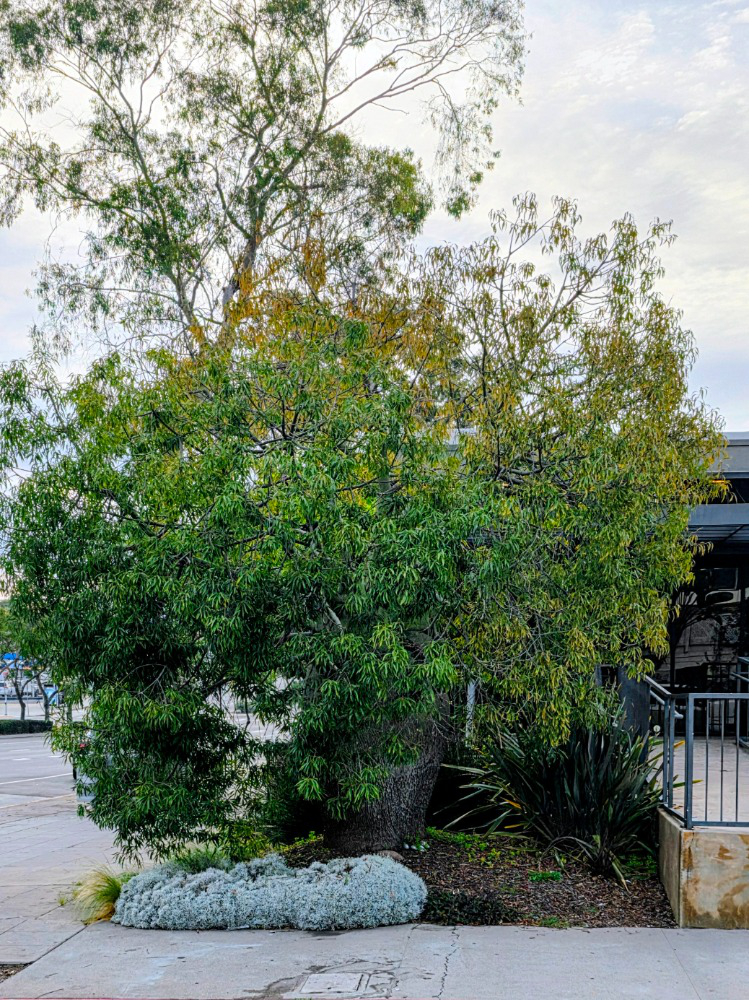
Similar to many Ceiba, the trunks can get very fat and swollen with age. Because we plant them from seeds, they vary tremendously in overall maturity.
Pat Pawlowski of 92084 is happy about…
I have an Engelmann oak on my property, just a youngster. It was in a 15-gallon pot when I planted it, so I don't know exactly when it had started off life as an acorn.
But it is now about 20 feet tall and about 12 feet wide.
And it is already majestic.
Unlike other types of live oaks which have standard-issue green leaves, the leaves of the Engelmann differ: they are a subtle gray-green color. The acorns are, of course, adorable.
Oaks host all kinds of wildlife: birds, insects, and so on. They vibrate with life, and it is a pleasure to be near them. Visit them while you can, because according to a wonderful book called the Oaks of California, Engelmanns may be the most imperiled of all tree oaks in California. They are classified as an endangered species.
So I'm glad I planted one.

Cathy Tylka of 92026, says…My Jacaranda Tree, which is a zone 9, and 1000ft. above sea level, provides me with pleasure and fun. I planted it away from the house, so purple, sticky flowers…would not be trailed into the house. It blooms later than the rest of San Diego County due to location. But who doesn’t love a tall tree with purple flowers.
The species Jacaranda mimosifolia has achieved a cosmopolitan distribution due to introductions, to the extent that it has entered popular culture. It can be found growing as an environmental weed in Central America, the Caribbean, Spain, Portugal, southern and northern Africa, China, Australia, Rwanda and Cyprus.
The birds love it for look outs and I’ve seen so many different species hanging out in it.

Tony Gurnoe of 92007 summarizes...
Although I work with trees every day, the only trees in my own small garden are a Mexican lime tree and a Meyer lemon tree. I salvaged both trees from project sites and enjoy using the fruit of each in cooking so I'd consider that a worthwhile reason for me to maintain them. Although citrus are not particularly well adapted to our region because they're naturally more sub-tropical than Mediterranean, needing more water, and often becoming chlorotic in alkaline soils, California also arguably produces the best quality of citrus fruit anywhere in the world. Fruiting trees are a group that I love dearly so I am working to infuse more edible native fruiting trees into projects. Walnuts for one example - native throughout the U.S. and incredibly rich in their offerings.

Question for next month:
This past month the most knowledgeable Kevin Alison, who serves as the Native Plant Manager for Catalina Island, where he leverages his expertise in conservation, restoration, and horticulture to prevent extinction.
I was wondering if you have done or are doing or plan to do this to any plants in your garden? It does not have to be to prevent extinction, but to restore of keep a plant that is failing on you!
And, even if your method is unconventional or just happened, it’s interesting to hear about this.

Cathy Tylka, RN, retired Emergency Nurse, found her love of plants and the SDHS merge many years ago. Cathy acted as Treasurer for the organization and volunteers for many activities. Now, she is more than happy to assist in gathering questions to ask you in the Sharing Secrets area of the Newsletter.

The funds garnered from this enterprise support our scholarships.
