
PLANT FORUM: August 2025 General Meeting
By Susi Torre-Bueno, for Let’s Talk Plants! September 2025.

For over two decades a meeting highlight was the Plant Forum, where a horticultural expert spoke about plants brought in by members. These descriptions were printed in the newsletter and were also compiled and are available free on our website at https://sdhort.org/PlantForum. This is an alphabetical listing of over 7500 plants, including over 1600 detailed descriptions. Check it out when thinking about plants to add to your garden, and feel free to share this link with your friends.
After a few years on hiatus the Plant Forum returned with our May 2025 meeting, and we encourage all members to share some of your plants at the meetings you attend. I can guarantee that there will be many people who will not have grown, and might not have ever seen, the plants from your garden. All you have to do is:
1) Bring a cutting or a potted plant to a meeting.
2) BEFORE you leave home, take a minute to fill out a slip of paper with the common and scientific name of the plant, where it is native to (if you know that), what city it is growing in, your name, and a couple of sentences about your experience with the plant.
Although I’m no expert, I will do my best to talk about the plants I’m familiar with, and will get help from other attendees. At the end of the meeting, we will gather up the printed information and include it in the next newsletter. If you have any questions, contact Susi Torre-Bueno at storrebueno@cox.net.
Plants displayed at the August 2025 meeting:
Amaryllis belladonna
NAKED LADY
(Amaryllidaceae) South Africa

A lovely bunch of Naked Ladies was displayed at the August 2025 meeting by Sue Fouquette.
From the SDHS Plant Forum Compilation (https://sdhort.org/PlantForum) - Description by Steve Brigham:
“So-called because it blooms without leaves, the Naked Lady provides bright, late-summer color even in the driest of locations. Large fragrant trumpet-shaped flowers of glowing clear pink are produced in clusters of 4–12 atop tall slender stalks. Bulbs are 3–4 inches across, and multiply to make a clump. Leaves are produced in winter when the plant is not in flower; the plant is deciduous in summer. Divide and replant Naked Lady bulbs immediately after flowering in August, since dividing at other times of the year may postpone bloom. (Plants in containers may be planted at any time.) More spectacular than the species are the ×Amarygia hybrids of A. belladonna and Brunsvigia josephinae—these have larger, more numerous flowers in a variety of shades of pink, and even white. Naked Lady is fully drought-tolerant and flowers best where it does not get too much summer watering."
(Sue Fouquette, El Cajon, 8/25) – S.B.
Crassula mucosa
WATCH CHAIN PLANT, LIZARD’S TAIL
(Crassulaceae) South Africa

This small succulent is very distinctive, with tiny bright green leaves growing closely together, like links on a chain. Grow it in the ground or in a container, in full sun to part shade. Although it is drought-tolerant, it is much lusher with occasional watering. It will get to about 1 foot tall and 1-2 feet wide.
From the website for San Marcos Growers: (https://www.smgrowers.com/products/plants/plantdisplay.asp?plant_id=3358)
“This small succulent plant's interesting looks have been likened to that of undersea coral. It grows to 6 to 12 inches tall by a little wider with a spreading habit of branching stems having tightly overlapping stacked narrow light green leaves. These leaves completely hide the stems, which start off erect but then trail over from the weight of all of the leaves. The small pale yellowish-green musty-smelling flowers appear along with the leaves tight along the stems in spring to midsummer or other times after rains or irrigation. Plant in a well-drained soil in part to full coastal sun to light shade or indoors – best color maintained with a little shade even on the coast. Water sparingly or abundantly.”
(Susi Torre-Bueno, Vista, 8/25) – S.T-B.
Crassula multicava
FAIRY CRASSULA
(Crassulaceae) South Africa

This plant was described in the June 2025 newsletter Plant Forum section here: PLANT FORUM: Please Welcome Back The Plant Forum To The Monthly Meetings
(Cathy Tylka, Escondido, 8/25) – S.T-B.
Lampranthus deltoides
TOOTH-LEAVED ROCK VYGIE
(Aizoaceae) South Africa

From the SDHS Plant Forum Compilation: (https://sdhort.org/PlantForum)
“The 200 succulent subshrubs in the genus Lampranthus are found only in South Africa, and they’re among a group of genera commonly known as Ice Plant. L. deltoides (also known as Oscularia deltoides) is from the Northern and Western Cape regions, and has reddish-pink stems and fleshy grey-green leaves (triangular in cross-section) with toothed edges. The color combination is quite attractive in the garden, and this plant looks best growing over a wall, where it can flow for several feet. In late spring or early summer, it has 1-inch pink daisy-like flowers. It roots very easily from cuttings and is hardy to around 20ºF. Moderate to low water; good in full sun to part shade; mine do best in part shade in Vista.”
(Susi Torre-Bueno, Vista, 8/25) – S.T-B.
Ledebouria socialis
SOUTH AFRICAN SCILLA, SILVER SQUILL
(Liliaceae) South Africa

This small drought-tolerant bulb grows a rosette of leaves to about 6”-10” tall x 8” wide in full sun or shade. It has small white flowers in summer. Plant with only half of bulb in the soil. Over time each bulb will form a small clump, and the baby bulbs are easily separated. The bulbs grow at least half out of the ground, so be careful when using garden tools around them. The plant is mostly grown for the foliage which is a bright gray-purple with green blotches on the top side; underside of leaf is all purple. Also good as a houseplant. My first bulbs were planted in 2006 and have multiplied a good bit over the years, but not in a bad way.
(Susi Torre-Bueno, Vista, 8/25) – S.T-B.
Sedum rubrotinctum (= S. × rubrotinctum) JELLY BEAN PLANT, PORK AND BEANS
(Crassulaceae) Horticultural Hybrid
Here’s some pork and beans even a vegan will love.
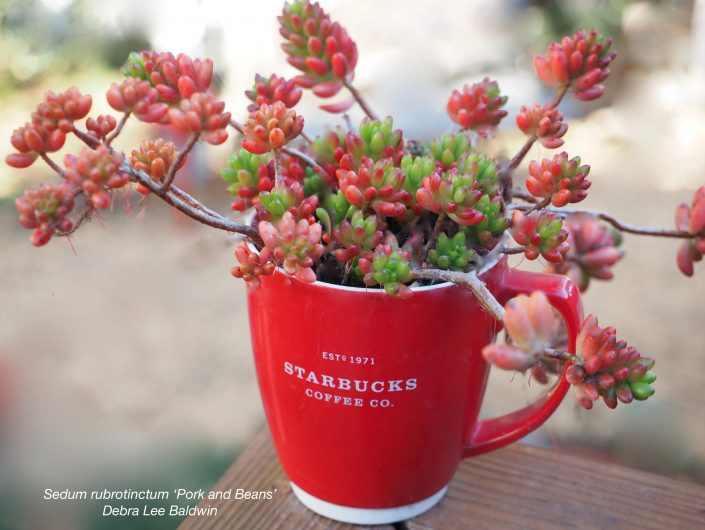
This charming succulent has green leaves often tipped with red (with most of the leaf colored bronzy-red during the summer months, especially when grown in full sun) and shaped like fat jellybeans. It grows to about a foot tall and spreads at least that wide; looks nice hanging over the side of a container. Bright yellow flowers appear in spring, but they’re not much to write home about. Best in bright shade to full sun, it needs very little water to thrive. Grow it in well-drained soil; probably can’t take much frost, so if you live in a colder area bring it inside for the winter. Very easily propagated by putting the leaves on soil and misting them every few days (or put some leaves in a shady spot in the garden where they’ll get some water and check for roots in a few weeks). Wikipedia notes that...
... “Sedum rubrotinctum is poisonous and may cause irritation when ingested or touched.”
Although this has never irritated my hands (I usually wear gloves), you should take care when handling it and you certainly should not eat it. According to Kew Gardens, this plant is a hybrid of two Mexican sedums: S. pachyphyllum × S. stahlii.
(Susi Torre-Bueno, Vista, 8/25) – S.T-B.
Solanum valerianum 'Navidad, Jalisco'
(Solanaceae) Mexico

I purchased this fast-growing evergreen vine as a 4” plant (basically a rooted cutting) in 2022 from Plant Depot, a terrific nursery in San Juan Capistrano. They got it from the former Annie’s Annuals (which was closed and is now reincarnated as Curious Flora Nursery - www.curiousflora.com).
My plant is in a 20-gal container in partial shade and hasn’t gotten quite as large as it would in the ground. The flowers are stunning.
The Annie’s website notes:
“Fast growing, evergreen and almost ever-blooming, this heavenly vine reached 8' x 8' for us in its first year! Plentiful and deliciously large 8-12" panicles of starry purple flowers accented with big pillowy golden-yellow anthers drape gracefully – Wisteria-style – from long sweeping stems that will fill in to cover a wall or fence in a year or two. Some say the flowers, which appear from at least Spring to December, are sweetly scented! The lush, tapered 4" leaves add even more allure. Doesn't climb by tendrils, so you do have to provide something for it to climb on. EASY, deer resistant (woo-hoo!) and not fussy about soil or water, it will be more exuberant with compost enhanced soil and somewhat regular water. Has survived bouts of 25 F, but do protect from hard frosts or grow against a warm wall. Introduced by Suncrest Nursery.”
For an interesting blog post about this plant visit https://agrowingobsession.com/?p=78213.
(Susi Torre-Bueno, Vista, 8/25) – S.T-B.

