
PLANT FORUM: At The July 2026 Meeting
By Susi Torre-Bueno, for Let’s Talk Plants! August 2026.

For over two decades a meeting highlight was the Plant Forum, where a horticultural expert spoke about plants brought in by members. These descriptions appeared in the newsletter and are available free to the public on our website at https://sdhort.org/PlantForum. This is an alphabetical listing of the over 7500 plants which were displayed at meetings, including over 1600 detailed descriptions. Check it out when thinking about plants to add to your garden, and feel free to share this link with your friends.
After a few years on hiatus the Plant Forum is back, and we encourage all members to share some plants at the meetings. I can guarantee there will be members who will have not grown, and might not have ever seen, at least one plant from your garden.
All you have to do is:
1) Bring a cutting or potted plant to a meeting.
2) BEFORE you leave home, take a minute to fill out a slip of paper with the common and scientific name of the plant, where it is native to (if you know that), what city it is growing in, your name, and a couple of sentences about your experience with the plant.
Although I’m no expert I will do my best to talk about the plants I’m familiar with and will get help from other attendees. At the end of the meeting, we will gather up the printed information and include it in the next newsletter. If you have any questions, contact Susi Torre-Bueno at storrebueno@cox.net.
I want to thank the members who bring in plants for the Plant Forum and then donate these cuttings for other members to take home.
Dracaena (Sansevieria) sp. or cv. SANSEVIERIA, SNAKE PLANT
(Dracaenaceae)

Lorie Johansen brought in a carton of snake plants suitable for planting in member gardens – thank you! She noted: “It seems like yesterday there was only one, now there are thousands!” There are a number of species of Sanseveiria (most of which are now classified as Dracaena) that perform beautifully in our climate, thriving on neglect. Most grow best in part shade and need very little water. They are native to Africa and southern Asia, and the most commonly sold is Dracaena trifasciata.
(Lorie Johansen, Vista, 6/26, 7/26) – S.T-B.
Eriogonum fasciculatum CALIFORNIA BUCKWHEAT, FLATTOP BUCKWHEAT
(Polygonaceae) California

See the August 2025 newsletter for description
(Laura McCullough, 7/26, Alpine)
Glottiphyllum sp. Or cv. (probably G. longum) GLOTTIPHYLLUM, TONGUE PLANT
(Aizoaceae) So. Africa

From Wikipedia: “Glottiphyllum is a genus of about 57 species of succulent subtropical plants of the family Aizoaceae. It is closely related to the Gibbaeum and Faucaria genera…The species are native to South Africa, specifically to Cape Province and the Karoo desert. Glottiphyllum plants have thick, soft leaves arranged in pairs that are low to the ground and often graze the soil surface. They also have rhizomes. They sport yellow flowers with narrow petals in the autumn and winter. The flowers are sometimes fragrant and around 5 cm in diameter. The species readily interbreed, making hybridization easy. …G. longum is the most widespread Glottiphyllum species, and the most common one in cultivation. It can be distinguished from its relatives by the way that its flat, green, fleshy, tongue-shaped leaves are all born in two opposite rows (distichous), lying flat and mostly prostrate along the ground. The long leaves are distinctively strap-shaped, with rounded margins. Sometimes they are also mildly curved or upturned at the tips, but not hooked. The bladder cells at the leaf margins are oriented horizontally and not elongated. The fruits are born on long stalks. The seed capsules have 9 or more locules and persist on the stem for many years. The seeds are very small and smoothed on the sides.” We can grow this plant in the ground or in pots. It prefers full sun or very light shade and a gritty well-draining cactus or succulent mix, with moderate water. Overwatering can cause the leaves to split or lead to root rot. Dormant briefly in spring and summer, water very sparingly during this time.
(Liz Adams, 7/26, Rancho Bernardo) – S.T-B.
Heterotheca grandiflora TELEGRAPH WEED
(Asteraceae) California

From Calscape.org: “Heterotheca grandiflora is a species of flowering plant in the Asteraceae (Sunflower) family known by the common name Telegraph Weed. It is native to the southwestern United States and northern Mexico, but it can be found in other areas as an introduced species, such as Hawaii. In California it is widespread from Butte County southward. It is a pioneer species and roadside weed even where it is native. This is a tall, bristly, hairy plant exceeding a meter in height and densely foliated in hairy to spiny toothed or lobed leaves. Leaves are smaller and more widely spaced toward the top of the stem, which is occupied by an flower cluster of bright yellow daisylike flower heads. The disc and ray florets drop away to leave a spherical head of achenes, each with a long white pappus. This plant is rarely used in the garden but is a useful for restoration projects.”
(Laura McCullough, 7/26, Alpine) – S.T-B.
Kalanchoe luciae PADDLE PLANT, FLAP JACKS
(Crassulaceae) South Africa

This evergreen succulent with distinctive rounded leaves is a commonly-seen plant in San Diego, and deserves a place in every garden in full sun to light shade. From the San Marcos Growers website: “This succulent has been likened to clam shells, because of the shape of the basal rosette of the thick 4-6 inch long by 2-5 inch wide rounded leaves. The leaves are covered with a gray bloom and the leaf margin takes on a reddish hue during cooler winter months if grown in bright light otherwise the leaves remain uniformly green. In late winter into early spring arises a single long stem, to 2-3 feet, bearing clusters of pale yellow tubular flowers. Plant in full sun to light shade. Hardy to around 27° F - plants survived and resprouted after several nights around 25° F in January 2007. Protect from snails which permanently disfigure the leaves. This plant has been sold for many years in California under the name Kalanchoe thyrsiflora but is really Kalanchoe luciae. The true Kalanchoe thyrsiflora has similar color foliage on shorter broad leaves and doesn't turn nearly as red in winter. The flowers on Kalanchoe thyrsiflora are a darker yellow and are sweetly fragrant. Other common names manufactured for K. luciae are Red Pancakes and Desert Cabbage. The name Kalanchoe is somewhat of a mystery - there is some thought that it comes from a phonetic transcription of the Chinese words 'Kalan Chauhuy' meaning "that which falls and grows", likely in reference to the plantlets that drop from many of the species but others believe it from the ancient Indian words 'kalanka' meaning "spot" or "rust" and 'chaya' meaning "glossy" in reference to the reddish glossy leaves of the Indian species K. laciniata. The specific epithet "luciae" is thought to either honor Mademoiselle Lucy Dufour, an acquaintance of the French botanist and physician Raymond Hamet, who authored this species or it was named because the plant is endemic to an area in South Africa called Saint Lucia Park.”
[Debra Lee Baldwin, the SDHS Horticulturist of the Year in 2017, has an excellent video about this plant: https://www.youtube.com/watch?v=faAfymH54BY along with more information at https://debraleebaldwin.com/succulent-plants/kalanchoe-luciae-flapjack-succulent/ ]
(Laura McCullough, 7/26, Alpine) – S.T-B.
Malosma laurina LAUREL SUMAC
(Anacardiaceae) California

A California native related to cashews and poison oak, so be wary of skin rash. Laurel Sumac can be found along the coast from the Mexican border all the way to around San Luis Obipso. From Calscape.org: “Laurel sumac (Malosma laurina) is a large, rounded evergreen shrub or small tree that grows to 20 feet tall and as wide. In bloom, it is intensely aromatic. The lance-shaped leaves have reddish veins and stems. Plumes of small white flowers bloom at the tips of twigs in late spring and early summer. They resemble lilac blossoms. After flowering the tree bears whitish single-seeded fruit. This shrub is named “laurel” because the foliage is reminiscent of bay laurel but it is not in that plant family. It is a key plant in coastal sage scrub and chaparral, and the berries are appreciated by songbirds, especially warblers. Laurel sumac grows in full sun and is very drought adapted once established, but is not cold tolerant and is not found in areas where freezing temperatures are normal. It is adaptable to many types of soil but prefers well drained soil, either sandy or rocky.”
(Laura McCullough, 7/26, Alpine) – S.T-B.
Myrtus communis MYRTLE
(Myrtaceae) Mediterranean

From the American Botanical Council: “Native to North Africa, myrtle (Myrtus communis, Myrtaceae) is a shrub with brownish-red bark, small pointed leaves, fragrant white flowers, and black berries. The shrub can be found all over the Mediterranean region also and is cultivated in gardens throughout Europe. The ancient Egyptians thought that myrtle could calm facial tics, while the Romans considered it a panacea for urinary and respiratory conditions. Myrtle was also a symbol of love and immortality for the Greeks and was a staple ingredient in love potions. Both leaves and berries were used to treat diarrhea, dysentery, and lung and bladder infections. They were also main ingredients of angel water, a 16th century skin care lotion. Myrtle is considered antiseptic, astringent, restorative, bactericidal, expectorant, and mildly sedative. Its leaves have been used in Persian folk medicine as a mouthwash to treat oral yeast infections, e.g., thrush. Reports have indicated that myrtle extracts may have antioxidant activities, suggesting that myrtle could be used to treat diseases related to inflammation and allergy. Myrtle has other medical uses including for peptic ulcers, hemorrhoids, headache, palpitation, leucorrhea, conjunctivitis, excessive perspiration, cough, skin diseases, diabetes, heartburn, swelling, and stiffness of the limbs. In vivo and in vitro studies indicate that myrtle may be beneficial in the treatment of cancer…” https://www.herbalgram.org/resources/herbclip/herbclip-news/2016/myrtle/
This from English Heritage: “Since the reign of Queen Victoria there has been something that ties most English royal weddings together – and we’re not talking about a white dress or a handsome groom. Myrtle, a delicate white flower that grows at Osborne, has been the flower of choice for royal brides since the 1850s. It was originally given to Victoria in a posey by Albert’s grandmother in 1845. The descendants of this plant are still growing in the grounds of the house today. The first known use of Osborne myrtle [Osborne is the place it grows, Queen Victoria’s holiday home on the Isle of Wight, and not a variety of myrtle] in a royal bouquet was at the wedding of Victoria and Albert’s eldest daughter, also Victoria. Since then, flowers grown from the same plant have featured in the bouquets of several generations of royal brides from Queen Elizabeth II to Diana, Catherine Middleton, and Meghan Markle to name a few.”
From My Pinch of Italy: “In Italy, myrtle is especially prominent on the island of Sardinia. Sardinian cuisine makes extensive use of this herb, flavouring traditional dishes and creating a strong cultural association—when you think of myrtle, Sardinia naturally comes to mind. Sardinian chefs use myrtle leaves to flavour game meats, pasta sauces, and stews. They are also steeped to make decoctions or infusions traditionally used in Sardinia to relieve bronchitis and inflammation of the respiratory tract. A …“famous liqueur is made from myrtle berries, called Mirto… It has an intense, slightly spicy flavour and can be enjoyed chilled or at room temperature—though slightly chilled allows its full bouquet to shine. Mirto liqueur is a Sardinian specialty, often served as a digestif at the end of a meal. It pairs beautifully with ice cream, fresh fruit, or even coffee. In essence, Mirto is to Sardinia what Limoncello is to Campania: a symbol of local flavour and tradition.”
(Karen England, 7/26, Vista) - K.E.
Quercus agrifolia COAST LIVE OAK
(Fagaceae) California to N. Baja California

From the SDHS Plant Forum Compilation: https://sdhort.org/PlantForum: “This San Diego County native is a large, much-branched evergreen tree, 20’ – 60’ tall and wide. The cupped leaves are a rich green; new growth is reddish. It grows in full sun to part shade, needs good drainage, and is a tough, drought-tolerant plant needing only occasional water. It is an important plant for wildlife, and provided acorns eaten by Native Americans. [For good descriptions, see smgrowers.com and laspilitas.com.]”
(Laura McCullough,7/26, Alpine) – P.P. & S.T-B
Salvia guaranitica ‘Black and Bloom’ BLACK AND BLOOM SALVIA
(Lamiaceae) Horticultural Hybrid

This salvia blooms almost all year (not in winter) with dark blue flowers on a stout plant that needs very little water. The leaves have a lovely scent. From almostedenplants.com: “Who knew you could out do Black and Blue Salvia?! Black & Bloom Salvia produces larger flowers that emerge from deep black calyces adorned along black stems. It flowers earlier and is a more vigorous plant overall growing slightly larger and has thick deep green quilted foliage. Like its pollen parent, Black & Bloom Salvia attracts hummingbirds as well as larger butterflies to its deep dark violet blue tubular flowers. This a great perennial for full sun to mostly sunny gardens or medium to large containers. Anise or Brazilian Sage, Salvia guaranitica, is an upright growing perennial that may flower nearly continuously from spring to frost. It has been known to spread by rhizomes but under most conditions stays neatly where it's put and where hardy will return year after year. Provide full to partial sun with average drainage and average moisture for best results. Periodic deadheading is not required but may help to keep the plants looking fresher. Salvias are considered the #1 plant for Hummingbirds with their tubular flowers designed for pollination by these amazing flyers. If your Salvia or Sage starts to look unkempt in mid to late summer consider giving it a light shearing or remove the spent flowering spikes to help promote new growth and flower production. An application of fertilizer at this time may also be beneficial in spurring flower production.”
(Susi Torre-Bueno, Vista, 7/26) – S.T-B.
Senecio radicans (=Curio radicans) STRING OF BANANAS
(Asteraceae) South Africa
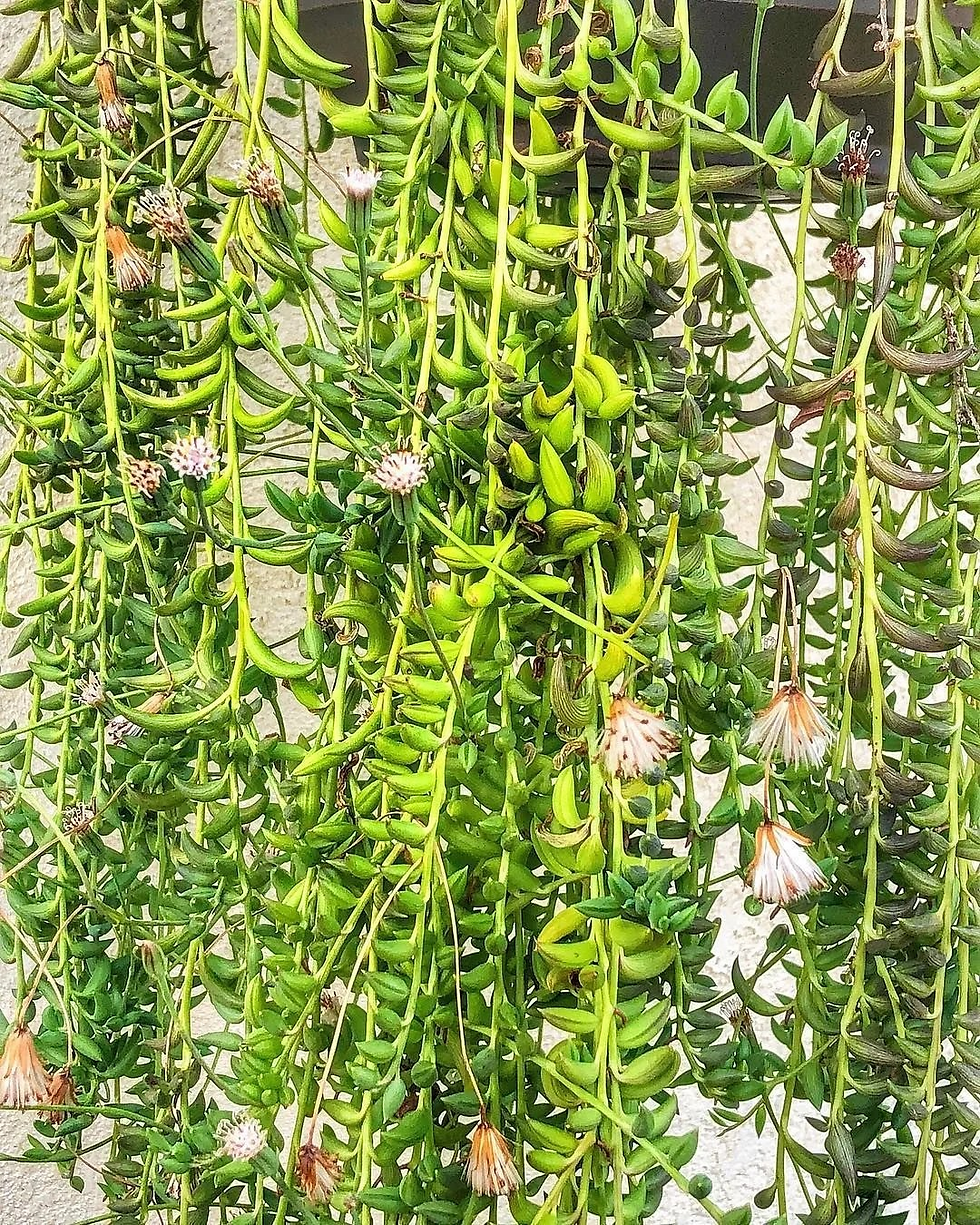
From Planetdesert.com: “String of Bananas makes a great hanging plant, with its cascading vines and glossy, banana-shaped leaves creating a flowing curtain of greenery. Native to South Africa, this fast growing succulent, formerly known as Senecio radicans and now classified as Curio radicans, adds texture and movement whether spilling from a hanging basket, trailing off a shelf, or softening the edge of a garden wall. A String of Bananas (Curio radicans) succulent trails from a terracotta hanging pot, green leaves cascading against a white background. The String of Bananas plant typically grows up to 3 feet long and 12 inches wide when grown in hanging containers, although the stems can extend longer in favorable outdoor conditions. The vines are densely packed with glossy, green, banana-shaped leaves arranged in a semi-spiraled pattern. These leaves are not only attractive but also serve a functional role by storing water during dry periods. From late winter to early spring, the tiny, star-shaped white or pale pink flowers may release a light cinnamon or clove-like scent. Flowering is more common outdoors or when grown in bright light and slightly cooler winter conditions. Thanks to its durability and unique appearance, String of Bananas is popular in modern container arrangements, xeriscapes, vertical gardens, and minimalist interior designs. It’s worth noting that String of Bananas is often confused with “String of Fishhooks”, which is a slightly bluish-gray cultivar with thinner, longer leaves.”
(Susi Torre-Bueno, Vista, 7/26) – S.T-B.
Thymus citriodorus ‘Variegata’ LEMON THYME
(Lamiaceae) Mediterranean
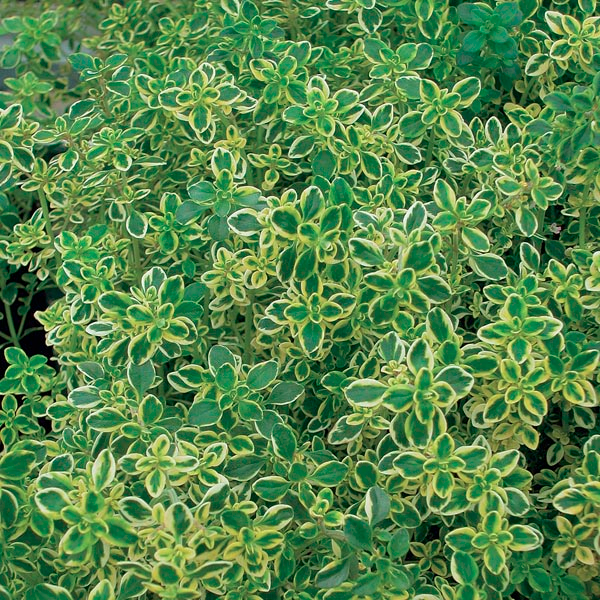
From thespruce.com: “Lemon thyme, is a Mediterranean herb that has been used for centuries. Once believed to be a hybrid of garden origin, between Thymus pulegioides and Thymus vulgaris, it has since received its classification after DNA analysis revealed it is its own species (Thymus citriodorus). The aesthetic appeal and the many uses of lemon thyme in garden design are reason enough to plant this aromatic treasure. Using lemon thyme in a garden can bring interest and appeal in various ways. Lemon thyme makes an excellent border plant in a rock garden and thrives in those conditions. If looking to xeriscape, thyme is perfect and will provide color when it flowers, or, depending on the cultivar, can add yellows and lime greens.” In my garden I grow this in full sun with very little water, and in addition to using it for cooking it is an excellent groundcover, and will recover easily from the occasional errant footstep. I have it growing among succulents as a border edging plant, and it thrives for at least 3 years. If some stems revert to all green cut them off (as you would any other reverted leaves on a variegated plant) to keep the attractive variegation. Here’s an interesting article about thyme differences, with some good photos: https://www.rogersgardens.com/blogs/current-news-events/the-thyme-trio-exploring-the-differences-between-variegated-lemon-lemon-and-lime-thyme?srsltid=AfmBOoreUEsp_neaNx7qbahFWh43KRFTP0egcVJcroG5QSrnlfrmqRxe
(Susi Torre-Bueno, Vista, 7/26) – S.T-B.

