
PLANT FORUM: At The August 2026 Meeting
- 19 hours ago
- 7 min read
By Susi Torre-Bueno, for Let’s Talk Plants! September 2026.

For over two decades a meeting highlight was the Plant Forum, where a horticultural expert spoke about plants brought in by members. These descriptions appeared in the newsletter and are available free to the public on our website at https://sdhort.org/PlantForum. This is an alphabetical listing of the over 7500 plants which were displayed at meetings, including over 1600 detailed descriptions. Check it out when thinking about plants to add to your garden, and feel free to share this link with your friends.
After a few years on hiatus the Plant Forum is back, and we encourage all members to share some plants at the meetings. I can guarantee there will be members who will have not grown, and might not have ever seen, at least one plant from your garden.
All you have to do is:
1) Bring a cutting or potted plant to a meeting.
2) BEFORE you leave home, take a minute to fill out a slip of paper with the common and scientific name of the plant, where it is native to (if you know that), what city it is growing in, your name, and a couple of sentences about your experience with the plant.
Although I’m no expert I will do my best to talk about the plants I’m familiar with and will get help from other attendees. At the end of the meeting, we will gather up the printed information and include it in the next newsletter. If you have any questions, contact Susi Torre-Bueno at storrebueno@cox.net.
I want to thank the members who bring in plants for the Plant Forum and then donate these cuttings for other members to take home.
Coleus barbatus (syn. Plectranthus barbatus) WOOLLY PLECTRANTHUS,
(Lamiaceae) Tropical Africa across the Arabian Peninsula to parts of South Asia and East Asia. It is native to Burundi, China South-Central, East Himalaya, Eritrea, Ethiopia, India, Kenya, Nepal, Oman, Rwanda, Saudi Arabia, Somalia, Sri Lanka, Sudan, Tanzania, Thailand, Uganda, Yemen and Zaïre

Here’s an interesting tropical-looking bushy perennial herb related to mint. Widely distributed, it grows well here in San Diego Couty in full sun to light shade, and cuttings root easily in moist soil and grow quickly. Protect it from frost or take cuttings in fall and keep them rooting indoors over the winter months. The woolly thick foliage has an unpleasant aroma, so it is best planted where you won’t be brushing up against it. This negative trait is made up for by the beautiful blue flowers that appear in terminal spikes during the summer. In my Encinitas garden this grew to about 5’ tall by at least 8’ wide in full sun, but you can easily keep it smaller by pruning when necessary. Once established it needs very little water and makes a good background plant in the ground or in a large pot. The website for San Marcos Growers notes it can grow 6-8’ tall and wide, and says to “…plant in full sun to part shade and water occasionally - pretty drought tolerant but certainly looks much lusher with some regular irrigation. Will resprout after a frost freezes top growth and seems root hardy to 20 to 25 °F but evergreen only in near frostless conditions - useful in USDA zones 9 -11. This plant has long lasting blooms and will even flower in the shade but it also looks good even with just the foliage and is great for adding a somewhat lush tropical look to the garden or as a backdrop for other smaller flowering plants. It is used as a hedge-plant in Kenya…”
(Cindy McIntyre, San Diego, 8/26) – S.T-B.
Penstemon spectabilis ROYAL BEARD TONGUE
(Scrophulariaceae) So. California, Baja California (Mexico)

Walker Wilson, who brought this plant into the meeting, has a nursery in Fallbrook where you can purchase this and many other native plants. According to www.walkerswildlands.com: “Penstemon spectabilis is native to Southern and Baja California, that stands out for its numerous brightly colored flowers. Usually on the smaller side shorter than 4ft, some specimens may exceed this. Herbaceous and not large and woody, it doesn’t often live past 10 years, yet will readily reseed to grow new individuals nearby. They can handle full sun, but if so are better situated near some rocks or in soil that will hold water better. They can do well in shady spots as well provided they are decently fast draining. The profusion of bright purple flowers held up on tall stems will be a centerpiece in any garden, and they provide nectar for hummingbirds as well as wasps and other insects.”
(Walker Wilson, Fallbrook, 8/26) – S.T-B.
Phytolacca americana POKE, POKEWEED, POKEBERRY
(Phytolaccaceae)

I remember this plant as a weed in The Bronx. NYC, where I grew up in the 1950s; we kids made ink with the ripe berries. It has recently appeared in my garden, perhaps from seeds sown by birds, but I haven’t seen it elsewhere in Vista or San Diego, where it isn’t common. The specimen displayed showed up in a pot with soil from the garden but noting planted in it.
From Wikipedia: “[It] is a poisonous, herbaceous perennial plant in the pokeweed family Phytolaccaceae. This pokeweed grows … 4 to 10 ft. It has simple leaves on green to red or purplish stems and a large white taproot. The flowers are green to white, followed by berries which ripen through red to purple to almost black which are a food source for songbirds such as gray catbird, northern mockingbird, northern cardinal, and brown thrasher, as well as other birds and some small non-avian animals (i.e., for species that are unaffected by its mammalian toxins). Pokeweed is native to eastern North America, the Midwest, and the South, with more scattered populations in the far West where it was introduced. It is also naturalized in parts of Europe and Asia. It is considered a pest species by farmers. Pokeweed is poisonous to humans, dogs, and livestock. In spring and early summer, shoots and leaves (not the root) are edible with proper cooking (hence the common name "poke sallet"), but later in the summer they become poisonous, and the berries are also poisonous. It is used as an ornamental in horticulture, and it provokes interest for the variety of its natural products (toxins and other classes), for its ecological role, its historical role in traditional medicine, and for some utility in biomedical research …. In the wild, it is easily found growing in pastures, recently cleared areas, and woodland openings, edge habitats such as along fencerows, and in wastelands. … [It] is a large herbaceous perennial plant, growing up to 8 feet in height over the course of a summer. One to several branches grow from the crown of a thick, white, fleshy taproot; Michael D. K. Owen describes the branches as "stout, smooth, [and] green to somewhat purplish". Simple, entire leaves with long petioles are alternately arranged along the stem. Pokeweeds reproduce only by their large, glossy black, lens-shaped seeds, which are contained in a fleshy, 10-celled, purple-to-near-black berry that has crimson juice. The flowers are perfect, radially symmetric, white or green, with 4–5 sepals and no petals. The flowers develop in elongated clusters termed racemes. The seeds have long viability, able to germinate after many years in the soil.”
(Susi Torre-Bueno, Vista, 8/26) – S.T-B.
Stachys bullata CALIFORNIA HEDGENETTLE
(Lamiaceae) So. California, Baja California (Mexico)
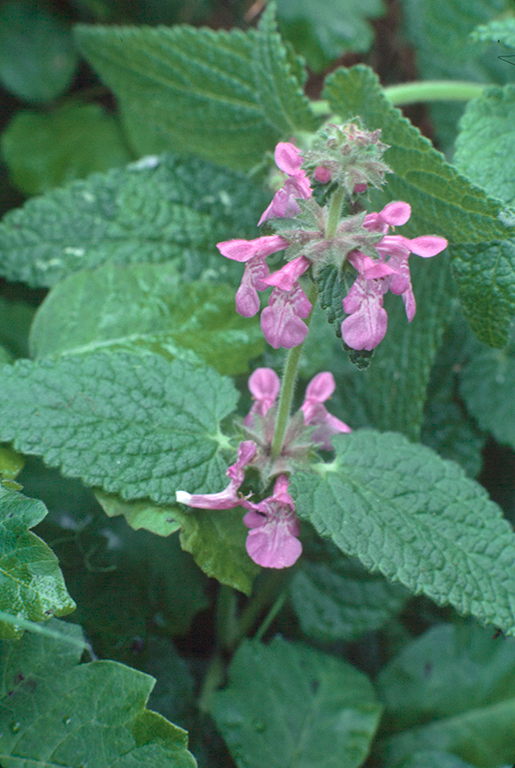
Walker Wilson, who brought this plant into the meeting, has a nursery in Fallbrook where you can purchase this and many other native plants. For information visit www.walkerswildlands.com. From www.calscape.org: “California Hedgenettle (Stachys bullata) is a perennial evergreen herb in the Mint family. California Hedgenettle is a delicate, attractive flowering plant that performs well in damp, partially shaded areas. It tends to grow in wet, swampy, boggy places, at elevations from sea level to 1,600 feet. The leaves are deep green and tongue-shaped. Two-lipped purple or pink flowers bloom on stalks spring through summer. Throughout the rest of the year, the plant forms a bushy, spreading groundcover. Like most wetland plants, it spreads to occupy suitably damp land but is easily controlled. California Hedgenettle thrives in partially shaded areas and will tolerate clay soils. While not drought adapted, this plant is a good choice for bioswales, pond margins, and similar areas where a showy, flowering plant may be desired. California Hedgenettle attracts hummingbirds, butterflies and other insects. Despite its common name, it does not form a hedge nor sting like true nettles.” This perennial grows about 1-3 feet tall should thrive given the right conditions in most of San Diego County.
(Walker Wilson, Fallbrook, 8/26) – S.T-B.
Viguiera laciniata (syn. Bahiopsis laciniata) SAN DIEGO SUNFLOWER, SAN DIEGO MARGUERITE, SAN DIEGO COUNTY VIGUIERA
(Asteraceae) San Diego to Ventura County, Sonora and Baja Mexico

Walker Wilson, who brought this plant into the meeting, has a nursery in Fallbrook where you can purchase this and many other native plants. For information visit www.walkerswildlands.com. From www.calscape.org: “Native to coastal Southern California, San Diego county viguiera (Bahiopsis laciniata) adds a bright splash of yellow to the waterwise landscape. This evergreen shrub is a member of the Aster family. It is sometimes called the San Diego sunflower or tornleaf goldeneye.The sunflower-like blooms cover the plant from winter to summer. The small, toothed leaves are a vibrant, shiny green. San Diego county viguiera is a hardy, fast-growing shrub. It is easy to grow and does well in sandy, well-draining soil with minimal watering. San Diego county viguiera’s cheerful blooms attract butterflies, bees, and hummingbirds to the garden. The plant provides cover for wildlife. After blooming, the spent flowers can be deadheaded or left for birds. Prune in the fall after flowering.This plant does well on dry slopes. Plant in clusters to form a hedge or combine with other colorful, low-water perennials for visual interest.” The plant grows 2-3’ tall and 3-4’ wide, with a mounding form and fast growth rate.
(Walker Wilson, Fallbrook, 8/26) – S.T-B.

