
PLANT FORUM: At The April 2026 Meeting
By Susi Torre-Bueno, for Let’s Talk Plants! May 2026.

For over two decades a meeting highlight was the Plant Forum, where a horticultural expert spoke about plants brought in by members. These descriptions appeared in the newsletter and are available free to the public on our website at https://sdhort.org/PlantForum. This is an alphabetical listing of the over 7500 plants which were displayed at meetings, including over 1600 detailed descriptions. Check it out when thinking about plants to add to your garden, and feel free to share this link with your friends.
After a few years on hiatus the Plant Forum is back, and we encourage all members to share some plants at the meetings. I can guarantee there will be members who will have not grown, and might not have ever seen, at least one plant from your garden.
All you have to do is:
1) Bring a cutting or potted plant to a meeting.
2) BEFORE you leave home, take a minute to fill out a slip of paper with the common and scientific name of the plant, where it is native to (if you know that), what city it is growing in, your name, and a couple of sentences about your experience with the plant.
Although I’m no expert I will do my best to talk about the plants I’m familiar with and will get help from other attendees. At the end of the meeting, we will gather up the printed information and include it in the next newsletter. If you have any questions, contact Susi Torre-Bueno at storrebueno@cox.net.
I want to thank the members who bring in plants for the Plant Forum and then donate these cuttings for other members to take home.
Abutilon palmeri INDIAN MALLOW
See August 2025 newsletter and the SDHS Plant Forum Compilation https://sdhort.org/PlantForum.
(Anne Murphy, Vista, 4/26)

Callisia fragrans BASKET PLANT
(Commelinaceae) Central Mexico south to Colombia

From the San Marcos Growers website:
“A low growing perennial with 6- to 10-inch-long waxy green leaves arranged alternately with the bases overlapping so tightly that they appear to be in rosettes. The leaves have a slight purplish color underneath and on the upper margins when in bright light. Trailing stems grow out over the ground or upward with support. When in bloom in summer months the small, white fragrant flowers arranged in clusters of three in terminal panicles rise up on 2-foot-tall spikes. Best planted in well-drained soil that is regularly irrigated in part sun to shade (purple color best with more light). Flourishes in warm subtropical climates but can tolerate a mild frost in the cooler winters of coastal California. Makes a good groundcover in mild climates and is good in a hanging basket. In bright light it lays flat and takes on the look of a cluster of bromeliads but when in deeper shade it grows upright and more closely resembles a small Dracaena. Callisia fragrans comes from central Mexico south to Columbia and it has naturalized in many subtropical areas where it is considered to be a garden weed and there often referred to as Inch Plant for the tendency to inch out on its stems, which root on contact with moist soil. This spreading nature has led some to also call it Octopus Plant.”
In my garden this plant does well in part sun with low watering about every 2 weeks, and I grow it for the foliage rather than for the flowers.
(Susi Torre-Bueno, Vista, 4/26) – S.T-B.
Calothamnus villosus SILKY NET BUSH, WOOLLY NET BUSH
(Myrtaceae) Australia

This unusual evergreen shrub from the south-western part of western Australia has foliage reminiscent of pine needles, and grows to about 4-6’ tall and 6-8’ wide. The new foliage has a red tinge, and mature leaves are green. It has unusual 1”-long red flowers (reminiscent of bottlebrush blooms) with very long stamens, which are borne from winter to early summer; they arise directly from the woody stems, and attract ants in my garden. Grow it in full sun to part shade; drought-tolerant once established. According to the website for Australian Native Plants (australianplants.com), this species is grown commercially for the cut foliage.
(Susi Torre-Bueno, Vista, 4/26) – S.T-B.
Clarkia sp. (probably C. unguiculata) ELEGANT CLARKIA
(Onagraceae) California

From the SDHS Plant Forum Compilation (https://sdhort.org/PlantForum) - Description by Susi Torre-Bueno:
“A beautiful native annual with 1-2” wide late spring and early summer flowers in various shades of white to dark pink. It is native to San Diego County (and elsewhere), and can get over 3’ tall and wide in a good location. One of the best reference books on our native flora, California Native Plants for the Garden, notes that, ‘The blossoms are well spaced along the stems and are produced over a long period of time. Individual petals have a long, stalk-like base and give the flowers a spidery appearance.’ A long-lasting cut flower, too! Will reseed in the garden, so site it carefully. According to the on-line catalog for J. L. Hudson, Seedsman (www.jlhudsonseeds.net), ‘The parched, ground seeds were eaten with acorn mush.’”
(Anne Murphy, Vista, 4/26) – S.T-B.
Corpuscularia lehmannii (= Delosperma lehmannii)
Aizoaceae, South Africa

From the San Marcus Growers website:
“A cushion groundcover succulent that grows 4 to 6 inches tall and spreads to 1 to 2 feet wide with thick 3 angled 1-1/2 inch long grey-green leaves arranged in tight opposite pairs. From late spring until to fall appear the 1-1/2-inch-wide yellow daisy-like flowers that are darkest toward the middle with shorter petal and nearly at tips of the longer petals along the edges. Plant in full sun to light shade in a well-drained soil and irrigate occasionally in the warm months - though this plant can handle going through a dry summer it comes from summer moist East South Africa and looks its best with some irrigation. Has proven hardy to at least 25° F. Makes a very attractive and unusual small area ground cover, rockery or container plant. This plant is endemic to an area between Coega and Port Elizabeth in Eastern Cape, South Africa where it grows naturally on quartzite outcrops and crevices of rocks in association with the xeric shrubs and grasses found in the Karoo. This area is threatened by loss of habitat and habitat degradation with two thirds of the known habitats gone, mostly due to the urban expansion of Port Elizabeth.”
(Laura McCullough, Alpine, 4/26) – S.T-B.
Dudleya edulis EDIBLE DUDLEYA
(Crassulaceae) San Diego to Baja, California

From the SDHS Plant Forum Compilation (https://sdhort.org/PlantForum) - Description by Joyce & Michael Buckner:
“This beautiful and easy to grow succulent is commonly found growing on banks and cliffs along the coast, sometimes in pure sand. It has pencil-shaped chalky leaves which turns brilliant read in full sun and white flowers in mid- to late spring. A few populations have intragressed with Dudleya viscida and may have pink to reddish flowers, but this is uncommon. Native peoples used it as a water source. It should be hand-watered to keep the dusty, felty surface intact. Rare in cultivation, the specimen displayed had multiple branches on single stems.”
(Anne Hines, Vista, 4/26) – M. & J. B.
Eriogonum fasciculatum CALIFORNIA BUCKWHEAT, FLATTOP BUCKWHEAT
(Polygonaceae) Arizona; California; Utah; Baja California

See the SDHS Plant Forum Compilation (https://sdhort.org/PlantForum). For the specimen displayed 4/26, Pat Palowski adds:
“Native to Vista and Bonsall in San Diego County. I planted this, but there were a few plants already on the property.”
(Pat Pawlowski, Vista, 4/26) – P.P.
Gaura lindheimeri ‘Siskiyou Pink’ GAURA
(Onagraceae) Hybrid
An attractive clump forming perennial hosting pink 1" long flowers along tall loosely branched slender stems appearing as pink butterflies floating in the wind. Its long bloom season from spring to fall make it especially appealing. The white flowering species, Gaura lindheimeri, had gained the reputation as being weedy, yet when hybrid G. 'Siskiyou Pink' was introduced some years ago it gave it new meaning, regaining its reputation as a valuable addition to a perennial garden. Had Gaura been pruned properly, sheering it back to at least half after flowering, it never would have developed a bad rap. Its ability to send a deep tap root makes it one of the best choices for a drought tolerant planting. Gaura is also very heat tolerant, being native to Texas and Louisiana. Average growth is from 3' to 4' and as wide, preferring well drained amended soils in full sun. Sunset zones 2-24.
(Susi Torre-Bueno, Vista, 4/26) – S.T-B.
Leucophyllum frutescens ‘Green Cloud’ GREEN CLOUD TEXAS RANGER

From T-Y Nursery website:
“Evergreen shrubs that thrive in soaring temperatures, feature colorful blooms and are tolerant to most pests are hard find. ‘Green Cloud’ Texas sage has all of these features, plus makes a wonderful focal point, hedge or foundation shrub in water-wise landscapes. Green foliage complements the one-inch magenta flowers that appear en masse just before a rainfall or when humidity is high. Because ‘Green Cloud’ can grow to full size in just two to three seasons, it makes an excellent specimen for commercial and public spaces looking to grow an established landscape quickly. In warm climates, it retains all of its foliage. In milder climates, expect up to 50% of foliage to drop in winter. While it does tolerate periods of drought very well, when given supplemental moisture through summer, foliage will grow more dense and flower more often. Plant in full sun for best growth habit. ‘Green Cloud’ is prone to root rot if planted in compacted soils. Amend beds with organic matter and expanded shale to improve drainage. Live in areas with high heat? ’Green Cloud’ Texas Sage is a standout specimen that thrives in extreme conditions.”
(Susi Torre-Bueno, Vista, 4/26) – S.T-B.
Melianthus major HONEYBUSH
(Melianthaceae) S. Africa

See the SDHS Plant Forum Compilation (https://sdhort.org/PlantForum); description by Steve Brigham & Tom Piergrossi:
“A South African suckering perennial shrub discovered in 1688, grown for its striking foliage. An imposing and very architectural shrub to 8–10 feet tall, with large silvery-gray divided leaves along upright stems. The foliage is strongly scented and toothed with winged stalks. Terminal flower spikes of brownish-red flowers arch like plumes to 1–1½ feet above the foliage. It flowers in late summer after which it produces four-celled flat capped seeds valuable in flower arranging. Easily grown in poor soil, sun or part shade, and quite drought tolerant. It has a habit of holding on to old brown foliage and if in a focal point needs to be cleaned up regularly. Evergreen in mild climates; will freeze to the ground and resprout from the roots after heavy frost. Another species, M. minor, has smaller foliage and is less hardy. Both can be produced by seeds, cuttings, as well as clump division.”
(Anne Murphy, Vista, 4/26) —S.B. & T.P.
Mimulus aurantiacus (light yellow-flowered form) BUSH MONKEY FLOWER
(Scrophulairiaceae) California, Oregon

From the SDHS Plant Forum Compilation (https://sdhort.org/PlantForum) - Description by Tom Piergrossi:
“One of our California natives, often seen growing on the sides of roads, these tough little perennial plants are very drought tolerant and grow in heavy soil, but need good drainage. They are relatively short-lived, but can be reproduced from cuttings. This light-yellow color selection I found along a road cut in Encinitas. The flowers are snapdragon-like and produced freely all summer. There are hybrids with large flowers and a wide color range sometimes available at native plant nurseries, and although I’ve had more success with the smaller flowered types, I would try them again. Part shade inland would be advised; some water extends bloom. Most don’t grow more than a couple of feet tall and wide.”
(Susi Torre-Bueno, Vista, 4/26) – T.P.
Nigella damascena cv. LOVE-IN-A-MIST
(Ranunculaceae) S Europe, N Africa

From the SDHS Plant Forum Compilation (https://sdhort.org/PlantForum) - Description by Susi Torre-Bueno:
“At first glance it is hard to believe that this wispy blue flower is related to the shiny yellow buttercups we used to gather when we were children, but the Ranunculaceae family does include widely different looking genera such as Aconitum (Monkshood), Anemone, Clematis, Delphinium and Consolida (Larkspur). Nigella has been cultivated for hundreds of years, and N. sativa is used in many cultures both as a food (the seeds are known as black cumin) and an herbal remedy. Love-in-a-Mist is a wonderfully descriptive name for this charming annual, which cradles its short-lived flowers within a lacy nest of thread-like green leaves. The late spring and early summer borne flowers may be blue, pink or white, and many named cultivars are sold, some as short as 8 inches and others rising to about 18 inches tall. The plants are extremely easy to grow from seed sown in place, and will self-seed readily. The inflated, papery seed pods are good in flower arrangements.”
(Anne Murphy, Vista, 4/26) —S.T-B.
Pelargonium x domesticum Martha Washington type GERANIUM

From Missouri Botanical Garden website:
“Pelargonium × domesticum, known as regal or Martha Washington geraniums, are a loose grouping of hybrid geraniums involving P. grandiflorum and P. cucullatum. They typically grow to 3’ tall on somewhat woody stems and feature rounded heart-shaped to kidney-shaped medium green leaves that have irregular teeth and crinkled margins. Showy flowers in shades of pink, purple, lavender and red, often speckled with interesting markings and splotches, are borne in clusters (umbels).”
(Susi Torre-Bueno, Vista, 4/26)
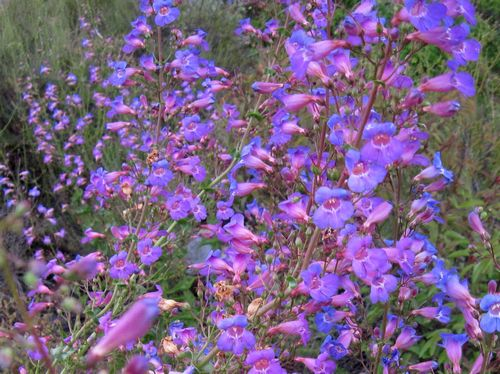
Penstemon spectabilis ROYAL BEARD TONGUE
(Scrophulariaceae) So. California, Baja California (Mexico)
From Calscape (https://calscape.org):
“Showy penstemon (Penstemon spectabilis) lives up to its name, being the showiest of the penstemons. It grows fast, reaching 2 to 4 feet tall and 3 to 4 feet wide. This perennial bears spectacular wide-mouthed, tubular violet or purple-blue flowers from its first year on. In good conditions it may flower late winter into summer. Showy penstemon is beautiful and easy to grow. It likes full sun and tolerates a variety of soils, including clay. If planted in an area that holds water better, it usually doesn't need supplementary summer water. The plant will flower more abundantly with occasional summer water (once per month) but may be shorter lived. It is fairly short lived even under the best of circumstances, typically lasting 5 to 10 years. However, it often self-seeds. This deer-resistant plant is great for wildlife, attracting a variety of native bees and hummingbirds for nectar. It is a larval host for a likely total of 13 butterfly and moth species.”
(Anne Murphy, Vista, 7/25 & 4/26) – S.T-B.
Salvia ‘Love Child’ Salvia leucophylla x S. clevelandii
(Lamiaceae [Labiatae)]) Garden Hybrid

From Calscape website:
“Salvia hybrid. We consider the fragrance of Cleveland sage leaves and the fragrance of orange blossoms to be part of the essence of California. The Somis hills are home to Salvia leucophylla, which has beautiful 8 ft. tall silvery foliage setting off bright pink blooms, but the foliage fragrance is not exciting. Thankfully a bee arranged a tryst between the two sages in our garden. The resulting 'Love Child' is a great garden plant 2-3 ft. tall by 3 ft. wide with the unmistakable fragrance of Cleveland sage and the pink flowers of Salvia leucophylla. This plant was introduced by John Schoustra of Greenwood Gardens.”
(Susi Torre-Bueno, Vista, 4/26) – S.T-B.
Salvia canariensis CANARY ISLAND SAGE
(Lamiaceae) Canary Islands

One of the larger sages, this shrub can easily reach 6 feet tall and at least as wide. This plant can get by on little water (once established) in full sun; it needs good drainage. The grey felty leaves borne on white stems are attractive all year, and the violet and purple spring through fall blooms are a striking contrast. Some nice specimens may be seen in the Canary Island garden section (near the gift shop) at the San Diego Botanic Garden.
(Susi Torre-Bueno, Vista, 4/26) – S.T-B.
Salvia clevelandii CLEVELAND SAGE
(Lamiaceae) S. Calif., Baja Calif.

From the SDHS Plant Forum Compilation (https://sdhort.org/PlantForum) - Description by Tom Piergrossi:
“One of our native sages, very popular and with good reason. It’s drought tolerant, needs little care, blooms heavily in spring and summer with light blue flowers, and has very aromatic foliage in the most subtle gray-green. It grows to about 4 feet tall and wide, requires full sun and good drainage and while it will look great even with no summer water it also tolerates being grown in a mixed garden. I prune mine back about a third in the summer to keep it neat. Eventually the plant can get old and woody and needs to be replaced, but young replacements grow quickly and can be grown from cuttings. Many named varieties exist as do hybrids. ‘Winifred Gilman’ is one of my favorites, blooming a little later with violet blue flowers and with a little greener foliage.”
Pat Pawlowski showed this plant 4/26 and noted:
“Hummingbirds! Bees! Butterflies! Seeds for birds! Shelter!”
(Pat Pawlowski, Vista, 4/26) —T.P
Salvia clevelandii ‘Pozo Blue’ GREY MUSK SAGE
(Lamiaceae [Labiatae)]) Garden Hybrid
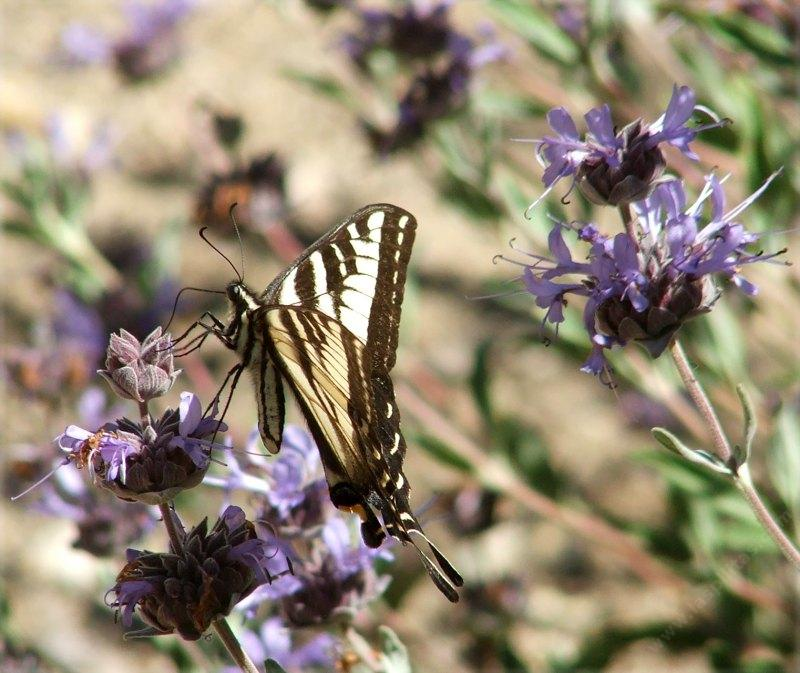
If you’re looking for an attractive, evergreen, drought-tolerant, low-maintenance perennial with light violet-blue flowers – this could just be it! It doesn’t mind clay soil and even tolerates seaside conditions. Salvia ‘Pozo Blue’ grows to about 3ʹ′ tall and wide and bears flowers from spring to summer (or longer). The gray-green foliage has a strong pleasantly herbal scent. If you live in cool parts of our county take heart – this sage tolerates temperatures down to 5°F. The plant does best in well-drained soil in full sun and good air circulation. Once established it needs only occasional watering.
Las Pilitas nursery (where this plant first appeared) notes that:
“This is THE NATIVE BUTTERFLY BUSH. We’ve seen about thirty species of butterflies and a lot of hummingbirds working the flowers.”
(Susi Torre-Bueno, Vista, 4/26) – S.T-B.
Solanum muricatum PEPINO, PEPINO DULCE
(Solanaceae) South America

From Wikipedia:
“Solanum muricatum is a species of evergreen shrub native to South America and grown for its sweet edible fruit. It is known as pepino dulce (‘sweet cucumber’) in English, in order to differentiate it from cucumber (which is also called ‘pepino’ in Spanish) or simply pepino. The pepino dulce fruit resembles a melon (Cucumis melo) in color, and its flavor recalls a succulent mixture of honeydew and cucumber, and thus it is also sometimes called pepino melon or melon pear. Another common name, tree melon, is more often used for the papaya (Carica papaya) though the pepino dulce plant generally does not look much like a tree; it looks more like a ground cover, trailing plant. The present species is, however, a close relative of other nightshades cultivated for their fruit, including the tomato (S. lycopersicum) and the eggplant/aubergine (S. melongena), which its own fruit closely resembles. The fruit is common in markets in Colombia, Chile, Bolivia, Peru and Kenya, but less often overseas because it is quite sensitive to handling and does not travel well…The pepino dulce is presumed to be native to the temperate Andean regions of Colombia, Peru and Chile though it is not known in the wild and the details of its domestication are unknown… In the United States the fruit is known to have been grown in San Diego before 1889 and in Santa Barbara by 1897.”
(Sue Mansour, Rancho Bernardo, 4/26) – S.T-B.
Sphaeralcea ambigua APRICOT MALLOW, DESERT HOLLYHOCK
(Malvaceae) Baja California to Utah

From the SDHS Plant Forum Compilation (https://sdhort.org/PlantForum) - Description Susi Torre-Bueno:
“Apricot Mallow is a 2’ evergreen perennial with many 1” orange flowers on a 2-3’ spike with gray, almost fuzzy foliage which tolerates full sun, alkaline soil, sand, and clay. Flower spikes can occur most of the year. Apricot Mallow needs sun and good air flow. It grows throughout the deserts from Baja California to Utah. There are pinkish forms around Mojave, sometimes growing into the pine forest, sometimes into oak woodland, often into juniper woodland. San Diego Desert Mallow looks like a five-foot Fremontia with flowers on it all the time. It seems to be stable as long as the rainfall is between 5-20", sun and air flow. Cut flowers are great for bouquets. [Description adapted from www.laspilitas.com.]”
(Anne Murphy, Vista, 4/26) – S.T-B.
Tradescantia zebrina SILVER INCH PLANT, WANDERING DUDE
(Commelinaceae) Mexico, Central America, and Colombia, Caribbean islands

From Wikipedia:
“Tradescantia zebrina, formerly known as Zebrina pendula, is a species of creeping plant in the Tradescantia genus. Common names include silver inch plant and wandering Jew. The latter name is controversial, and some now use the alternative wandering dude. The plant is popular in cultivation due to its fast growth and attractive foliage. It is used as a groundcover in warm winter climates, and as a houseplant elsewhere. Tradescantia zebrina has attractive zebra-patterned leaves, the upper surface showing purple new growth and green older growth parallel to the central axis, as well as two broad silver-colored stripes on the outer edges, with the lower leaf surface presenting a deep uniform magenta. The leaves are bluish green and usually have two longitudinal stripes that are silvery on the surface and purple on the underside. When chronically exposed to long periods of intense sunlight, the variegation fades and the leaf becomes purple throughout. The leaf sheaths are thin and translucent, 8 to 12 mm long and 5 to 8 mm wide, at the mouth they are long, otherwise glabrous or slightly hairy. The low-lying, slightly succulent, perennial, herbaceous plant often forms dense mats or colonies. This is done primarily by natural formation of taproots. On the nodules of the shoot are root approaches, from which roots develop in permanent contact with water or a sufficiently moist substrate under favorable conditions within a day. The shoots are glabrous or hairy. The stalked, parallel-veined leaves are mostly ovate, 4 to10 cm long and 1.5 to 3 cm wide, pointed towards the tip, rounded to the base. The upper surface is glabrous to mildly hairy, the underside hairless to averagely hairy, ciliate towards the leaf base. The structure of the flower—usually from the three pink petals and the white sexual organs—is similar to that of the other Tradescantia, but unlike what happens in those, the plant branches off thanks to new buds whose attachment starts below that of the leaf (and not above).”
(?, 4/26) – S.T-B.

