
PERMACULTURE: Blue Oyster Mushrooms - A Powerhouse Worker
Updated: Aug 2, 2025
By Mary 'Klibs' Dralle, for Let's Talk Plants! August 2025.

Blue Oyster Mushrooms. Photo credit: https://oneplanetlife.com/people-and-planet-first/protect-the-planet/blue-oyster-mushrooms
Blue Oyster Mushrooms - A Permaculture Powerhouse Worker
While I have known that fungus is amazing and works hard in our world, in my PDC class, I came to a full understanding of how much they do. While studying the foremost authority on fungus, Dr. Paul Stamets, CEO of Fungi Perfecti in Olympia, Washington, we delved into the mycoremediation properties of Mycelium. Mycoremediation is a form of bioremediation that uses fungi to clean up contaminated soil or water and it went a little bit like this.
When I say World Wide Web, I am not referring to computers but the mycelium that runs in the soil all around our world. Mycelium is the fungi’s root system. The underground web-like white threads are called hyphae. They connect to one another in soil and other moisture-rich environments such as rotting tree trunks. They communicate the needs of the host plant in search of nutrients and such. This is the biggest part of the fungus. When the time is right for reproduction, they send up the fruiting bodies that we see all around us and call mushrooms.

Mycelium are one of nature’s most resilient living organisms because they are fire-resistant and water-retardant.
Mycelium are classified into four main feeding types:
Saprotrophic (aka decomposers) - obtain nutrients by absorbing them from dead or decaying organic matter. Examples are oyster mushrooms, shiitake mushrooms, and common button mushrooms.
Mycorrhizal - fungi that form a symbiotic relationship with plant roots, essentially extending the plant's root system into the soil. Such as truffles, chanterelles, porcini, and morels.
Parasitic - living in or on other living organisms (hosts), causing harm to the host in the process. These include Hericium erinaceus (Lion's Mane); Trichophyton, which causes skin infections like ringworm and athlete's foot; and Armillaria (honey mushroom);. Amazingly, the honey mushroom, is the largest living organism on our planet. Located in the Malheur National Forest, it is a single, interconnected organism that covers approximately 2,385 acres, or roughly 3.7 square miles.

Map of Honey Mushroom in Malheur National Forest. Photo credit: https://www.usda.gov/about-usda/news/blog/fungus-among-us-author-names-oregons-humongous-fungus-one-grossest-places-earth.
And lastly, Endophytic - these live inside plant tissues, such as leaves, stems, and roots, without causing disease. There are nine different fungi, Alternaria species, Cladosporium species, Fusarium oxysporum, Fusarium species, Penicillium chrysogenum, Penicillium olsonii, Penicillium species, Sarocladium species and Sarocladium strictum. The most used of these is Penicillium chrysogenum because it is used to manufacture penicillin, and its derivatives, on large scale as an antibiotic.
This article will focus on the Blue Oyster Mushroom because they are amazing tools used to clean our environmental via remediation. On a "small" scale, they are used to clean soil in a garden or on a farm. On a grander scale, the fungi are employed to regenerate land after environmental disasters such as wildfires and offshore oil spills have occurred.
Blue oyster mushrooms, in particular, are known for their ability to degrade hydrocarbons (like oil and diesel) and heavy metals. Mycoremediation, uses the fungi's natural process to break down organic and inorganic pollutants with their enzymes. After all, those hydrocarbons are the ancient plant material that have been compressed over a millennia to produce crude oil that we use to make those plastics!
There are two methods to inoculate and clean up a contaminated area. First one, straw wattles on the boundaries to clean up any water runoff. It was Dr. Paul Stamets who, in the late 1980s used the inoculated straw wattle method, with Stropharia rugoso-annulata, to clean up the runoff water around his homestead in Oregon. The county authorities were so impressed with his method they encouraged others to follow suit. Dr. Stamets submitted a patent for it, as well.

A line of mycelium-and-substrate-filled bags in Mason County, Washington. Photo credit: https://fungi.com/blogs/articles/mycofiltration-enters-the-commons
Second, direct inoculation as to purify the areas inside the wattles. In this video link, plugs are made with sawdust and fungi spores then inserted into logs. Example of the process can be viewed in this video on YouTube: Researchers plant mushrooms to clean post-wildfire soil
With either method, it is important to note that weather conditions need to be taken into consideration. Fungi like a moist and warm environment rather than a dry and hot one in order to properly grow and clean the soil.
Another use of fungi in forests maintenance is using it to clear up wood as sighted in this video on YouTube: Cold Fire: Ally With Fungi - FUNGAL DEGRADATION FIRE MITIGATION
If there is an area in your garden that may need cleaning up such as because the former owner used it to change the oil in vehicles, rather than remove and replace the soil, try Mycoremediation. First, purchase Blue Oyster Grain Spawn. It can be done online from many vendors. Next, you will want to obtain a bale of straw from your local feed store and a tarp or two, from a big box store, that will cover the area.
For growing Blue Oyster mushrooms on straw, a common and recommended spawn to straw ratio is 1:10 to 1:20, meaning one part spawn to 10 to 20 parts straw by weight. A bale of straw typically weighs around 40 to 50 pounds and can cover an area between 500 and 1000 square feet depending on the thickness. A 3-5 inch layer is recommended for effective mushroom growing.
Let's say the area in question is 20 x 20 feet, that is approximately 400 square feet. It will require 2-3 lbs. of mushroom spawn and a large portion of a bale of straw.
Mycoremediation steps:
1. Remove the 'weeds' growing in the area. A lawn mower, weed wacker or scythe work well.
2. Next, water down to soil to make it moist. Place a 3-5 inch thick layer of straw on top of the soil.
3. Distribute about half of the acquired grain spawn, 2-4 lbs., over the straw.
4. Add another 3-5 inch thick layer of straw on top.
5. Finish up with the second half of acquired grain spawn.
6. Water the area again and cover with the tarp.
7. Cut a few holes in the tarp so that oxygen will be available to the fungus.
8. Over the course of the next two months, periodically pull the tarp back and check on the Mycelium growth.
9. Ensure that the straw is moist but not wet. Add water when necessary.
10. At first, the Mycelium, the white webbing, will establish throughout the straw.
11. As time goes on, the mushrooms will start to pin. This is the initial stage of fruiting body formation.
12. Continue to let them grow to maturity and when they dry out, remove all of them and send them to a household hazardous facility. THESE ARE NOT TO BE CONSUMED BY HUMANS OR ANIMALS.
13. Analyze the soil to ensure it is clean. This may involve sending it to a soil test lab in your area to be sure the soil is clean of any hydrocarbons.
14. Repeat the process until test results come back clean.
Edible Blue Oyster Mushrooms
Now that we have discussed the Mycoremediation capabilities of Blue Oyster Mushrooms, let's talk about growing edibles ones.
They can be grown in a garden bed and the process would be the same as described above. Another way is using a bucket with holes or bag with slits. The difference in the bucket/bag method is that they require boiling the straw before using it. This reduces the number of competing organisms giving the mushroom mycelium a competitive advantage to colonize the substrate as it is "closed" environment. When done in an "open" environment like the garden bed, the concern is not as high as the yield may be lower.
As a member of the San Diego Mycological Society, I attended a presentation hosted by Sam Andrasko and Eric Muller many years ago and have been growing mushrooms off and on since 2015. SDMS has a very detailed video on YouTube, Fungus Fair 2021 - Mushroom Cultivation Demonstration with Sam Andrasko. that goes into great detail. Another video that can be viewed is, Grow Mushrooms at Home In A 5 Gallon Bucket. While I do have the buckets and such, I decided to save a bit of time and purchase a kit from Eric Muller at Muller's Mushrooms, at the Vista and Oceanside Farmers Markets. They are available online at muellersmushroom.com.

Mushroom Grow Buckets (Repurposed cake frosting buckets from the grocery store). Photo credit: Mary Dralle.

Mushroom Grow Cabinet (Free cabinet found on roadside given a special purpose). Photo credit: Mary Dralle.

Mullers Mushroom Banner, Vista Farmers Market. Photo credit: Mary Dralle.

Oyster Mushroom Kit purchased on May 24, 2025, Vista Farmers Market. Photo credit: Mary Dralle.

Lion's Mane Mushroom Kit purchased on May 24, 2025, Vista Farmers Market. Photo credit: Mary Dralle.

First Fruits, June 2, 2025. Photo credit: Mary Dralle.

Ready for Harvest, June 15, 2025. Photo credit: Mary Dralle.
Spinach Pasta Mushroom Arugula Alfredo
Ingredients:
2-3 tablespoons Extra Virgin Olive Oil
1 lb. of Blue Oyster and Lion's Main Mushrooms, diced into bite sized pieces
1 red onion, diced
3-4 serrano peppers, deseeded and diced
3-4 cloves of garlic, diced
salt and pepper to taste
1 lb. of cooked spinach pasta, reserve a cup or so of the pasta water
1 qt. of arugula
~1/2 cup of Greek Yogurt
2 oz. of shaved parmesan cheese
6-8 society garlic flowers, left whole
Directions:
Add oil to a hot skillet over medium high heat.
Add mushrooms, serranos, onion, garlic, salt and pepper to taste.
Sauté until mushroom edges are golden brown.
Divide the mushrooms in half and reserve half for the next recipe.
Add in arugula and stir until just wilted. Use reserved pasta water if a bit of steam is required.
Remove from heat.
Toss in the Greek Yogurt and hot pasta.
Mix until yogurt is incorporated.
Plate the Alfredo and top with shaved Parmesan and society garlic flowers.

A basket full of delicious dinner items, June 15, 2025. Photo credit: Mary Dralle.
Fresh from my garden, serrano peppers and garlic, a bit of olive oil into the hot skillet so food does not stick, sautéed mushrooms with garlic and peppers, mushrooms divided and tossed together with pasta, a bit of Greek yogurt and arugula, and fresh from my garden, society garlic flowers, June 15, 2025. Photos credit: Mary Dralle.
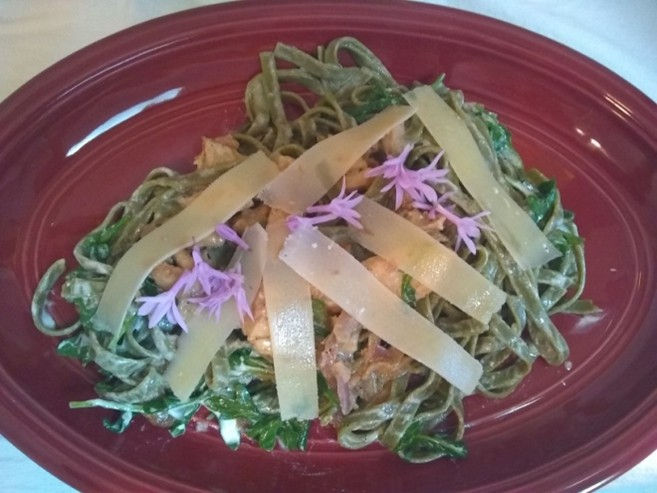
Spinach Pasta Mushroom Arugula Alfredo, June 15, 2025. Photo credit: Mary Dralle
Corn Tortilla Mushroom Quesadillas with Roasted Corn Tomato Salsa with Avocado
Roasted Corn Tomato Salsa with Avocado
Ingredients:
1-2 tablespoons Extra Virgin Olive Oil
1 pint of cherry tomatoes,
1 cup of corn, fresh cut from the cob or frozen
3-4 serrano peppers, deseeded and diced
1/2 red onion, diced
1-2 cloves of garlic
salt and pepper to taste
1 avocado, diced
Directions:
Combine ingredients, except the avocado, for the Roasted Corn Tomato Salsa.
Dry roast at 400 degrees F. for 30 minutes.
Remove from oven, place in a bowl and toss with avocado. Set aside.
Corn Tortilla Mushroom Quesadillas
To the reserved mushrooms from the recipe above, add...
Ingredients:
Chile Rub Mix: 1 teaspoon each chili powder, paprika, and cumin
4 Corn Tortillas
1 oz of grated Monterey Jack Cheese
Directions:
In a skillet over medium heat, warm tortillas until soft and playable.
Top with 2-3 spoonfuls of the seasoned mushrooms and cheese.
Place tortilla on top.
Heat both sided of the quesadilla by turning it often until cheese has melted and tortilla has a bit of color.
Plate quesadilla on platter and serve with salsa.
Second divided half of sautéed mushrooms with Chile Rub. Mushroom Filling on Corn Tortillas. Add some cheese to make quesadillas. Mushroom Corn Quesadillas plated for eating. Photos credit: Mary Dralle.
I hope that this article inspires you to have a good time with a really fun guy, Blue Oyster Mushroom!
Until next time, keep those hands soiled,
~ Mary 'Klibs' Dralle

Certified Permaculture Designer, The Dancing Raven Ranch & Retreat Center
Chef, Cookin' with Klibs Presents the Chemistry of Cooking,
Labyrinth Coordinator/Builder, The Wander-Full Labyrinth Walkers
Follow me on Facebook, LinkedIn & Meetup