
MY LIFE WITH PLANTS: Things Go Boom
Words and pictures by Jim Bishop, for Let's Talk Plants! March 2026.
Well, at least I think they went boom. I was asleep when all of the action took place.
Following a very long, hot, and dry summer, we experienced an unusually wet fall and early winter. It seems we're experiencing a bit of a weather yo-yo pattern. 2023 was among the wettest winters on record, featuring a rainstorm that delivered more than 6 inches in just 24 hours. This is the most rain I've ever seen here in such a short period.

After that season, we encountered one of the longest recorded dry spells in San Diego, with no significant rain from late April until late January.
This year's rainy season began earlier than usual, with rainfall in September, another event in early October, and significant precipitation in November. This was followed by even more rain in late December and into early 2026. Since then, there hasn't been any rain. Most of this precipitation has been relatively warm, generated by abundant moisture from the tropics. I recall that in the 1980s, this was referred to as the Pineapple Express, but meteorologists now commonly call it an Atmospheric River. Hopefully, more rain will arrive before the rainy season concludes.
Rain totals by date of above photos:
September 21 - 0.75 of an inch
October 14 - 1 inch
November 15 - 1.125 inches
November 18 - 1.75 inches
November 21 - 1.375 inches
December 25 - 1.125 inches
December 27 - 0. 875 inches
And the big New Year's day rain total January 2 - 4.75 inches
This brings our total to 12.75 inches on our hillside for this rainy season so far.
However, between the rains on November 16, while hiking the relatively new coastal trail at Cabrillo National Monument, we observed several waterspouts, including one that moved into San Diego Bay:

First Storm Damage
Euphorbia lactea
The initial storm damage we observed happened overnight on December 23, when the large potted Euphorbia lactea in front of the house was knocked over by the wind storm. The strong winds primarily blew from the south before the storm that arrived in the afternoon of December 24.
It may have been top-heavy and somewhat likely to topple because we reduce watering the pot when the weather cools. This euphorbia doesn't tolerate wet roots in cold conditions and is susceptible to rotting in winter. The only dry and warm location where I've successfully grown it is in the front of the house, exposed to full winter sun and sheltered under the house eaves to keep it dry.
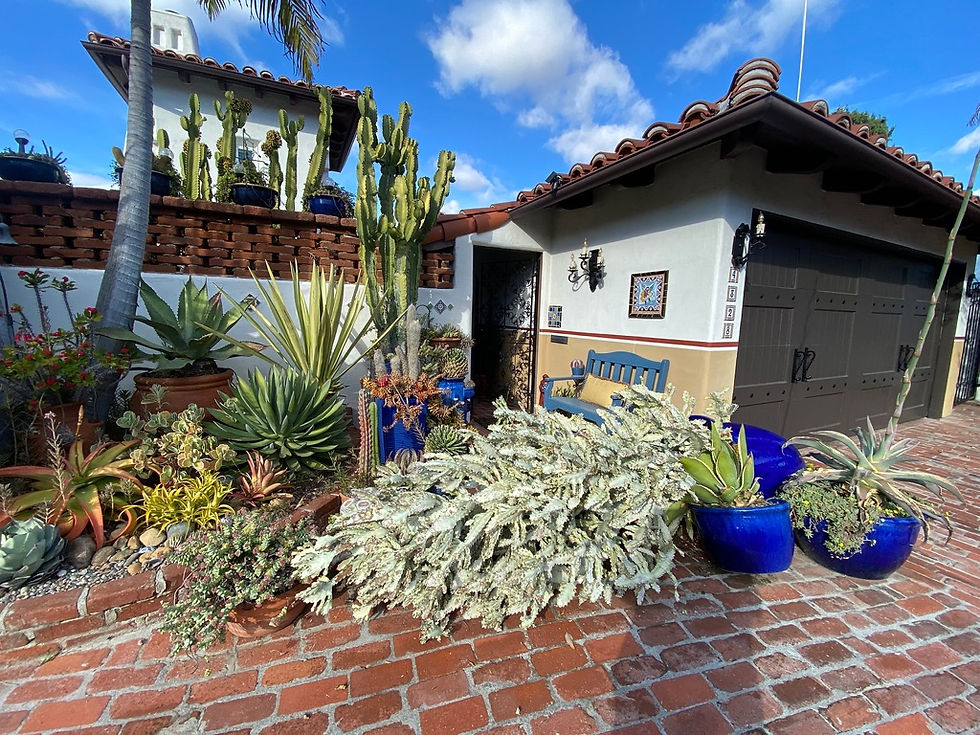
It was too heavy for one person to lift, but fortunately, my garden helper was able to stop by after work that day, and we managed to set it upright just as the rain began. A bit of pruning, some cuttings to share, and we were back in action until the next big windstorm.
Top snapped out of Grevillea robusta
The same windstorm also damaged the top of our Grevillea robusta. This tree is known for being brittle and prone to wind damage. In fact, the top 20 feet blew out during a windstorm back in 2017. It never fully recovered and developed several central leaders, which are known to weaken the tree's structure, leading to the recent damage.
Luckily arborist Tony Gunroe was available and removed the damage portion on December 27.

Tony mentioned that due to the tree's structure and some irreparable decay, it might not last much longer. However, we will observe its condition for the time being.
Second Storm Damage - New Year's Surprise
As seniors, New Year's Eve is typically a quiet affair at our home, often wrapping up well before midnight. The year 2026 was particularly subdued, with heavy rain predicted to continue through New Year's Day after several weeks of rainfall. By the morning of January 2, our rain gauge indicated 4.75 inches of rain had fallen.
The real surprise, however, came on the morning of January 1st when we discovered that the 15-foot-tall aloe tree in front of the house had toppled over towards the street.

The Back Story
I obtained this aloe in the early 1990s from Carl Dykema, the owner of Exotic Gardens, when they were situated in a breezeway between two buildings in Uptown. In an unusual twist, the location is now home to Uptown Tavern, partially owned by my partner Scott Borden, while Carl's business has relocated to El Cajon.

I don't remember much about the one-gallon aloe, except that Carl may have mentioned it was a hybrid tree aloe. I’m not sure if he didn’t specify or if I just don’t recall the parentage.
Over the years, aloe growers have speculated a lot about the parentage, but since we can never be certain, I won't share any of those theories. Regardless, it certainly behaved like a hybrid, growing tall very quickly and blooming at a relatively young age. Within a few years, it reached the size of a small palm tree, producing three-and-a-half-foot tall yellow/orange bloom spikes each December. It was truly a standout.
In 2023, I revamped the front garden where it was planted, removing most of the plants there, including the three water-starved palms that had begun to touch the wall. You can read the full story of the front garden makeover at: Front Garden Refresh. I kept the tree aloe as one of the focal points of the front garden.
Attempts to Save the Plant

I shared photos of the toppled plant on Facebook seeking suggestions for how to set the aloe upright. This also sparked a lot of speculation about the cause of its fall. My assessment is that, weighing over 250 pounds and standing 15 feet tall while leaning toward the street, the combination of several days of rain and saturated soil proved too much, and gravity prevailed. Upon digging out the stump, we confirmed that the roots were in excellent condition with no signs of rot.
After reviewing the various suggestions and advice, we concluded that setting the plant back upright was nearly impossible and therefore highly improbable. Even if successful, the aloe would need supports to prevent it from toppling again. Justin, my gardening assistant, had some recent experience with digging up and relocating large aloes, but this one was about twice the size of those aloes, and they were already at the limit of what one person with my help could manage to move.
Removing the lower leaves to decrease the weight.
Ultimately, we decided to remove the flowers, all the dead leaves and about half of the live ones to reduce the weight to a manageable level. We also chose to saw the trunk off at a height that would fit into Justin's truck. He would then transport the plant from the front of the house to the hotel parking lot at the bottom of our hill. Together, we would carry it through the gate at the bottom and temporarily store the aloe in the shade there while the cut end dried out.
Cleaned up aloe.

Made a bucket bouquet of the flowers.
Measuring the aloe to fit into Justin’s truck.
Sawing off the trunk.
Ready to drive to the bottom off the hill.
Storing the aloe to dry out.
Digging out the trunk. Roots looked good, but shallow.
With the aloe removed, the front bed became more accessible, prompting me to rearrange the rocks and boulder in the dry creek bed. This creek also serves as a path for garden maintenance, but the rock arrangement was challenging to walk on and posed a tripping hazard. Over the years, I had received several large commemorative etched rocks from various garden tours and events we hosted. I decided to place these at the end of the dry creek bed near the base of the wall. Additionally, we removed and relocated several large bromeliads in the area that required dividing.

Re-laid Creek Bed.
The removal of the aloe left a noticeable gap in the front garden, eliminating a significant focal point. I pondered for days on how to replace it. I didn't want to wait years for something to grow in. This spot is one of the sunniest and hottest on our property, so a low-water plant that could withstand the heat was ideal. Since I already have an abundance of plants, I hoped to relocate an existing one from the garden. I considered a silver torch cactus, Cleistocactus strausii, which was growing out of sight in the side yard. I've had the cactus for decades; it was initially in a pot near the garage door but was moved due to being in the way of the trashcans. In 2017, after removing a large loquat and adding an 8-foot privacy fence at a neighbor's request, we planted the cactus in the now sunny, exposed area, where it thrived, growing over 5 feet tall.

Cleistocactus strausii, planted in the sideyard.
Prepping plant for move.
The next challenge was how to dig it up and relocate it. I was concerned about the soil being too wet and heavy from recent rain, making it difficult to dig out the roots intact. However, I wanted to move it soon since the new location is sunnier, and delaying until later in the year could risk sunburn. Additionally, moving something with many spines and plump, rain-swollen trunks was tricky.
I decided to wrap the cactus in chicken wire and insert plastic pots of various sizes between the arms to keep them stable. We then wrapped the base in furniture foam with bungee ties. We cleared the rocks from the base, cut the drip irrigation line in the way, and dug out as much of the root ball as possible. Justin managed to carry the entire plant by himself and placed it in the hole in the front bed, with me overseeing the placement. Some arms leaned slightly but began standing upright in a few days, although they still shift slightly. We only broke the growing tip off one of the tallest arms, and hopefully, a new one will develop at the broken end.
Replanting in front bed.
Once in place, the base of the cactus appeared stark emerging from the creek bed. At the bottom of the garden was a beautiful large Agave potatorum, mostly hidden by other plants. I had been looking for a relocation spot, and this seemed perfect.

Transplanted Agave potatorum.
To complete the arrangement, we planted large variegated bromeliads against the wall and added a grey Hechtia to the side of the creek bed.

After just a few weeks, it looks as if the plants have always been there, and a local lizard enjoys basking in the sun at the new spot.
Replanting the Tree Aloe
After experiencing several weeks of warm and dry weather in January with no rain forecasted, we decided it was time to plant the large tree aloe that had been cut off.

Replanting the aloe.
Originally, we intended to plant it near the fence in full sun at the base of the hill. However, once we began digging, we quickly realized, as we had feared, that the area was filled with Eucalyptus roots from the trees just outside the fence. Upon reassessing, we decided it could serve as an even better focal point if placed in the middle of an existing bed where I had planted a Psuedobombax ellipticum. While it was doing well, it was leafless most of the year and didn't stand out much. I removed it and gave it to my good friend Jodi for her garden. We dug a large, deep hole and managed to balance the aloe in place. We backfilled the hole with decomposed granite and compacted it. We were able to get it to stand without any support and hope it will be rooted by next December, showcasing a beautiful display of flowers.


Jim Bishop is on the San Diego Horticultural Society's board as Past President Emeritus, as well as he was the 2019-2020 Horticulturist of the Year.
You can read all of Jim's blog posts at:
Tickets on Sale Now!


