
HERITAGE HAUNTS: Introduction To Gasterias
By Annie Morgan, originally published in the December 2015 Let’s Talk Plants! No. 255 newsletter. Republished January 2026.

From the archives: Introduction to Gasterias

Though slow growing, Gasterias are a small, charming species and one of the easiest succulents to grow, thus they are an ideal starting plant for the novice. They are related to Aloes and are in the Asphodelaceae family and are named for their stomach-shaped f lowers (“gaster” is Latin for “stomach”). Gasterias have been cultivated since the late 1700s, and were first described in the late 1600s by the Dutch East India Co. Early man used them as food, and for medicinal and magical purposes.

Native to the Southern African region, they receive erratic rainfall and evolved as drought-resistant, shade-loving and shallow-rooted succulents. They are easily recognizable by their thick, hard, succulent tongue-shaped leaves, which range from an inch to over a foot in length, and by their belly-shaped orange-pink flowers which are on curved branches that may be up to 12 times longer than the height of the plant. Hummingbirds love their nectar and are frequent visitors to Gasteria flowers.

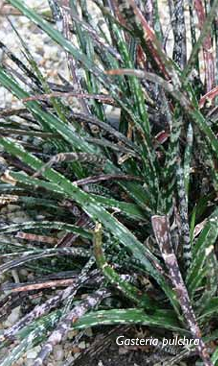
Most Gasterias are small and shallow rooted and range in height from ¾” to 24” tall. They are stemless, and over time most species’ leaves become spirally arranged or form rosettes. Many have leaf spots, often in transverse bands. Water is stored in their thick succulent leaves, which become deeply channeled during drought, but recover rapidly after rainfall. Flowering is mainly in winter and spring.

Cultivation:
In nature Gasterias mainly grow in well-drained humus-rich, sandy and sandy-loamy soil on dry rocky hillsides under taller shrubs. In cultivation they adapt to a variety of soil types and grow well in pots or in the garden. Because of their small size it is possible to build up a rewarding collection even in a limited space. As the flowers are similar in size regardless of plant size, the smaller the plant the more striking the flowers. Most species prefer light shade and should be protected from the hot sun and severe frost. They are sensitive to sunburn and full sun for even half an hour can cause damage. Water sparingly throughout the year, no more than once a week, and less frequently in winter. Almost any pot is suitable if it provides sufficient drainage. Repot plants every 3 to 4 years, trimming back the roots when doing so. Well-fed plants are more resistant to disease, so liquid fertilizer such as kelp should be added 2-3 times a Gasteria baylissiana year when watering. Because Gasterias tolerate low light they make excellent indoor plants.
Propagation:
Pups form naturally at the base of most plants and rapidly increase in size in most species. If they develop into a dense cluster they may be divided using a sharp knife any time of year, but summer is recommended. Leaf cuttings may be taken at any time of year, although they will grow faster in summer. When taking leaf cuttings, the lower leaves may be removed without damaging the point of removal or causing it to look unsightly. From a healthy mature plant hold a lower leaf securely in your right hand while holding the plant in your left hand. Pull the lower leaf sideways towards you and it should detach itself at the base with minimal damage. Place the leaf in a slightly horizontal position with the base lightly covered with soil. Keep it moist, and when the leaf becomes firm, it is a sign rooting has taken place, usually within a few weeks. Cuttings will soon grow pups and may be planted out after a year or two. Seed propagation is also common and relatively easy. Germination usually occurs within 8 days, but may take as long as one month, depending on the species.

Pests/Disease:
Leaves are prone to unsightly black spots, which may be discouraged by avoiding humidity and condensation. The black spots will not spread and are the result of the plant sealing off damage, or fungal infection, which oxidizes to a dark color. Pests are rarely a problem with clean and correct gardening practice. Species: Dividing Gasteria into species is extremely difficult, as each plant can be highly variable. One plant will look different depending on its location, its soil and its age, and young Gasteria plants typically look entirely different from older specimens. There is disagreement on how many species exist, although current studies tend to agree that there are 26 species, 2 subspecies and 10 varieties that occur in nature. They are listed below:
Gasteria acinacifolia
G. armstrongii
G. barbae
G. batesiana
G. batesiana v. dolomitica
G. baylissiana
G. bicolor
G. bicolor v. fallax
G. bicolor v. liliputana
G. brachyphylla
G. brachyphylla v. bayeri
G. carinata
G. carinata v. glauca
G. carinata v. verruculosa
G. croucheri
G. croucheri ssp. pendulifolia
G. croucherai ssp. pondoensis
G. disticha
G. disticha v. langebergensis
G. disticha v. robusta
G. doreeniae
G. ellaphieae
G. excelsa
G. glauca
G. glomerata
G. loedolffiae
G. nitida
G. pillansii
G. pillansii v. ernesii-ruschi
G. pillansii v. hallii
G. polita
G. pulchra
G. rawlinsonii
G. retusa
G. thunbergii
G. tukhelensis
G. vlokii
Resources:
pza.sanbi.org/search?s=gasteria-barbae – very detailed information about each species, plus photos
succulent-plant.com/families/aloaceae/gasteria.html – good selection of photos davesgarden.com/guides/articles/view/2915/#b – article about gasterias
search.fotki.com/?q=Gasteria – many gasteria photos
succulentguide.com/cactus/?genus=Gasteria – This is an incredible site for all succulents/cacti!
