
GOING WILD WITH NATIVES: What you might find with your Great Valley Gumweed and Milkweed plants
By Susan Lewitt, for Let’s Talk Plants! July 2026.
What you might find with your Great Valley Gumweed and Milkweed plants
Native plants support more than pollinators such as Monarch butterflies and their caterpillars. Here is another part of this web of life:
On Tuesday May 5, I rolled out my recycling container, as usual. A few minutes later, when I came back to add to it, I was astonished to find a magnificent orb weaver. I was concerned that if she stayed, she would be squashed by the arm mechanism of the city collection truck, so I carefully transferred her back to the native plants just behind the can, where I think she had been hiding. I moved the web carefully and found it to be quite strong.

Later that day, she had relocated to an area between the Great Valley Gumweed (Grindelia camporum) and some Narrow Leaf Milkweed (Asclepias fascicularis), sitting on a fine web. She even managed to catch something, a fly, I think. I saw the tiny silk wrapped morsel. Later this package disappeared, having been devoured by this stealthy predator. It is fascinating to gaze at the beauty of this creature as she sits motionlessly, waiting for victims to get trapped on the sticky parts of her web partially hidden from view by native plants. She will then wrap them in spider silk, to be consumed later.

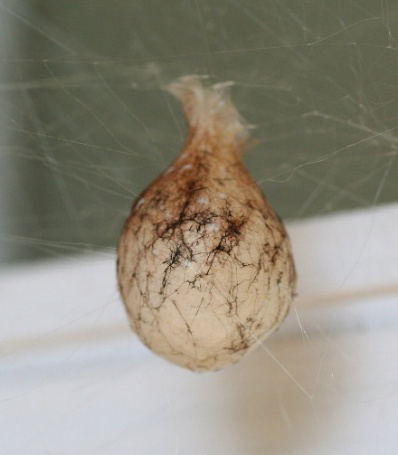
Sunday, May 10, her magnificent fragile looking web was still there, but there was no sign this extraordinary spider. I did notice that there was a package left behind which I will keep my eyes on because I suspect that it is an egg case and like in the book, Charlotte's Web, about a spider who was also an orb weaver, I think this package holds the next generation of orb weavers. I have been watching this tiny package and it seems to be developing and getting darker.
Meanwhile, while we are waiting to see if there will be some juvenile spiders, how about that Great Valley Gumweed (Grindelia camporum) that started blooming last August and is still going strong? At first, they were only 2 to 3 feet tall and there were 3 different plants. At any one time, at least one of them would be in bloom. Now, 9 months later, the tallest ones are about 6 feet tall and covered with buds, with many open at any one time. I also noticed small amounts of some white foam on my Great Valley Gumweed. This foamy substance shields the plant from the sun as a sunscreen. (See planetary for more details on the self-protecting plant: https://plantiary.com/plant/grindelia-camporum_38329.html)

It is now May 22 and the egg sack has gotten darker. I hope the baby or babies come out soon! While watching the egg sack, On May 28: Now that the little package has disappeared, I think it was intended as my orb weaver’s last supper, and she may have been eaten by a predator before she could leave an actual egg sack behind. So, no baby spiders, but there's some good news.

I saw a lady bug (they are actually male beetles) on the nearby milkweed and here is how to make sure you have lady bugs: Do not spray or squish the aphids because lady bug larva rely on them as their food source. Aphids on the milkweed will not damage it. It may even be healthier with aphids on it.

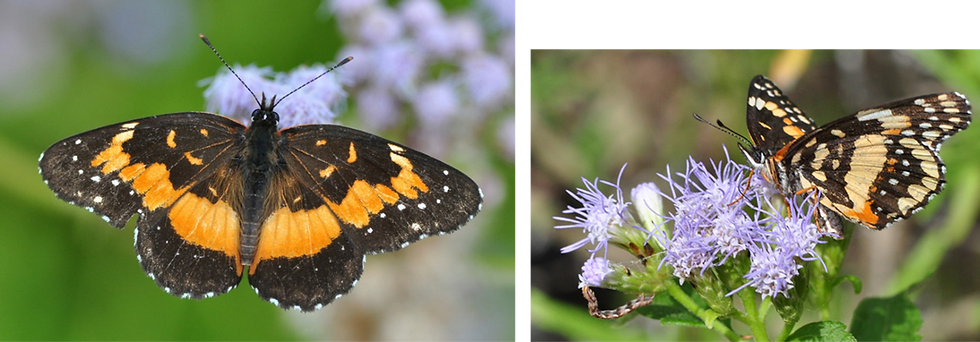
This Great Valley Gum weed, which is a perennial herb, does well in full sunlight, with very low water. Once it is established be careful not to water it more than once a month during the summer to avoid problems with rot. The soil can be slow, medium, or fast draining, and possibly saline with a pH range of 6 to 8. This perennial member of the sunflower family occurs in Chaparral, Coastal Sage Scrub, Valley Grasslands, and Wetland-Riparian communities. The native companion plants vary depending on location and include native grasses, Penstemon spp., Lupines (Lupinus spp.), Poppies (Eschscholzia spp. or Papaver spp.), and various native cactus, and succulents. My orb weaver liked it, and it also supports bats, bees, caterpillars, butterflies and moths. One visitor that you might get to see is the Bordered Patch butterfly (Chlosyne lacinia).

I hope you are able to incorporate many beautiful native plants into your garden and therefore support biodiversity by giving food and homes to many native faunas. Please remember not to overwater the Great Valley gum Weed and other drought tolerant native plants. Some have a very high tolerance for excess water, while others are more sensitive like the witch in the Wizard of Oz and Wicked. While they may be shriveling, your plants won’t cry out that they are melting! Happy Gardening!
