
GOING WILD WITH NATIVES: Natives Can Be Very Easy And Attractive Also!
Updated: May 27
By Susan Lewitt, for Let’s Talk Plants! May 2026.

Natives Can Be Very Easy and Attractive Also!
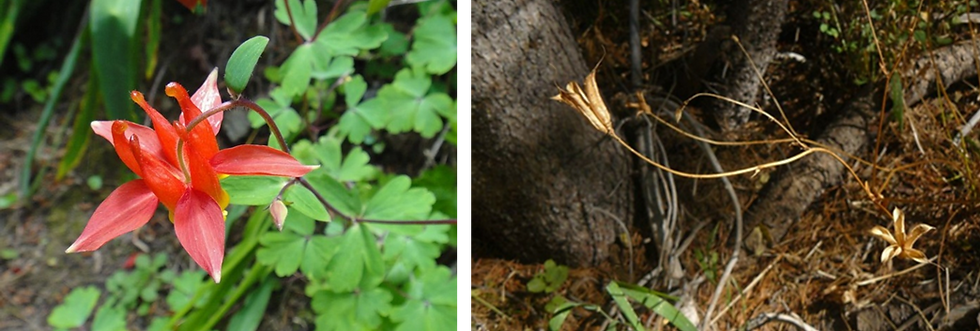
As an enticement to grow more native plants, I have chosen four beauties that are easy to grow. Some people avoid natives because they may think that they can be difficult, but just like any other group of plants, there will always be those that test your courage and patience, and those that despite being ignored, still thrive.
So, here goes:

WESTERN COLUMBINE (Aquilegia formosa) is a perennial herb that attracts hummingbirds with its springtime, red, and yellow flowers, that have pollinator attracting nectar. Keep the flowerheads to have them produce seedheads. When these pods mature, they will feed other birds including finches. It is also known to support bats, caterpillars, butterflies, and moths including the Small Engrailed Moth (Ectropis crepuscularia).

This fast-growing plant forms an upright fountain-like shape at about 2 to 3 feet tall and 1 foot wide. It is winter deciduous and deer resistant. It is also suitable for containers. It will tolerate any amount of sun from full and partial sun to deep shade. It will do well in medium draining soil with organic material, and a once-a-month summer watering once it is established. It can be planted near trees such as Coast Redwood (Sequoia sempervirens), Santa Lucia Fir (Abies bracteata), and Douglas Fir (Pseudotsuga menziesii). Shrub and herb companions include Meadow Rue (Thalictrum fendleri), Snowdrop Bush (Styrax redivivus), Yellow Monkeyflower (Erythranthe guttata), Western Azalea (Rhododendron occidentale), and Huckleberry (Vaccinum ovatum).

CALIFORNIA SAGEBRUSH (Artemisia californica) is a fast growing easy to grow shrub that will give you flowers with a pleasing fragrance for a good part of the year. You will see soft colors of cream, white and yellow from spring to the fall. Since this is summer deciduous, it should be planted with species that are green at least during the summer, such as California Buckwheat (Eriogonum fasciculatum var. fasciculatum), Woolly Bluecurls (Trichostema lanatum), Scrub Oaks, Toyon (Heteromeles arbutifolia), Lemonade Berry, Yucca species and some of the native cactus species. It should be located in full sun with low nutrient sandy or clay soil that is slow medium or fast draining. Once it is established, it will only need watering once a month during the summer or very warm months.

Other companion plants for California Sagebrush that are summer deciduous, or semi-deciduous, include Black Sage (Salvia mellifera), White Sage (Salvia apiana), Bush Sunflower (Encelia californica), Chamise (Adenostoma fasciculatum var. fasciculatum), Coyote Brush (Baccharis pilularis ssp. pilularis), and Sticky Monkeyflower (Diplacus viscidus). Bats, birds, caterpillars, butterflies and moths are supported by Sagebrush. You might even get a visit from Old-World Swallowtails (Papilio machaon) and Painted Ladies (Vanessa cardui). The Little Brown Myotis (Myotis lucifugus), the Hoary Bat (Lasiurus cinereus), and the Mexican Free-tailed Bat (Tadarida brasiliensis) are bats that are associated with sagebrush habitats. Bats are pollinators and help control insects.

HONEY MESQUITE (Neltuma odorata) a small to medium sized easy to grow tree is a member of the legume family. Being popular and easy to grow is not always an asset. Outside of its native range, it has become an invasive nuisance due to its popularity as a desirable horticultural plant. But in its California range it supports multiple wildlife species making it an important, possibly keystone, species. When it is a low growing shrub with dense foliage, animals such as quail and rabbits make use of Honey Mesquite to safely hide from danger. As a tree it may reach 30 feet tall by 30 feet wide and occasionally grow beyond that. It is winter deciduous and its yellow flowers appear in spring and summer. The long pod shaped fruits that appear after it has flowered, are high-quality nourishment for wildlife.

Honey Mesquite supports bats, caterpillars, and butterflies including the Great Purple Hairstreak (Atlides halesus). It is resistant to deer. There are also many companion native plants for this native species including Brittlebush (Encelia farinosa), Ocotillo (Fouquieria splendens), Chuparosa (Justicia californica), Beavertail Cactus (Opuntia basilaris), Palo Verde species (Parkinsonia spp.), and Joshua Tree (Yucca brevifolia).

Plant this tree in full sun with fast draining soil of sand or decomposed granite. Once it is established, it will only need to be watered once a month during summer and summer-like weather. As a shrub, it does not need any pruning, but it may be pruned in the winter if you desire a tree. When pruning, or working on or near this plant, please be cautious around the sharp spines. Choose a primary trunk to help form an attractive tree. Due to its sharp spines, it should also be planted away from areas where it could harm people, especially children.

DESERT WILLOW (Chilopsis linearis) which is not a willow, is yet another easy to grow California native species. This plant may be grown as a small tree with many trunks, reaching about 26 feet tall to 20 feet wide, or it may be used as a shrub that is limited to 5 feet tall by 10 feet wide. After being bare in the winter, it will produce fragrant flowers of purple, lavender, pink and white, from spring through fall.

Full sun in fast draining soil of damp decomposed granite or sand meets the needs of this plant. Once it is established, it should be watered no more than three times a month during the summer or for long stretches of summer-like weather. Pruning may be done in the winter when it is dormant. Some possible companion plants include Blue Palo Verde (Parkinsonia florida), Desert Ironwood (Olneya tesota), Brittlebush (Encelia farinosa), Chuparosa (Justicia californica), and Desert Lavender (Condea emoryi). It supports a host of animals such as hummingbirds, other birds, bats, bees, caterpillars and butterflies. The Rustic Sphinx (Manduca rustica) and the Wavy-Lined (Synchlora aerate) are potential visitors.

There are quite a few more easy-to-grow native plant species which are found on Calscape. This is a great website to find native plants for all your landscaping situations. Calscape will show information on each of the native species, as well as nurseries that usually carry these plants. It is always a good idea to check with the nurseries to see if they have the plants you want in stock. When you choose to add plants to your garden, please keep in mind all the native fauna that are supported by these native plants and how that protects our biodiversity and our health.
We are starting to plan the display for the San Diego County Fair. It won’t be quite as intricate as last year's, but it will be worth visiting. The current plans include many unique features such as a vernal pool, a sensory garden and more.
Visit the fair to see the gardens and other fun fair exhibits, starting on June 10 and ending July 5, (except Mondays and Tuesdays) from 11 am to 11 pm.

