
GOING WILD WITH NATIVES: Had Enough Wet? How About Desert Plants For Dry Areas?
By Susan Lewitt, for Let's Talk Plants! December 2025.


Okay, this is a teaser! This marvel is tiny and hard to find in nurseries, but I just couldn’t resist showing it off! This and others like it could be lost without our supporting biodiversity through the use of native plants. Left photo: "Sicklepod rockcress" by Henrik Kibak is licensed under CC BY 4.0. Middle photo: "Sicklepod rockcress" by Tom Wainwright is licensed under CC BY 4.0. Right photo: "Sicklepod rockcress" by kasey_johnson is licensed under CC BY-NC 4.0.
Had Enough Wet? How About Desert Plants For Dry Areas?
Even though we are heading into the rainy season, this month’s article will be the opposite of last month, which was all about water loving plants. It will highlight drought tolerant desert plants. In the article for June 2025, San Diego Is Not A Desert, But…, I wrote about a few desert species. This is a continuation, with some different candidates for your garden. As mentioned in the June article, San Diego is not a desert, but its many microclimates include areas that tend to be desert-like. Do you have an area that is hot, dry, and sunny? If so, consider some of these native drought tolerant species.
“Native Desert plants thrive in hot sunny places with good drainage, perfect for an area near pavement. They support local ecosystems where there were previously none by providing nectar, seeds, and shelter to native birds, pollinators and beneficial insects. These drought tolerant plants reduce water use, and enrich your garden with vibrant blooms and unique textures year-round. Water deeply once per month and use well-draining soil mixes.” (WWW.CNPSSD.ORG) (Some prefer no supplemental watering, while others may need watering 2 times a month in the summer. It is a good idea to ask the experts about individual plant requirements.)
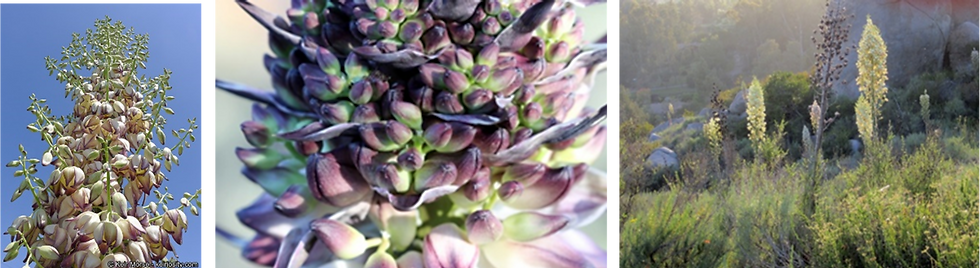
The flower stalk of the Chaparral Yucca can get quite tall reaching about 12 feet in height. Left photo by Keir Morse. Middle and right photo courtesy of Calscape.
CHAPARRAL YUCCA (Hesperoyucca whipplei) will take its time reaching maturity, about 5 to 6 years. When it matures, it will bloom in the spring, shooting up a tall spike of white to purple flowers that will last several weeks as the plant fades away, but don’t give up hope. It will leave behind pups and seeds for a new generation. The leaves on this plant are sharp and spike-like, but for safety, it is okay to trim off the sharp tips. Give this plant plenty of space, in full sun with fast draining soil, but not too close to walkways (ouch!). In natural areas it is found in rocky dry soil, in Chaparral, Creosote Bush Scrub, and Joshua Tree Woodland plant communities. It may need water once a month in the summer, once it is established.

The Yucca Moths are busy keeping the Chaparral Yucca and itself thriving. Left photo: "Yucca Moth, Merrimac Farm Wildlife Management Area, Aden, Virginia" by Judy Gallagher is licensed under CC BY 2.0. Right photo: "Tegeticula yuccasella - Marissa Calvert 01" by Marissa Calvert https://www.inaturalist.org/people/calvertm is licensed under CC BY 4.0.
The Yucca Moth has a close relationship with this species. The moth collects pollen from one plant, inserts her eggs in a seed pod and deposits the pollen on a flower’s stigma of another Yucca. The larvae eat some of the seeds, but leave enough behind for more Chaparral Yuccas to start. The seeds may be planted later in the spring or fall, and will germinate in about a month. The plant may die before the Yucca moth (Tegeticula maculata) larvae have matured, so don’t remove the plant immediately. Another reason to leave it is because the flower stalk may remain standing for many years after the rest of the plant is gone. The Chaparral Yucca also supports birds, bats, caterpillars and butterflies. Good plant companions for the Chaparral Yucca include Mission Manzanita (Xylococcus bicolor), Spiny Redberry (Rhamnus crocea), California Buckwheat (Eriogonum fasciculatum), and California Sagebrush (Artemisia californica).

The Chaparral Yucca, with its pleasing symmetry, is attractive all year round. Photos by Neal Kramer.
This plant was important to the indigenous people because every part of the plant had a use. Roasted stalks were eaten, soap and shampoo came from the roots, plus sandals, nets, and shelters were made from the strong fibers of the leaves. The seed pods were also considered edible and nutritious by the coastal people. These pods were left whole or ground into flour for storage.

Lovely leaves and an overview of the Yellow Bush Penstemon. Photos by Keir Morse.
YELLOW BUSH PENSTEMON (Keckiella antirrhinoides) is in the plantain family and has several names, such as snapdragon penstemon and chaparral beardtongue. It occurs naturally in the plant communities such as chaparral, deserts, Pinyon-Juniper Woodlands, and Creosote Scrub. These plant communities are found in Arizona, California and Baja, California. Habitats for this Penstemon include dry rocky slopes, canyons and mesas.

Yellow Bush Penstemon with buds about to open and one open. Left photo by Keir Morse. Right photo by Jean Pawek.
This summer deciduous shrub enjoys full sun in medium to fast draining soil. It will bloom in the spring with a pleasant scent and may need watering 2 times per month during the summer heat, once it is established. Chaparral native species that are good companions are California lilacs (Ceanothus spp), California buckwheat (Eriogonum fasciculatum), Scrub Oaks (Quercus spp), Southern Honeysuckle (Lonicera subspicata var. subspicata), and Chaparral Yucca (Hesperoyucca whipplei). Desert companions include Creosote Bush (Larrea tridentata), Brittlebush (Encelia farinosa) and Desert Agave (Encelia farinosa). Pinyon-Juniper companions include Pinus spp., California Juniper (Juniperus californica) and Big Sagebrush (Artemisia tridentata). Many native animals depend on this species including birds and hummingbirds, bees, caterpillars and butterflies. One confirmed visitor is the Variable Checkerspot (Euphydryas chalcedona). Attracting this beauty to your garden is a good reason to consider this native plant species.

The Yellow Bush Penstemon will attract the eye-catching Variable Checkerspot (Euphydryas chalcedona) to your flower garden. Photos by Christopher L. Christie, used with permission.
CALIFORNIA COPPERLEAF (Acalypha californica) will add color to your landscaping whether it is blooming, or not, making this small shrub worth having. Its pink, red and white flowers may be seen winter and spring, but when not in flower young leaves will have edges of pink or copper during the summer months. This slow growing evergreen shrub forms a mound and has been used as lawn substitutes since it only gets to about 3 feet tall, but can spread to 5 feet wide. Unlike typical lawns, once it is established it only needs watering once a month in the summer and no mowing! It does best in a location with full sun and fast draining decomposed granite or sandy soil.

California Copperleaf will enhance your landscape. Photos courtesy of Calscape.
Hopefully, you will be able to find the California Copperleaf in a local nursery, or at a future CNPS SD plant sale. In the natural areas, it is found in Chaparral, Creosote Bush Scrub, Desert, and Southern Oak Woodland plant communities. Good companions for this petite shrub include Chamise (Adenostema fasciculatum), California Buckwheat (Eriogonum fasciculatum), Chaparral Mallow (Malacothamnus fasciculatus), Brittlebush (Encelia spp.), Desert Agave (Agave deserti), Mojave Yucca (Yucca shidigera), Creosote (Larrea tridentata), Big Sagebrush (Artemisia tridentata), and cactus species. It supports butterflies and caterpillars. One such butterfly is the Gem (Orthonama obstipata)

The leaves of California Copperleaf are heart shaped and serrated. The bumpy pinkish-reddish flowers add more color and attract the Gem, a butterfly with its subtle coloration. Left and middle photos: courtesy of Calscape. Right photo: "Orthonama obstipata female 2" by Jacy Lucier is licensed under CC BY-SA 4.0.
More desert plants to consider include Desert Willow (Chilopsis linearis), and Deer Plant (Acmispon glaber). One other, Sicklepod Rockcress (Boechera sparsiflora) may be just about impossible to find in nurseries, with its dainty purple flowers (pictured at the beginning of this article). It has been available at the CNPS SD Fall plant sale. Calscape lists 98 possible native desert species, including the above highlighted species, to consider in your drought tolerant or desert landscapes. These species are typically available at local native plant nurseries and CNPS plant sales within 50 miles of San Diego.

“Where Native Plants Thrive, We Thrive.” Graphics by Artefact Design
CALLING FOR ARTISTS and SPONSORS: If you are an artist and your art is related to native flora and fauna, you have until the end of December to apply to be part of the California Native Plant Society’s 2026 Garden Tour, April 11th, and 12th of 2026. Also, sponsors are welcome and appreciated. WHERE NATIVE PLANTS THRIVE, WE THRIVE: When native plants flourish, they create gardens full of life where everything is connected. Songbirds return, butterflies flutter by, and the landscape feels alive in a way that ordinary gardens do not. Surrounded by this living richness, all garden dwellers find calmer, greener spaces, and neighborhoods become cooler, healthier, and more resilient. That liveliness engages our senses, restores our well-being, and deepens our connection to the natural world. Save the date and spread the word! For more details, please go to: cnpssd.org/2026-garden-tour
Sources:
California’s Most Dramatic Native Plant: Chaparral Yucca, You Tube video, July 9, 2025, https://www.youtube.com/shorts/HQQzNVJO1eI?feature=share
Chaparral Yucca Seeds, and a Guest by EarthKnight. Https://writingfornature.wordpress.com/2013/06/30/chaparral-yucca-seeds-and-a-guest/

Susan Lewitt is a member of the California Native Plant Society (CNPS), participating in their Native Gardening Committee, and their Conservation Committee.
Susan uses Wildhero - email that plants trees, and she can be reached at nativebutterflies213@gmail.com.
