
GOING WILD WITH NATIVES: Bonsai - The Art of Making the Mighty into ‘Miniatures’ Even with Native Plants!
By Susan Lewitt, for Let’s Talk Plants! October 2026.

Bonsai - The Art of Making the Mighty into ‘Miniatures’ Even with Native Plants!
Do you want more native trees, but you have no space for them? How about having ‘miniature’ trees, or Bonsais, instead. There are many native plants that may do well as Bonsais. Choose a native plant with small leaves and woody growth. In its scaled down form, the plant will have even smaller leaves than the full-size specimen. Native companion plants are mentioned in this article with each species because there is the option of having more than one species in a container or dish garden as bonsais. The following are some examples of native trees and shrubs that have been made into bonsais and can be seen at the San Diego Zoo Safari Park’s Bonsai Pavilion which opened in 2011. Bonsais had been at the SDZ Safari park for a while, but this updated space flows with a waterfall, three bridges, and a meandering stream for a peaceful chance to explore the exquisiteness of bonsais.

Keeping and maintaining a bonsai does take some time and effort. According to the San Diego Zoo Safari Park Botanical Tour, “Bonsai Pavilion” booklet, “The bonsai process relies on restricting the growth of the plant by using a smaller container and pruning. …. When the roots fill the container, the growth of the bonsai slows and foliage size gets smaller. Fertilizer application is controlled so that the bonsai is healthy, but does not excessively grow. The foliage is pruned to maintain the shape and size. Eventually the roots get too root bound and … the bonsai is removed from its container and about 50 percent of the root mass is removed and the bonsai is returned to the pot and new soil is added.” Many of the bonsais in the SDZSP Pavilion are exotic species, but there are several really pleasing examples of native bonsais.

COAST LIVE OAK has 2 taxa: Quercus agrifolia var. agrifolia and Quercus agrifolia var. oxyadenia. Both are available locally, but the first one is found in more nurseries. It is considered a keystone species, supporting a multitude of wildlife; over 270 species. This includes 25 native bee species, plus butterflies, moths, hoverflies, hummingbirds and bats. It is resilient and may live over 250 years, reaching a height of 30 to 80 feet. Flowers of yellow, green, and cream also known as catkins, will occur on mature trees during the winter and spring. It occurs in many areas throughout California and is found in Foothill Woodland and southern Oak Woodland communities. It works well to stabilize banks and can be seen in natural areas on slopes. The lower part of the slope might have streams or riparian areas, while the upper part might be populated with plants from Chaparral or Coastal Sage Scrub communities.

If you are growing this as a full-size tree the roots of young tree needs shade, which can be created by surrounding the base of the tree with mulch, rocks, and native plant ground cover. It may be in full sun or partial shade and requires very little water. Indirect, once-a-month watering in the summer, for established trees will be adequate. The soil type should be medium draining loam which may be created from leaf litter as it breaks down. In your garden or even as a bonsai, you might consider having one or more of the following companion native plants nearby: Coyote Brush (Baccharis pilularis), California Buckwheat (Eriogonum fasciculatum), Coast Sagebrush (Artemesia californica) , Toyon (Heteromeles arbutifolia), California Coffeeberry (Frangula californica), Woolly Bluecurls (Trichostema lanatum), Yellow Bush Penstemon (Keckiella antirrhinoides), Fuchsiaflower Gooseberry (Ribes speciosum), California Wildrose (Rosa californica), Manzanita spp. (Arctostaphylos spp.), Ceanothus spp., Salvia spp. and annual wildflowers. These are just a few of the many native plants that work well with Coast Live Oak.

LEMONADE BERRY (Rhus integrifolia) has relatively small leaves and petite flowers which are ideal for bonsais. Its initial growth is slow, but in the ground, it may reach 30 feet tall and 10 feet wide. Pruning will allow it to be used as a hedge. It is also useful on slopes and as a ground cover. From February through May, wee pink blossoms will be present, followed by dark red, tart, sticky rectangular berries. In natural areas it may be found in Chaparral, Coastal Sage Scrub, and Woodland plant communities. It supports many different types of wildlife, such as butterflies, moths, caterpillars, hoverflies, and bats. There are also 54 native bee species attracted to, and supported by Lemonade Berry.

Lemonade Berry may be in full sun to partial shade. It is easy to grow in a variety of soils that are fast, medium, or slow draining. It only needs a deep watering, at the most, twice a month once it is established. Consider planting it with some of the following: Toyon (Heteromeles arbutifolia), Scrub Oak (Quercus berberidifolia), Chaparral Mallow (Malacothamnus fasciculatus), Laurel Sumac (Malosma laurina), California Encelia (Encelia californica), California Sagebrush (Artemisia californica), Yucca spp., and various cactus species.

CALIFORNIA JUNIPERS (Juniperus californica) are prized for their deadwood. The dark brown part on the trunk and branches is the live vein which keeps the foliage alive.” (Bonsai Pavilion brochure, San Diego Zoo Safari Park Botanical Tours) The compact needles are great for making a bonsai tree look like a miniature version of the full-size tree. In Nature this member of the Cyprus family is found mainly in California, reaching some parts of Baja California, southern Nevada and Arizona. It’s great for butterflies, moths, bats, caterpillars and birds.
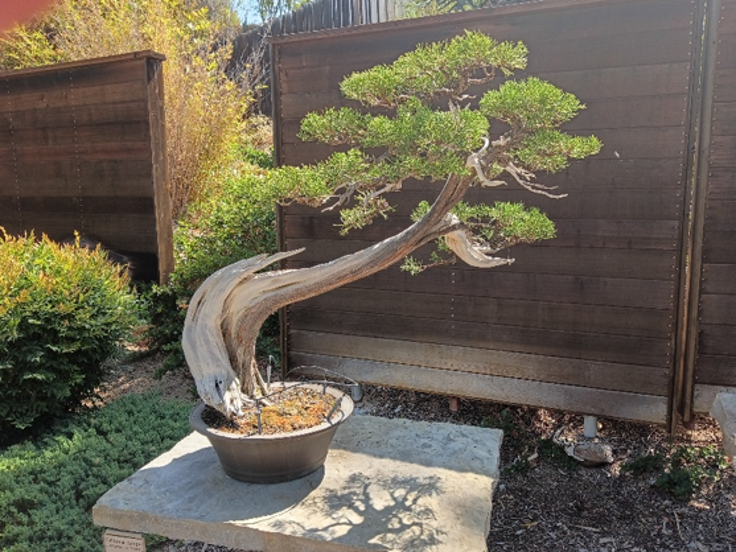
The California Juniper may reach a height of 26 feet by 20 feet wide, so if you want one of these, and don’t have the space, the bonsai form is ideal. It is a moderate to slow growing tree that does well in full sun to partial shade. It can be in medium to fast draining soil that is low in nutrients and coarse. DG or decomposed granite is an option. There are many native plants that are good companions for the California Juniper and they may be found together in natural settings. The list includes: Big Sagebrush (Artemisia tridentata), Buckwheat (Eriogonum spp.), Apache Plume (Fallugia paradoxa), Flannelbush (Fremontodendron californicum), Yucca (Hesperoyucca spp. or Yucca spp.), Antelope Brush (Purshia tridentata var. glandulosa), and various cactus species.
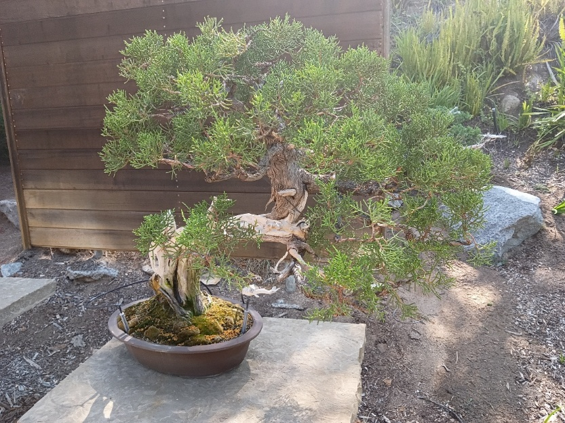
These are just a few of the potential native bonsai species, and there are many more options for native trees and shrub species as bonsais. This allows you to bring nature home even when you don’t have the space. Bonsais do more than creating a miniature of nature. “Bonsai, the Japanese art of making miniature trees, creates tiny simulacra that have lessons to teach about patience and the long view.” (Twelve Trees, Pages 37-38. Daneil Lewis, Avid Reader Press, New York, 2024). For expert advice on starting and maintaining bonsais, the San Diego Bonsai Club is a good place to start. They are the people who look after the Bonsais in the SDZ Bonsai Pavillion. Keep in mind, that you may not see these specific bonsais on display in the SDZ Bonsai Pavillion because they rotate these plants as they need care.
Sources and Resources:
Calscape, https://calscape.org/
San Diego Bonsai Club, https://www.sandiegobonsaiclub.com/pavilion.html
San Diego Zoo Safari Park Bonsai Pavillion, https://sdzsafaripark.org/animals/bonsai-pavilion
Twelve Trees, Pages 37-38. Daneil Lewis, Avid Reader Press, New York, 2024
