
BOTANICAL ENCOUNTERS: The Eye Dazzling Atacama Superbloom
Words and pictures by Ida K. Rigby, for Let’s Talk Plants! August 2026.

The Eye Dazzling Atacama Superbloom
What more can we say? Once again the photos will tell it all. On another late September day in 2011 we headed out for more visual overload and fascinating minutia. Within the profusion there even were a few familiar plants from our gardens (calandrinias, cisthantes, encelias and alstroemerias) in unexpected places and unimaginable numbers. Just feast your eyes, as we did.
We started out as usual at sea level in dense overcast (la camanchaca extends 5 - 10 miles inland) with fields of white Leucocorne appendiculata leading down to the Pacific.

We were all bundled up against the damp and cold, but never passed up an opportunity for a closer look, in this case at a vibrant purple Solanum heterantherum.


In the grittier soils we found Cistanthe grandiflora

and Cisthanthe longiscapa locally known as the “pata de guanaco” (Guanaco’s Foot) and blue Zephyra elegans.
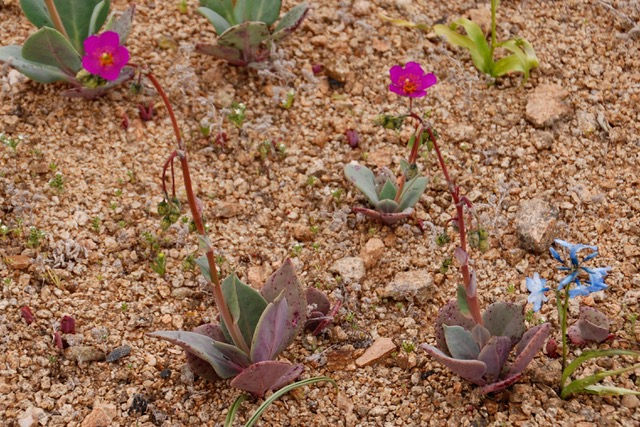

The modest little Pata de Guanaco is the subject of studies at the Andres Bello University because it might hold the key to creating more drought tolerant crops since it survives the extreme drought and UV radiation of the Atacama. Scientists are sequencing its genome to identify resilient genes that could be transferred to agricultural crops. (www.youtube.com/watach?v=AU9lPX9z-qk)
As we began to climb a rocky hillside we came upon the intriguing Aristolochia chilensis (Fox Ears).

This creeping vine wound around the rocky outcroppings at our feet. The odoriferous flowers, which range from brown to maroon, can have white or yellow hairs. The hairs point downward and trap fly pollinators attracted to the foul smell. For about a day the flies remain trapped and gather pollen on their bodies as they feed on the nectar; when the flower withers the hairs trapping the flies wilt. The flies can then escape and deposit pollen in another flower. Vivid blue Nolana’s filled the pebbly areas.

As we continued rock hopping, enjoying the freedom of knowing there were no poisonous snakes in this desert, we passed by then familiar cistanthes, shrub nolanas, encelias and white, sweet scented Heliotropium pycnophyllum.

At the crest of the hill we were rewarded with stands of Pasithea coerulea (Blue Wand Flowers).


We returned to the “fog oases” lower down and found valleys filled with vast numbers of contrasting orange Argylia radiata, pink species Cristaria sp., magenta Cistanthe grandiflora, golden Heliotropium linearifolium, white Pychnophyllum sp. and yellow Encelia canescens with brown centers (Coronilla del Fraile — crown of the head).


Towards midday we climbed a hill in quest of Leontochir ovallei (Lion’s Paw), one of our most highly anticipated sightings. Our climb began in fields of Cistanthe grandiflora punctuated by various Eulychnia sp. cacti.


The shrub with long, densely packed leaves and yellow flowers is probably Oxalis gigantea. The Cistanthe grandiflora underfoot became ever denser.


Nature’s exuberance was overwhelming; it was as though nature were celebrating with floriferous laughter. We became giddy and just laughed and shook our heads in amazement. We climbed ridges

and passed rocky outcroppings filled with a maroon flowered variety of Aristolochia chilensis (Fox Ears).


The Atacama created one photogenic vignette after another.

Among the rocky ridges we found our prize, the rare and endangered Leontochir ovallei (Lion’s Claw) in full bloom.

It’s a trailing, tuberous vine, and the flower clusters have 20 -30 blooms. We headed inland to a valley behind the first coastal range. There we took the opportunity to talk with a man who was, along with his cocker spaniel, herding goats.


His beautiful companion was what we call an English cocker; to the rest of the world it’s a cocker spaniel. What look like hills in the background are in fact huge mounds of tailings from mining operations. The next day we began by exploring some of the rocky hillsides of the drier, back side of the coastal range. We found tall stands of various Eulychnia sp. cacti
with yellow Balbisia peduncularis (a little like our native bush poppy) growing in their midst.

Alstroemeria philippii nestled in the spiny clumps of the shorter species of Eulychnia.

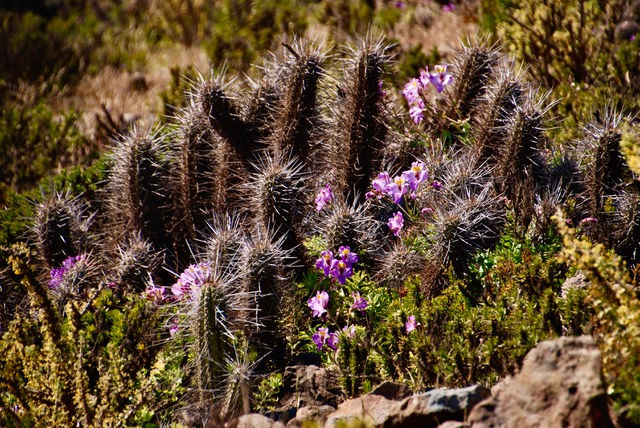

Note the blue anthers in the alstroemeria blossoms. On the rocky outcroppings we saw remarkable insects

and a range of cacti tucked in the crevices.


We returned to the coast and savored freshly caught fish in the brightly colored restaurants that brightened with the perpetual overcast.

The beachside landscape was filled with yellow Rhodophiala bagnoldii whose bulbs had waited patiently for rain.


As we continued south towards our next overnight, in Vallenar, we explored green “fog oases” filled with greenery and familiar blossoms.

Along the roadside we stopped at patches of Leucocoryne purpurea (Glory of the Sun)

and fragrant Leucocoryne coquimbensis.


Leucocoryne of the same species vary in markings. They hybridize easily, so we saw many either varieties or hybrids.

We continued our travels towards Valparaiso and Santiago enjoying the local artistry and glimpses into regional life.


In our next column we will begin a coastal trek south from Santiago.

Ida Rigby is a past SDHS Board member and Garden Tour Coordinator. She has gardened in Poway since l992 and
emphasizes plants from the northern and southern Mediterranean latitudes. Her garden received the San Diego Home/Garden magazine Best Homeowner Design and Grand Prize in their Garden of the Year contest in l998. Her travels focus on natural history.
