
BOTANICAL ENCOUNTERS: The Atacama Superbloom, Chile 2011
Words and pictures by Ida K. Rigby, for Let’s Talk Plants! February 2026.

The Atacama Superbloom, Chile 2011
Let’s return to the fog shrouded Atacama Desert coast in Chile…

…and immerse ourselves in the abundance of tough desert flora that were exuberantly flowering in the aftermath of a rare phenomenon in the Atacama, rain. As we know, the plants survive on whatever moisture the perpetual fog offers. Each plant has strategies for waiting until the next time there is rain when the desert becomes a dizzying profusion of flowers; then seeds and bulbs wait and wait until the next rain, often many years later. Today we are visiting the desert on the spring days of September 21 and 22, 2011. We’ll start near the coast and then move inland and up a few hundred feet. Near the coast the soil is a gritty combination of sand and ground rock.
The Pacific Ocean is visible at the far upper left; Echinopsis (probably deserticola) cacti, Encelia canescens and blue Zephyra elegans were scattered across the desolate landscape.
Zephyra elegans, in a range of blues, contrasted with the red sands.
We were enchanted, but as with so many other plants, we had no idea what was in store for us when we found them in their prime habitats. Solanum heterantherum nestled in some rock crevices.
We drove up a dirt road into a sandy area full of fragrant Heliotropium pycnophyllum, a shrub Nolana and various white and blue low growing Nolana species.
Note: chileflora.com is the best reference for identifying Chilean flora and also is a source for purchasing seeds. Chileflora lists some 40 plus different Nolanas in the Atacama, so exact identification is often not easy. They range in form from leafy creepers to scrawny shrubs to a succulent-like creeper. Periodically nature presented us with a charming vignette.

Here we can see how morning fog droplets coat both a magenta Cisthanthe longiscapa (guanaco’s paw) and a yellow Calandrinia littoralis, drips down to the soil and waters the roots. There are also a multitude of microflora and two Zephyra. For fun, count how many different plants you see in this tiny triangle of desert, probably no more than 9 inches on each side. A study at Chile’s Andres Bello University is focused on the tiny Cisthanthe longiscapa seeking to find a key to how agricultural plants can survive increasing droughts. The team is…
“…conducting genetic sequencing experiments to uncover the traits that allow . . . [it] to survive water scarcity and extreme temperature swings in one of the planet’s harshest environments. The goal is to transfer drought-tolerant characteristics to other crops. . . What makes [it] unique . . .is its ability to switch between different types of photosynthesis, making it a model plant for extreme environments. . . Under stress from drought, intense sunlight or salinity, the plant activates a water-saving method known as CAM photosynthesis. When conditions improve it reverts to the more common C3 photosynthesis.” https://www.reuters.com/sustainability/cop/ chiles-atacama-desert-flower-could-hold-key-drought-tolerant crops-2025-10-08/
Another tiny vignette…

… includes the Cistanthe longiscapa and a Zephra elegans.

Look closely as the buds on the Cistanthe are a delicately mottled maroon and light yellowish green. Various Leucocoryne appendiculata species (varying from white to purple) appeared in the sandy, pebbly soil.
Leucocoryne coronata has the golden center. The desert floor sported all manner of succulent-like creepers including Euphorbia thinophila with its maroon flowers.
We stopped at patches of tiny treasures and avidly photographed, forgetting that these were probably only harbingers of more spectacular things to come. The micro was just as fascinating as the overwhelming vistas. What to photograph? What to photograph first? We could not capture enough of the details.

As we feast our eyes on the flora, we must not overlook the beautiful rocks that had washed down from the hills and were scattered everywhere.
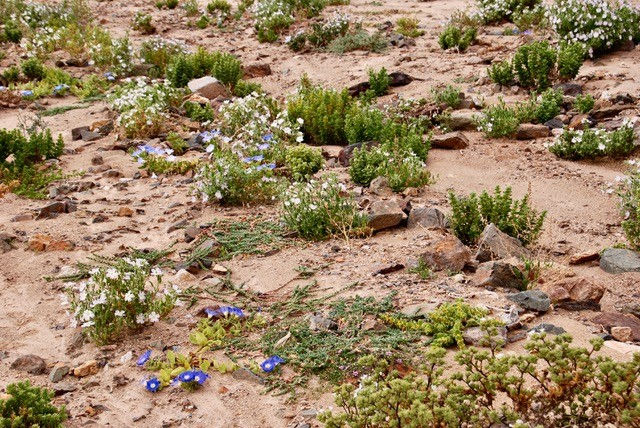
These images of a still wet wash include a flowering creeper (middle foreground), shrubs, Nolana elegans (the vine-like Nolana) and the bushy Cristaria integerrima var. integeri
The succulent like creeper is the white flowered Nolana crassulfolia mixed in with the larger leaved, deep blue Nolana elegans.

The airy, mallow-like flower is a species Cristaria.
There were also legume-like plants creeping among the exquisite stones. Heliotropium linearifolium, …

… an Adesmia …

… and a Tetragonia …

(33)
… spread atop the sand and among the rocks.
Kathy Musial of the Huntington was our tour leader, and she helped me with a few identifications including these last three. See her articles listed at the end of this column.
Argylia radiata, which we’ll see in profusion in the next column started to appear in the scree.

Note the Copiapoa in the upper left corner. Large Cisthanthe species dotted the landscape among the Nolana and Cristaria.
Nolana elegans is a particularly deep blue ground creeper and rock climber.
In our exuberance, we assumed all manner of postures to capture the wonders.
Here (with our van in the distance) we had just discovered the first Rhodophiala bagnoldii lily. Soon there would be more and more and more.
This one was accompanied by Schizopetalon maritimum with its charming snowflake flowers.
We’ll stop here and continue our journey in the April column. In the meantime, you might like to look for Kathy Musial’s articles in Pacific Horticulture magazine. The first is an account of her scouting trip for our expedition: “Chilean Adventure: Excerpts from a Travel Diary,” Pacific Horticulture, Jan./Feb./March 2011, pp. 5 - 10. The second is about our trip, “An introduction to the Geography, Climate, and Flora of Chile,” Pacific Horticulture, Oct./Nov./Dec. 2011, pp. 14 - 21. www.pacifichorticulture.org

Ida Rigby is a past SDHS Board member and Garden Tour Coordinator. She has gardened in Poway since l992 and
emphasizes plants from the northern and southern Mediterranean latitudes. Her garden received the San Diego Home/Garden magazine Best Homeowner Design and Grand Prize in their Garden of the Year contest in l998. Her travels focus on natural history.
