
BOTANICAL ENCOUNTERS: The Atacama Blooms - Copiapoa Cactuses
Words and pictures by Ida K. Rigby, for Let’s Talk Plants! December 2025.

The Atacama Blooms - Copiapoa Cactuses
Let’s continue our quest for the marvels of El Desierto Florido, the Atacama super bloom of September 2011. Along this foggy Pacific coast, ...

... as is often the case in areas that outsiders might consider gloomy, everything is colorfully painted.
Fishing ...
... and mining are the two main industries. We of course enjoyed delicious fresh fish.

Nature’s fishermen, South American pelicans, ...

... and scavenging vultures ...

... also fed off of the bounty of the sea. This topographic map...

... gives a sense for the beaches, low lying fog oases, coastal foothills and ravines we investigated. We focused on the lower area inland from Caleta de pescadores north to Islote Pan de Azucar. We followed dirt or gravel roads then parked and hiked. Some areas were in Pan de Azucar National Park (Sugar Loaf National Park), which was dedicated in l985.

This park is home to guanaco, two kinds of foxes, the European hare, marine otters and the South American sea lion. Humboldt penguins inhabit Pan de Azucar Island. We were anxious to see the rare Copiapoa cactuses. The best description/ celebration of Copiapoas is at https://copiapoa.com/copiapoa:
“The genus Copiapoa is among the most extraordinary groups of plants on Earth—rare, sculptural, and shaped by millions of years of evolution in Chile’s otherworldly Atacama Desert. Endemic to a narrow coastal corridor, these cacti are celebrated as living botanical treasures, admired for their striking morphology and ingenious survival strategies.”
The website goes on to describe the Copiapoa’s home, the Atacama Desert, as ...
“... one of the harshest environments on Earth, known for the highest solar irradiance ever recorded and for regions where rain has not fallen for more than a thousand years . . . Copiapoa has evolved to survive almost entirely on the moisture of the coastal fog. . . . Their silvery farina, slow metabolism, and specialized roots are hallmarks of this evolutionary mastery . . . [they are] restricted to the coastal zone . . . an ecosystem defined by intense sun, mineral soils, and the daily rhythm of fog and drought. Copiapoa cacti are among the longest-lived cacti on Earth . . . Their extraordinarily slow growth . . . and fog-harvesting adaptations allow them to endure where virtually no other life can.”
As Copiapoas evolved, some hybridized with near relatives, thus complicating their taxonomy. Small bees and flies are their pollinators. In 2015 genetic analysis identified thirty-two endemic Copiapoa species and seven subspecies. The Copiapoa depends on the coastal fog (la camanchaca) created by the contrast between the Pacific’s cold Humboldt Current from the sub-Antarctic and the ambient atmospheric temperature. La camanchaca can extend 5 - 10 miles inland. Over two days we sought out three Copiapoa species from gritty rises near the beaches to slopes farther inland. Above the beaches we found Copiapoa cinerascens, a low mounding variety.
En route to our next Copiapoa sighting we stopped to walkup a little gully. This spring, even in the austerity of the Atacama, there were always lovely moments filled with color.
These plants will be the subjects of subsequent columns. A few hours later we encountered the iconic Copiapoa cinerea.
Its waxy, silver farina reflects sunlight and reduces water loss. With time, the farina wears off leaving brown stems. This species can live for two hundred years, so what seems a small cactus can be centuries old. These elders can be easily poached and are irreplaceable, especially when seeds, too, are taken. Our third Copiapoa, Copiapoa cinerea ssp. columna-alba, lives on rocky outcrops up to 1,200 feet.
This Copiapoa is immediately recognizable by its habit of leaning northward in response to sun and wind.
A long taproot anchors an individual in place and contributes to its longevity, which can be centuries. This species has the typical spiny areoles filled with gray or black felt and fuzzy crowns of the Copiapoa genus.

It shares slopes with orange Argylia radiata ...

... and white Leucocoryne appendiculata.

The International Union for Conservation of Nature (IUCN) lists it as endangered. Midday we followed a depression into an inner valley paralleling the coastal range. This photograph gives a good view of how far inland the coastal fog penetrates.
Heliotropum linearifolium and Heliotropum pychnophyllum scented the air.
Cruckshanksia montiana hugged the ground.
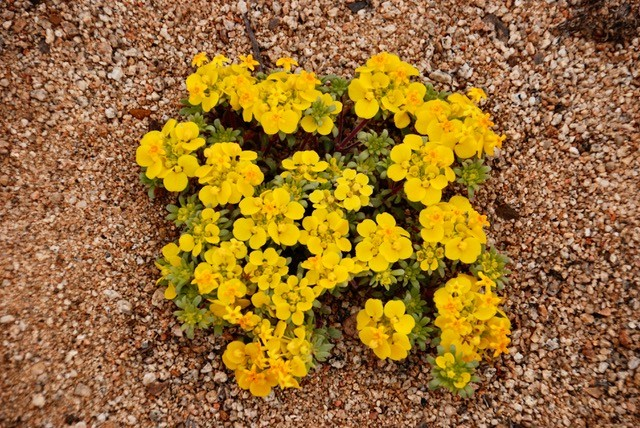
The next day we drove to see Copiapoa dealbata, a mounding, colony forming species.
Over centuries a plant produces hundreds of stems creating large cushions. This species occurs from sea level to 2,300 feet in arid coastal hills and shrub lands. It takes fifteen to thirty years for it to blossom. IUCN lists it as having relatively stable populations with some being vulnerable. Like so much flora discussed in our Botanical Encounters columns, the genus Copiapoa is increasingly at risk. Extinction drivers for Copiapoas include both anthropogenic and climatic factors. Population fragmentation and decline are often due to habitat degradation and destruction, poaching, pollution and the retreat of coastal fog. A Chilean government report cites, in addition to illegal collection of wild specimens, construction for mining, urban infrastructure and associated services (transportation routes; water and electricity supply), off-road motorsports and grazing from free-ranging livestock as direct threats.
For example, the world’s largest copper and lithium strip mining operations are located in the Atacama. Since 1975 CITES has listed all Copiapoa as regulated but not banned in international trade. In Chile, unauthorized collection of Copiapoa and other native flora has been prohibited since 2008. In 2013, the IUCN listed Copiapoa cinerascens as vulnerable due to poaching and environmental stress; now Copiapoa column-alba is listed as endangered, and a few Copiapoa species have critically endangered status.
A July 3, 2024, PBS Newshour segment (https://www.pbs.org/newshour/world/these-cacti-are-status-symbols-on-social-media-in-the-desert-theyre-endangered) discussed how poaching and illegal trade in cactuses has been...
“...facilitated by social media...” with “... indoor plant influencers...”
...promoting cactuses and e-commerce sites like Instagram and eBay giving easy access to plants. Infrastructure development has given poachers greater access to the desert; they can now post live, on site videos allowing customers to select in real time the very plants they want dug up in the wild. IUCN notes that 82% of Copiapoa species are at risk of extinction up from 55% in 2013 and that includes plants that are 30 - 500 years old. Collectors worldwide seek Copiapoa; they have become popular status symbols in Asia.
In 2020 the massive “Operation Atacama” raid took place in Italy. In 2021 The New York Times published an article about it. (Global Cactus Traffickers Are Cleaning Out the Deserts - The New York Times)
In February 2020 Italian police seized more than 1,000 illegally harvested Copiapoa and Eriosyce species, a cache valued at over $1.2 million on the black market. Some plants were over a century old. The alleged trafficker had been arrested in 2013 for a shipment of 600 Chilean cactuses, but because of bureaucratic delays the statute of limitations (4 to 5 years for environmental crimes in Italy) lapsed, and the case was never prosecuted. Testing confirmed that the plants seized in 2020 had been collected in the Pan de Azucar National Park area. They allegedly were mailed to addresses in Greece and Romania, where international customs were more lax than in Italy. The defendant’s cell phone contained text records of illegal cactus sales. The NYT reported that...
“... Cactuses confiscated by the Italian authorities are normally destroyed or, if they are rare species, sent to botanical gardens. But . . . the number of cactuses was so large, and some were critically endangered . . . with very specialized needs. Keeping the cactuses at the garden [Milan Botanical Garden] was a likely death sentence . . .”
... so, it was agreed to send them back to Chile. Eight hundred forty-four cactuses made the return journey. One hundred others had died, and eighty-four stayed in Milan for study. Experts hope that this case can be a turning point; it’s the largest known example of cactuses stolen from the wild to be repatriated for reintroduction into their native habitat. An excellent discussion of studies of threats to Copiapoa is at: https://conbio.onlinelibrary.wiley.com/doi/10.1111/cobi.14353.
It has a heartwarming photograph of some of the seized Copiapoas, fat, healthy and each nestled in crushed rock, its own individual paper cone after their return home. According to the NYT, American, British, European and Japanese collectors have traditionally driven the illegal cactus trade; more recently interest has spread to China, Korea and Thailand. The pandemic increased these plants’ popularity, with shops struggling to keep some species in stock.
“High-end plant shops in Japan display wild-harvested species, while sellers around the world advertise them on eBay, Instagram, Etsy, and Facebook.”
According to the U.S. Fish and Wildlife Service, ...
“Cactuses and other succulents are among the most sought after, along with orchids and, increasingly, carnivorous species.”
One suggested way to curtail poaching is to engage local communities in programs for legally collecting seeds and small cuttings with sales’ proceeds going to the community. There are also efforts afoot to establish industry standards for certifying that growers are using legally sourced plants. The website https://copiapoa.com/copiapoa has an instructive section that illustrates with side-by-side comparisons the difference between specific Copiapoa species in the wild and the same one grown in cultivation. Chile now has a plan in place for conserving Copiapoa (https://www.cpsg.org/sites/default/files/2025-04/Copiapoa_ActionPlan_Chile_2025_English1.pdf).
As the introduction states, ...
“... working in the field of biodiversity . . . often feels like swimming against the tide . . . and sometimes seems insuperable . . . Over half of the 32 species and seven subspecies are threatened [IUCN Red List, 2024] . . . Copiapoa cacti face a number of direct threats . . . it’s [also] likely that the impacts of climate change will alter the very narrow environmental parameters within which these species are able to survive.”
Another discussion of initiatives for conserving native Chilean flora is at a website for the Alliance for Zero Extinction (AZE): https://zeroextinction.org/ case-studies/chilean-aze-conservation-strategy/. The site discusses the Chilean Ministry of the Environment’s conservation strategy in twenty-two AZE sites in Chile. So, with all of the threats to what we SDHS members hold dear, there are many localized endeavors that can give us hope as we enter the Holiday Season.
Happy Holidays and Happy New Year

Ida Rigby is a past SDHS Board member and Garden Tour Coordinator. She has gardened in Poway since l992 and
emphasizes plants from the northern and southern Mediterranean latitudes. Her garden received the San Diego Home/Garden magazine Best Homeowner Design and Grand Prize in their Garden of the Year contest in l998. Her travels focus on natural history.
